Posted December 18, 2025

By Sean Ring
WTI…WTF?
It’s intermarket analysis 101, isn’t it?
If the dollar is down, oil should be up. If the dollar is up, oil should be down.
The inverse relationship between the dollar and oil is so fundamental to macroeconomic theory that there should be a law against it not working out.
Alas, here we are.
“West Texas Intermediate” is about to get relabeled “Why Trade Fundamentals?” as 2025 hasn’t been good to intermarket traders at all this year. Correlations, even inverse ones, are made to be broken. What are the reasons for this breakup?
A Globe Awash in Black Gold
I had been arguing the underlying economy was weak. But let’s face it, the real reason oil is down this year is the least fashionable reason imaginable: there’s too much of it.
Not in some abstract, spreadsheet-only sense, but in the very real, very tradable sense that the market has flipped from telling itself a looming deficit bedtime story usually loony economists tell themselves to confronting a surplus it can’t unsee.
OPEC’s own reports now show global supply matching demand next year as OPEC+ restores previously withheld capacity and non-OPEC producers continue to pump.
Never a cheerleader for oil bulls, the International Energy Agency (IEA) still sees demand slowly growing and has openly flagged a near-term surplus. Once those projections hardened, the market’s tone changed. And when key technical levels broke, systematic funds and CTAs did what they always do: they dumped their oil longs. (Charts below.)
OPEC+ barrels are coming back. Non-OPEC supply has proven stubbornly resilient. For sure, demand expectations have softened just enough to spook traders. And all of that has overwhelmed what’s supposed to be oil’s best friend—a weaker dollar.
Yes, Venezuela is back in the headlines. Yes, Trump is rattling cages with sanctions, tariffs, and threats to oil tankers. But those are short-term sideshows. The real driver of crude’s slide is structural. Supply is winning, sentiment has turned, and once that happens, the market doesn’t wait for permission to fall.
Technically Speaking.
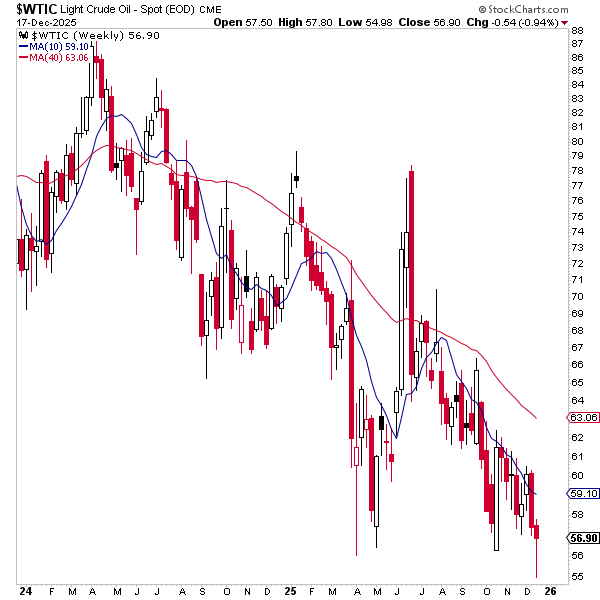
Brent is hovering around $60 a barrel, down in the high-teens versus a year ago and nearly 20% year-to-date, flirting with levels not seen in roughly five years despite a slight dead-cat bounce. WTI is telling the same story from a slightly cheaper seat, sitting in the mid-$50s, down just over 20% year-to-date. This is the market repricing material abundance.
Technically speaking, this was a snowball that kept coming down the hill.
Except for the spike in June when we thought war between Israel and Iran was inevitable, WTI has been down nearly the entire year without a break. And really, that decline started in April 2024.
What makes this move more interesting and uncomfortable for macro tourists is that it’s happening alongside a falling dollar. The dollar index has slid materially this year, down high single digits to low double digits and now camped in the high-90s after its first-half beating.
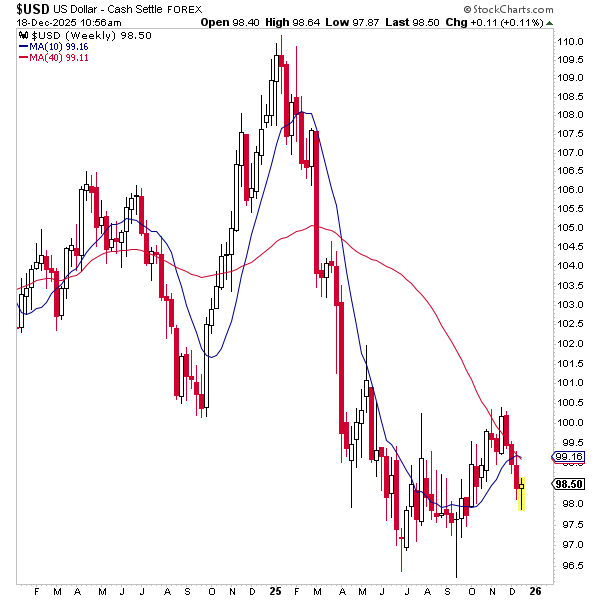
That should be bullish for oil. In textbooks, you’d need more dollars to buy a commodity; hence, prices go up. In reality, that relationship isn’t sacred. And this year, physical fundamentals have bulldozed the FX story.
It’s great for The Donald because he can inflate the dollar with less risk of a price explosion at the gas pump. That would put immense pressure on him at the 2026 midterms.
Venezuela and U.S. Policy Risk
This is where Venezuela enters the frame. Venezuelan production has slipped again under renewed U.S. pressure, tanker seizures, and tighter sanctions, falling to multi-month lows. But in the context of global supply, those barrels are immaterial.
The Donald’s revocation of Chevron’s license (earlier this year), his threats, and now his order to block sanctioned tankers generate headlines and occasional knee-jerk spikes.
They don’t meaningfully tighten the global balance when OPEC+ spare capacity exists, and a growing dark fleet sails around enforcement.
The World Bank noted that 2025 has been defined by soft, rather than catastrophic, consumption. The IEA and others still project growth, but they’ve trimmed expectations, particularly in key Asian importing economies. That matters because Trump’s trade and tariff policies land precisely where oil demand is most sensitive.
New tariffs on countries importing Venezuelan oil, in addition to broader tariffs targeting countries like China, Turkey, and parts of Asia, have cooled activity at the margin. Oil doesn’t need a recession to fall; it just needs fewer excuses to rally.
Add in broader macro unease, and the picture becomes clearer. Institutional outlooks indicate slower global growth, especially in tariff-hit regions. Traders have responded by marking down demand expectations, even as they nod politely toward long-term growth projections extending to 2050.
That’s how markets work: the distant future is someone else’s problem. Today’s curve reflects today’s fear, and right now the fear is that surplus plus sluggish growth is a bad mix.
Wrap Up
This is why oil has fallen even as the dollar has weakened. The usual inverse relationship has been steamrolled by three forces acting together.
First, an overwhelming supply narrative, with OPEC+ and non-OPEC growth signaling that barrels will be plentiful.
Second, positioning and technicals turned a manageable surplus into a problem once key price levels were penetrated.
And third, Trump’s stance on Venezuela tightens a few screws, while his broader trade agenda depresses demand expectations.
The dollar’s decline wasn’t enough to save crude. When physical markets loosen and sentiment turns, FX becomes less relevant.
Oil isn’t ignoring the dollar this year. It’s just decided something else matters more.

Icing The Green New Scam
Posted December 17, 2025
By Sean Ring

8 Things That Will Turbocharge The Gold Price
Posted December 16, 2025
By Jim Rickards

Can Miners Double Again?
Posted December 15, 2025
By Sean Ring
How FDR Put America Behind Golden Bars
Posted December 12, 2025
By Byron King
Swamp Thing
Posted December 11, 2025
By Sean Ring