Posted November 06, 2026

By Sean Ring
The Yuan Trap
In December 1949, Mao Zedong rode a train for ten days to reach Moscow.
He’d just won China’s civil war. He wanted a treaty, money, and respect. Stalin made him wait.
Mao sat in a dacha outside the city for weeks. He grumbled that his only jobs were to eat, sleep, and use the toilet. When the deal came in February 1950, the loan was $300 million, spread over five years. For a nation of more than 500 million people, that was pocket change.
In essence, Stalin announced to the world who the junior partner in this deal was.
Seventy-six years later, the train runs the other way.
Today, it’s Moscow that waits. Its money waits too, sometimes for weeks, in the back offices of Chinese banks. How that happened tells you more about sanctions, and about the dollar, than any speech from Washington or Beijing.
The Great Escape
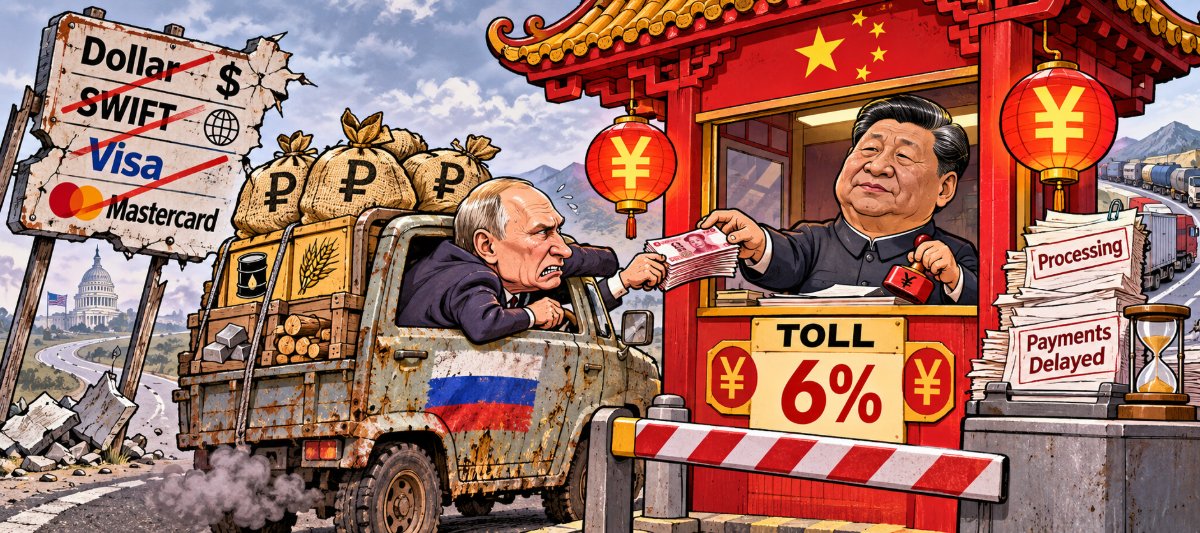
When Russia invaded Ukraine in 2022, the West froze about $300 billion of the Russian central bank’s reserves. Big Russian banks got cut off from SWIFT, the network that carries most of the world’s cross-border payment messages. Visa and Mastercard walked out.
The plan was simple. Cut Russia off from the dollar, and its economy chokes.
It didn’t choke. It rerouted.
Russia and China now settle more than 90% of their trade in rubles and yuan, according to China’s Commerce Ministry. The dollar has nearly vanished from the deal.
China’s own payment network, CIPS, keeps growing. It had 210 direct members by June, with reach into banks in 191 countries. In February, new rules let CIPS settle yuan against other currencies at the same time. That’s a step toward a full rival to the Western system.
Even tourists have options. Since May 19, a Russian with a VTB bank app can scan a QR code in a Chinese shop. Rubles leave his account. Yuan land in the shopkeeper’s. No Visa. No Mastercard. No dollar.
On paper, it looks like a clean escape.
The Toll Gate
But every escape route has a gatekeeper.
Russia’s payment network, SPFS, and China’s CIPS still don’t fully talk to each other. So the money has to pass through Chinese banks. And Chinese banks are nervous.
In June, Washington widened its threat of “secondary sanctions.” Those are penalties on foreign banks that do business with sanctioned Russians. By August, Reuters reported that Russian payments to China were slowing and costing more. Some deals sat for weeks. Reuters has also reported oil payments stuck for months.
So Russian firms turned to middlemen. These are payment agents and “trading houses” in Hong Kong, Central Asia, and the Gulf. They move the money… for a cut. Fees are rumored to run as high as 6%. Some Russian reports put them higher.
That means sanctions didn’t stop Russia’s trade. But they put a tax on it. The people collecting the tax aren’t in Manhattan. They sit in Chinese and third-country banks.
You don’t escape a toll road by cutting through your neighbor’s yard. You just pay your neighbor instead.
Why Beijing Won’t Bend
You’d think China would help its “no limits” partner. Why let Chinese banks squeeze Moscow?
It’s because of who keeps Xi Jinping in power.
In China, that includes the giant state banks, the export bosses, and party elites whose families hold wealth abroad. Those people need the dollar system. They need London branches, New York accounts, and American customers.
A Chinese banker who risks his bank’s dollar access for a Russian invoice isn’t helping Xi. He’s threatening the people Xi depends on.
So the big banks pull back. Small regional banks step in, with higher fees and slower service. Beijing gets cheap Russian oil and a captive customer. It gives up nothing it values.
The dependence runs one way. China makes up about a third of Russia’s foreign trade. Russia is a small slice of China’s. Moscow needs Chinese factories, cars, and chips. Beijing needs American shoppers far more than it needs Russian goodwill.
Meet The New Boss, Gentler Than The Old Boss
Back in 2021, DC could freeze Russian bank accounts. Today, one word from Emperor Pooh Bear can make their payments move as slowly as snail mail. In the end, Old Vlad traded one master for another.
A system with a single point of failure is fragile, no matter whose finger rests on the switch. It hums along for years. Then one day, someone flips it.
Two is one, and one is none, as they say.
Moscow knows this. Look at what the Russian central bank has done with its gold. It’s been selling since 2025 to pay war bills. By September, its gold holdings sat at their lowest since late 2019.
As soon as the yuan tollbooth got pricey, Russia reached for the one reserve that needed nobody’s permission.
Gold has had a rough year. It’s fallen from nearly $5,600 an ounce to below $4,000. Turkey dumped tons of it to defend the lira. Gulf money reportedly sold, too.
They all sold gold because they could. In a crisis, they could spend gold without asking anyone. That’s gold’s job description.
What This Means for the Dollar
So is the dollar safe?
For now, mostly. Settling trade in rubles and yuan is one thing. Replacing the world’s deepest bond market and most trusted reserve currency is another. Nobody has done either. The Russia-China experiment shows why. The yuan comes with Beijing’s strings, and those strings tighten when The Donald pulls them.
But the dollar’s grip isn’t what it used to be, either. CIPS keeps adding banks. QR payments keep spreading. More countries test their own currencies for trade. The shift is slow, but it’s real.
Wrap Up
Sanctions didn’t break Russia. But Russia didn’t break the dollar, either.
Something quieter and stranger happened. Moscow traded a landlord on the Potomac for one in Shanghai. It still pays rent on every transaction.
The lesson isn’t about Putin, though. It’s about your own money.
Every dollar you hold in a bank, a brokerage, or a fund answers to someone. That’s ok. It’s how modern finance works.
But a slice of your wealth should answer to no one. It should be something you can hold, move, and spend without permission.
Russia learned that lesson the expensive way. Learn from its mistakes.

The 16,000 Who Rule America
Posted November 05, 2026
By Sean Ring
The 87% Solution
Posted November 04, 2026
By Sean Ring

Warsaw Unpacked
Posted November 03, 2026
By Sean Ring
A Crude Tax
Posted November 02, 2026
By Sean Ring

You Can't Eat Conviction
Posted October 30, 2026
By Sean Ring
