
Posted April 15, 2026

By Sean Ring
The Woodpecker’s Tongue
Most Americans view today, the Ides of April, as Tax Day. But since I’m here in Italy, I get to look at it another way. Oh, don’t fret. I’m paying for this damn fool war, too, via inflation, as no one, anywhere in the world, is escaping its costs. The rest of us outside America’s borders just pay differently.
Let’s not dwell on the butcher’s bill. I’ve got a treat for you today that I hope will cheer you up.
It started when I was reading one of my favorite Substackers complain about self-help books. I’m ashamed to say I’ve read far too many, especially when I first left banking back in 2006. I went through a bit of an identity crisis. I knew I wanted to be a writer, but had no idea how to make that happen. Needless to say, standing in front of a mirror mouthing Stuart Smalley’s mantra of “I’m good enough. I’m smart enough. And doggonit, people like me!” gets you nowhere… slowly.
Well, this Substacker wrote, “Enough of the self-help books! Read biographies!”
That hit me like a ton of bricks. I was never into biographies. Besides my favorite one about Omar Khayyam, the only other one I recall finishing was Walter Isaacson’s Benjamin Franklin, which is magnificent. I can’t recommend it enough.
I have a copy of his Leonardo da Vinci biography, so I thought I’d start there. I’ve only got halfway through Chapter 4, but it’s brilliant so far. (Hint: don’t expect a full book review today.) And while reading, I discovered today is Leonardo’s 574th birthday.
All I can say is, “Happy birthday, you wonderful weirdo!”
And a big HAPPY BIRTHDAY! to another Renaissance Man, my dear friend, Rude subscriber, and OWC member Iowa Michael, who’s still climbing up rock walls after the ripe-old age of 39!
Leonardo isn't the story we've been sold. Not the lone bolt-of-lightning genius. Not the Renaissance version of a TED Talk. He was, if we're being honest, a deeply quirky dude who wrote backward, left most of his projects unfinished, and spent an alarming amount of time dissecting corpses… because he wanted to know how cheekbones worked before he painted them.
That's process, my friend!
The Notebook Nobody Wanted to See
Leonardo filled thousands of pages of notebooks with questions so basic they'd get you laughed out of any serious research meeting. Why is the sky blue? How does a woodpecker use its tongue? Why does water swirl the way it does around a rock?
Honestly, who gives a toss about a woodpecker’s tongue? Leonardo did. He was insatiably curious.
He kept a small notebook on his belt(!) so he could jot down how people laughed, argued, and threw punches in the piazza. The man was effectively running a one-person macro research operation on the human condition, 24 hours a day, in 15th-century Florence, with no Bloomberg terminal and no sell-side coverage.
His curiosity was, as Isaacson puts it, "both playful and obsessive." That’s another way of saying he never mistook knowing the name of a thing for understanding it. This is a habit most of modern finance has abandoned entirely in favor of a good-looking spreadsheet and a consensus price target.
Ask yourself: when did you last ask a question that felt too stupid to ask out loud?
Verrocchio's Workshop Wasn’t an Art School
By Chapter 4, Leonardo has landed in Andrea del Verrocchio's Florentine workshop. This is where Isaacson earns his advance. The place looked, apparently, like a jeweler's shop had a baby with a machine shop. Painting. Goldsmithing. Sculpture. Metalwork. Practical engineering. All under one roof, all considered part of the same serious pursuit.
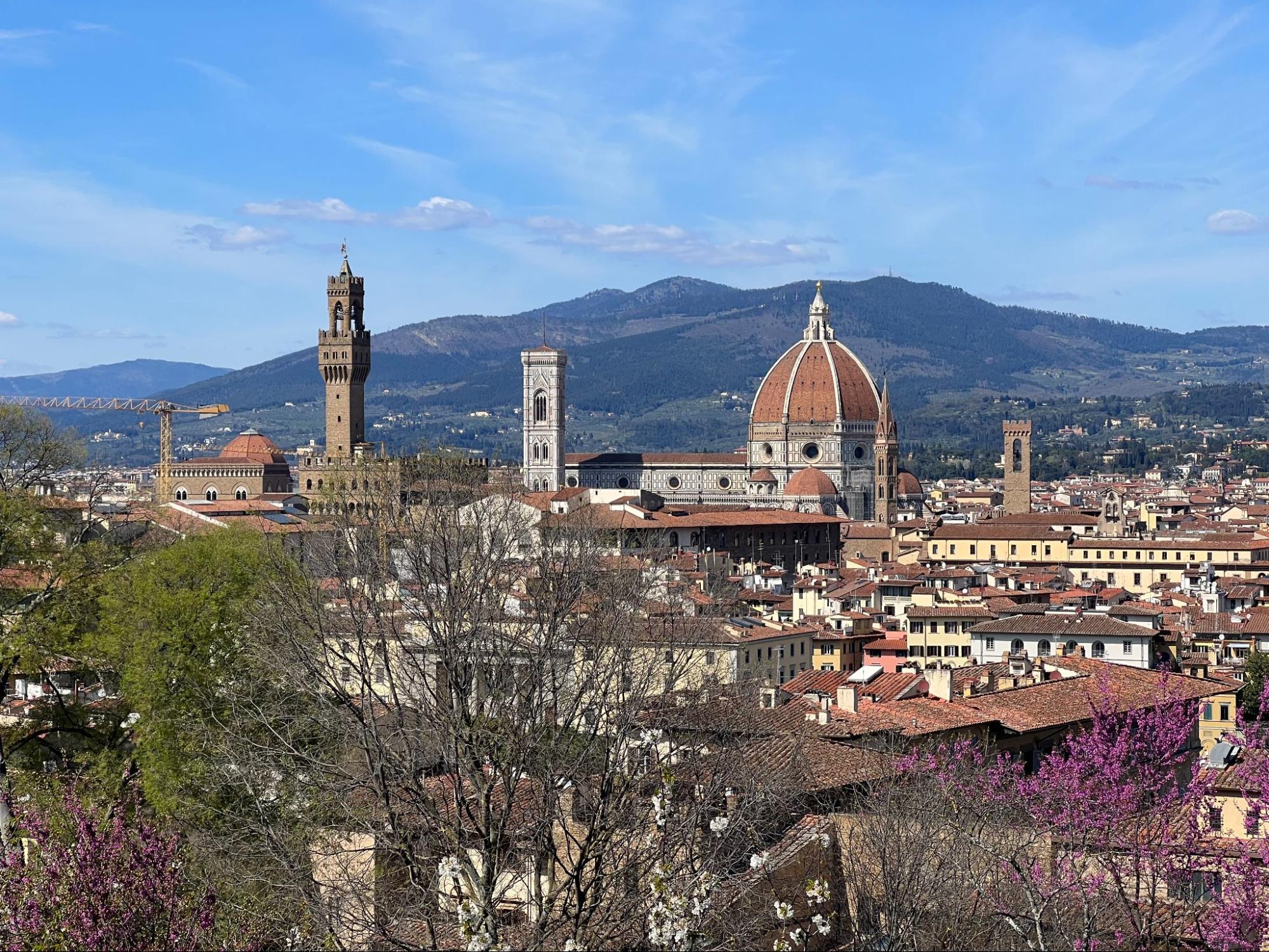 Florence skyline with the Cattedrale di Santa Maria del Fiore (Brunelleschi's dome on top) and Palazzo Vecchio, seen from the Giardino delle Rose. Spring 2026. Credit: Sean Ring.
Verrocchio's crew hoisted a two-ton copper orb onto the top of Brunelleschi's dome. Leonardo watched. Filed it away. But he was still sketching the hoist mechanism decades later. Not because he was sentimental, but because the mechanical problem was genuinely interesting, and interesting problems compound.
The workshop normalized what most institutions pathologically resist: the idea that technical rigor and aesthetic judgment aren’t opposites. That the guy who understands the load-bearing structure and the guy who understands the light hitting the surface might, in fact, be the same guy.
Finance parcels this out to different desks and calls it specialization. Leonardo would find this hilarious. Or possibly sad. It’s hard to tell with Renaissance geniuses.
Sfumato, Chiaroscurò, and Why Your Sentiment Work Is Incomplete
Leonardo's greatest technical achievement is sfumato. That’s the deliberate blurring of edges and what makes the Mona Lisa feel alive. The refusal to commit to a hard line where one thing ends and another begins. He understood that the human eye and face don't work with clean outlines. Reality bleeds into itself.
He got there by studying anatomy (the muscles pulling at the skin), light physics (how shadows grade across curved surfaces), and human psychology (what a microexpression actually looks like) — simultaneously, not sequentially.
The investment parallel is real: macro is your perspective and proportion. It's the vanishing point. You don't trade the horizon. But paint without it, and your foreground is a lie.
Fundamentals are anatomy. The income statement, the balance sheet, the cash flow… that's the skeleton and musculature. The question you must answer is “Which muscles are doing the work and which joints are about to give out?”
Sentiment is the light. Positioning, narrative, flows, and volatility don't change the skeleton. But they absolutely determine what people see when they look at it. Ignore sentiment, and you're painting in the dark, congratulating yourself on your rigorous process while the market does something completely inexplicable, leaving you to blame the algos.
Leonardo insisted on seeing all three layers at once. Most investors pick one, get very good at it, and then wonder why they keep getting blindsided by the other two.
Wrap Up
Isaacson wrote a great passage about Leonardo as a young man standing at the mouth of a dark cave — torn between fear of what's inside and burning desire to find out. He chose desire. He walked in.
Every trade worth making feels like that cave. Incomplete data. Real downside. There is a nagging sense that macro, fundamentals, and sentiment are all pointing at something just out of focus. The temptation is to grab the one framework you trust and pretend the others don't exist.
Leonardo's answer is clear: walk into the cave with every lens you've got. Look at the same thing as a geologist, a painter, and an engineer before you decide what it is.
That's not a bad idea for his birthday.
Cultivate curiosity that is both playful and obsessive. Refuse to be just a macro guy, just a value guy, just a chart reader. Build the whole picture, connect the dots, and keep writing in the notebook until the answers manifest themselves.
The market, like the cave, rewards those who go for it.

Autocrat Ousted; Congratulates Victorious Opponent
Posted April 14, 2026
By Sean Ring

The World’s Fragile Energy Tapestry
Posted April 13, 2026
By Sean Ring
MULLAH MOOLAH!
Posted April 10, 2026
By Sean Ring

Peace!Fire!
Posted April 09, 2026
By Sean Ring

The 4% Solution
Posted April 08, 2026
