Posted May 28, 2026

By Sean Ring
The War Tax on Hard Money
Here's something that shouldn’t happen.
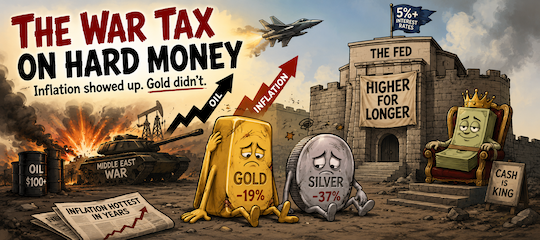
A war breaks out in the Middle East. Oil rockets past $100 a barrel. Inflation jumps to its hottest reading in years. By every rule you were ever taught, that’s rocket fuel for gold and silver.
And yet, since the fighting started in late February, both metals have fallen. As I write this, spot gold is off by just over $1,000 (about 19%) from its closing price on January 28th. Spot silver has dropped harder, down roughly 37% from the same day.
If you own metals, you have a right to feel confused. You did your homework. You bought the inflation hedge. Then the inflation showed up, but your hedge went down.
We weren't wrong. My colleagues, such as Adam Sharp and Matt Badiali, are correct in their analyses. The rules didn't break. But a force bigger than the inflation rule stepped in front of it.
The Rule We Forgot
Gold and silver pay you nothing. No dividend. No coupon. They just sit there and shine.
That's fine when cash and bonds pay nothing either. But the moment safe assets like those start paying real interest, metals have to compete against a steady paycheck, and they can't.
If you’ve ever heard of “Mr. Wonderful” Kevin O’Leary’s $5 million rule, this makes sense. Buying $5 million worth of safe, default risk-free 3-month T-bills yielding 3.7% earns you an annual return of $185,000. Why risk anything, especially in volatile, couponless precious metals, when your baseline income for doing nothing but lending your government money is nearly $200,000?
Follow this chain of reasoning: The Iran war choked the oil supply through the Strait of Hormuz. Then, gasoline prices jumped. In April, wholesale inflation — what producers pay — ran 6% over the year, the hottest since December 2022 and far worse than Wall Street analysts guessed. Consumer prices (CPI) followed at 3.8%, the worst since 2023.
Wholesale prices (PPI) matter more. Producers pass their costs to us, or at least what we, the consumers, let them get away with. So a 6% PPI reading isn't just bad news today. It's telling us more pain is coming down the turnpike.
Hot inflation means the Federal Reserve can't cut interest rates, so it didn't. Traders who spent all winter betting on rate cuts had to rip up those bets. A few are now betting on a rate hike.
Higher-for-longer rates are a tax on anything that doesn't pay you… And metals pay you nothing.
That's the whole trick. The war didn't lift metals. The war lifted oil, which lifted inflation, which killed the rate cuts, which made cash king. Gold and silver got caught in the crossfire.
Finally, central banks (especially Turkey’s and the Gulf states’) are selling gold to cover their governments’ budget shortfalls. The very institutions that started and sustained the gold rally suddenly began selling. It put enormous pressure on the gold price.
And where gold goes, silver goes on steroids.
Why Silver Took the Harder Hit
Notice silver fell almost twice as far as gold. There are a few clean reasons for that, and none of them means your thesis is broken.
As my colleague Nick Riso famously covered, silver’s sell-off began when it was trading like a meme stock… and then fell victim to a vicious unwind of a gamma squeeze.
Silver had run up roughly 150% over the past year. When a crowd is that leveraged and giddy, the exchanges raise margin requirements. That forces some traders to sell whether they want to or not. Selling triggers more selling. The exits get crowded. All that happened in January, just before silver got crushed.
Next, silver isn’t just a monetary metal. Nearly 60% of silver demand comes from industrial applications, such as solar panels, electronics, and wiring. When higher rates raise fears of a slower economy, that industrial half gets marked down. Gold doesn't carry that baggage.
Size-wise, the silver market is tiny. The London gold market trades many times the dollar value of silver. A small market moves fast in both directions. When traders are calm, that's thrilling on the way up. When they panic, it's brutal on the way down.
None of that is a verdict on silver itself. It's the physics of a small, hot, crowded market letting off steam.
What This Is — and What It Isn't
Mechanics are driving this pullback, not a collapse in fundamentals. The difference matters enormously for your wallet… and your sanity.
If anything, the structural case for silver is stronger than it was. The metal has run a supply deficit for 6 straight years. Aboveground stockpiles have been drawn down by hundreds of millions of ounces. About 70% of silver gets mined as a byproduct of other metals, so miners can't simply dig harder when the price rises. And new mines take the better part of a decade to come online. (This is what economists call an inelastic supply.)
Gold's story is just as intact. The big banks haven't blinked. UBS still targets $5,600. J.P. Morgan sees a path to over $6,000. One research shop notes that private wealth holds about half as much gold as it did a decade ago. If that gap even partly closes, the buying is enormous.
The reason for the fall is specific, not structural. Over time, specific reasons reverse.
What It Means for You
Don't read a price chart as a vote on whether you were right. In the short run, a war that drives up oil can drive down gold because the path runs through inflation and interest rates, not straight to the metal.
The thing to watch isn't the daily quote. It's the Fed. The day rate cuts come back onto the table, the tax on hard money lifts. Until then, expect a lot of chopping and changing. Right now, gold’s downside target is around $3,980. Silver’s is $58.25.
If you believe the long-term case, weakness is the friend you've been waiting for. Keep some dry powder. Let the crowded traders do the selling for you. Or, if you’re currently out like I am, waiting for the lower price action may be the ticket for you.
Wrap Up
The men who sold gold in a panic in 1980 weren't fools. They simply confused a pause for the end. The world was still a mess. They were right about the disease and wrong about the calendar, and it cost them dearly.
You know more than they did. You know why the metal fell. You know it has nothing to do with whether the case is sound.
So don't flinch at the screen. Read the Fed, not the ticker.

Mamma Mia, Maranello!
Posted May 27, 2026
By Sean Ring
Pump Fiction
Posted May 26, 2026
By Matt Badiali

The Knowledge Problem
Posted May 25, 2026
By Sean Ring
The False Boom
Posted May 22, 2026
By Sean Ring

Who Ate the Seed Corn?
Posted May 21, 2026
By Sean Ring