Posted June 17, 2026

By Sean Ring
Hormuz Premium
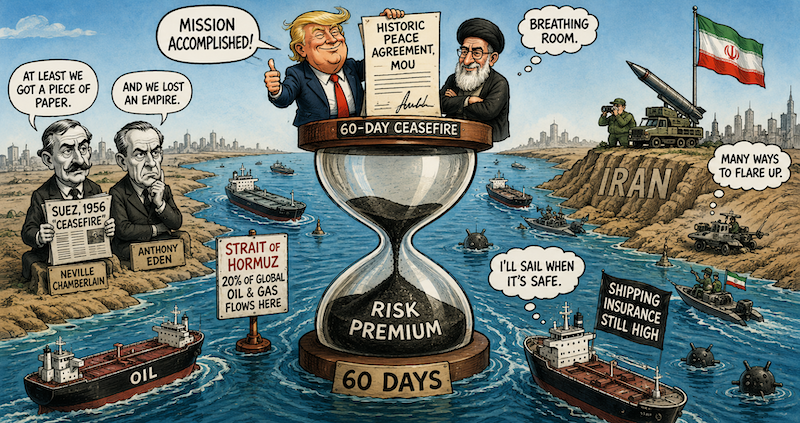
Almost immediately after this “deal” was announced, one of my dear colleagues posted a picture of Neville Chamberlain in our group chat.
I laughed and wrote, “No, it’s much worse than that.” I proceeded to post a picture of Anthony Eden, former UK Prime Minister, who lost his job after the botched Suez invasion with France and Israel in 1956. Most people agree this moment was the genuine end of the British Empire, though it continues to limp on impotently to this day, more a financial web covering the earth rather than a real power.
But I now realize that, too, is a lazy analogy.
Though there are similarities between Trump’s ridiculous climbdown and Eden’s ill-conceived venture, this is more a Suez-flavored dish than the real meal.
If you’re unfamiliar with that bit of history, I’ll fill you in.
In 1956, Britain, France, and Israel thought they had Egypt cornered.
They had troops in the Suez Canal Zone. They had air cover and a plan. What they didn't have was President Eisenhower's blessing.
DC pulled the financial rug, and the pound sterling collapsed. Within weeks, Prime Minister Eden resigned, and Britain's delusion of imperial permanence died in the Egyptian desert.
Nobody called it a defeat at the time. They called it a "ceasefire."
It sounds familiar.
The Deal on the Table
The Donald just signed what the White House is billing as a "historic peace agreement" with Iran.
Strip away the patriotic posterior-covering, and what you've got is a 60-day ceasefire, a US naval drawdown from the Strait of Hormuz, and a 14-point framework kicking the hard questions about nukes, sanctions, and enrichment down the road.
The Strait is supposed to reopen within 30 days. Iran gets breathing room and the prospect of the release of frozen assets (and that’s a lot of cash). DC gets a breather.
Really, Trump gets out of a situation he surely regrets getting into. My goodness, he must hate Bibi’s guts right now.
There’s no permanent settlement, nor verified denuclearization. There’s no signed agreement on enrichment levels. It’s just a time-out on the naughty step with shipping lanes attached.
The Economist put it plainly: this is "the beginning of the end." Stratfor was blunter. The deal "does not resolve core issues." Shipping through Hormuz "will resume only gradually," given the persistent risk of flare-ups and vessel harassment.
One is tempted to say, “This is why you don’t get into unjust wars.” And if you need a reminder of just how right I was about this, reread March 3rd’s edition of the Rude.
The core issue now is that the risk premium hasn't left. It just went on holiday.
What Suez Teaches Us This Time
It seems everyone is reaching for the Suez analogy right now, and we’re not wrong. But we’re reading the wrong lesson from it.
The lesson isn't that America is finished, like the Old Empire was. Britain lost the Suez Canal in 1956 and remained a power for decades. The lesson is more specific and useful for investors.
The 1956 Suez Crisis proved that halting military action doesn’t fix the underlying economic reality. Markets began to value a reality where London’s diplomatic influence was diminished.
That's exactly what's happening now, only it's The Swamp’s word on the scale.
The Donald entered this campaign with language close to ultimatum. Iran would disarm or be destroyed. Only 3 months later, the United States is accepting a ceasefire on terms that leave the Islamic Republic standing, its main export route reopening, and its nuclear file in a "framework for future talks."
From the March 3rd Rude:
Allegedly, Iran has rejected multiple invitations to negotiate. You don’t do this when you’re losing. The Iranians think they can weather a high-intensity conflict for 60- 90 days, which is why the Iranians don’t want a ceasefire. Yes, you read that correctly.
Two to three months. How do you think the administration’s ratings will be then? And then midterms in another 4 months or so? This is a disaster for Trump.
That was 110 days ago.
You don't have to call that a defeat to understand what markets will do with it.
The Two-Leg Trade
For your portfolio, the Iran deal creates two distinct legs. Keep them separate.
The first leg is the relief trade. The worst-case tail — full Hormuz closure, direct naval clash, sustained missile exchanges on Gulf infrastructure — has shrunk. Insurance on that tail was expensive. It gets cheaper now.
Crude loses some of its crisis premium. Tanker rates that had baked-in risk should ease. If you were long volatility on Gulf disruption, this is the moment to reassess the position.
But don't confuse tail compression with resolution.
The second leg is the structural bid. The 60-day clock is now running. Nothing in this MOU resolves the nuclear question. Israel's position hasn't changed. Spoilers on both sides have every incentive to test the truce before talks can harden into something permanent.
Think of this as moving from a "terminal crisis" distribution to a "prolonged low-grade instability" one. The catastrophic left tail gets trimmed. The fat right tail — repeated harassment, sanctions snapback, periodic drone wars — stays.
What Hasn't Changed
Iran still controls Hormuz. Roughly 20% of globally traded oil and gas flows through that 21-mile-wide waterway. That physical fact didn't change when Trump signed the MOU.
Gulf producers have every incentive to hedge US security guarantees more aggressively now, not less. That means deeper ties to Beijing and Moscow, even as it buys American hardware. Expect that to continue.
Old World importers will build greater redundancy into their supply chains by stockpiling critical elements, diversifying away from Gulf barrels, and paying a structural premium for alternative routes. That slow, grinding cost compounds over years.
America’s military credibility, from NATO's eastern flank to the Taiwan Strait, will be marked down, but not dramatically at this point. However, the direction is clear. Suez didn't end the British Empire overnight, but it changed the value of London’s promises.
The same adjustment is underway for American ones.
Wrap Up
The deal is real. But so is the draining hourglass.
At Suez, Britain lost its ability to pretend its empire’s bill wouldn't come due. The adjustment took years. But it started the day Eisenhower pulled the plug.
Trump's Iran deal is the beginning of the markets pricing American power more accurately.
The risk embedded in that narrow strait, the Hormuz Premium, didn't disappear with the MOU. It just changed shape.
Trade the truce. Watch the talks. And treat every skirmish near that waterway as a live-fire test of the world's most important economic chokepoint.
Wuhan Whoopsie!
Posted June 16, 2026
By Sean Ring
Rockets… and Bubbles?
Posted June 15, 2026
By Sean Ring
The Best Trade Since 1776
Posted June 12, 2026
By Ray Blanco
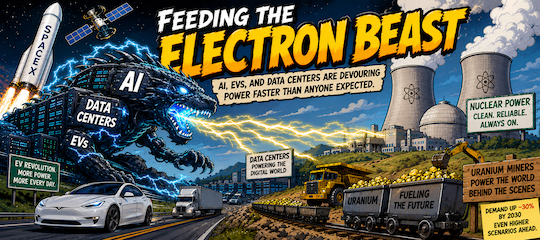
Feeding the Electron Beast
Posted June 11, 2026
By Matt Badiali
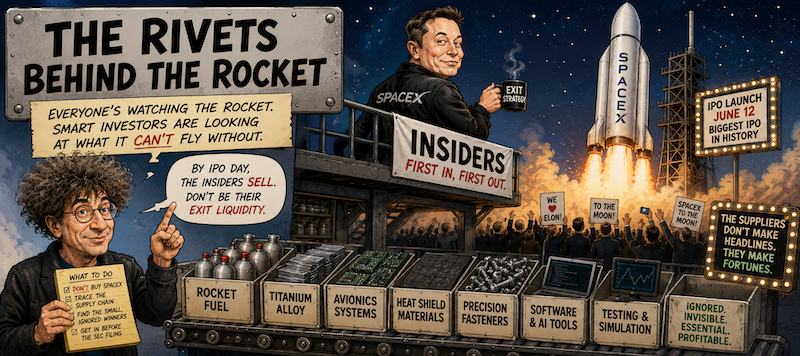
The Rivets Behind the Rocket
Posted June 10, 2026
By James Altucher
