Posted September 02, 2026

By Jim Rickards
The Straitjacket
The kinetic war between the U.S. and Iran has mostly ground to a halt. This is not a stalemate. A stalemate arises when both sides continue attacking but make no progress.
This is not a ceasefire or armistice, both of which are reached by agreement and formalized in some manner. It is simply a time-out in a game that is certain to continue in some fashion in the near future.
The time-out is mutually convenient. The U.S. wants to stop the fighting because none of the U.S. goals were being achieved.
The U.S. killed hundreds of top Iranian religious, political, and military leaders. But Iran simply replaced them with younger officers who are even more nationalistic and militant than the ones they replaced.
The U.S. destroyed much of Iran’s Navy, but it was never much of a navy in the first place.
The U.S. destroyed about 3,000 Iranian missiles and hundreds of missile launchers, while Iran launched about 3,000 missiles. But this leaves Iran with another 4,000 missiles in reserve and enough launchers to attack the Gulf states, Israel, and even targets in Europe.
Iran has more than made up the missile gap with drones. Iran is one of the leading drone manufacturers in the world, with ample access to Chinese components and Russian satellite targeting information.
The U.S. is also suffering from substantial depletion of its own supplies of weapons and ammunition, including Patriot anti-missiles, THAAD missiles, Tomahawk cruise missiles, 155mm shells, and more.
The U.S. would not be so low in these inventories if we had not wasted so much of the arsenal in a war in Ukraine that Russia is almost certain to win. The Russians are watching the U.S. expend weapons in Ukraine and Iran even as they resupply Iran. It’s a win-win situation for Russia in its global competition with the U.S.
Finally, the Strait of Hormuz is effectively closed to normal commercial traffic and may remain that way indefinitely. That’s a clear loss for the U.S. and the global industrial economy.
In short, the U.S. has accomplished none of its goals and is worse off in terms of weapons and critical materials trapped in the Persian Gulf. The U.S. desperately needs this time-out.
Iran’s Best Weapon Is the Clock
Iran has its own reasons for favoring a time-out.
It can use the hiatus to resupply its own military with new weapons from Russia and China. It can also receive financial support from Russia — some of which will arrive as gold bullion. That gold is difficult to trace and can be traded anywhere in the world for cash, arms, and technology.
Iran will also use the time to repair some of its critical infrastructure damaged by U.S. attacks.
The longer the clock ticks, the greater the possibility that the U.S. will blink first in terms of Iran’s demands because of the threat to the U.S. and the global economy coming from the closing of the Strait.
So, both sides need the time-out. What comes next?
Iran is betting that the shortage of critical resources, including oil, natural gas, sulfur, helium, aluminum and nitrates, will lead the U.S. to agree to Iran’s demands for reparations and sanctions relief.
Iran is also well aware of the midterm elections on November 3 and expects the White House to cave to avoid Republicans losing the House of Representatives.
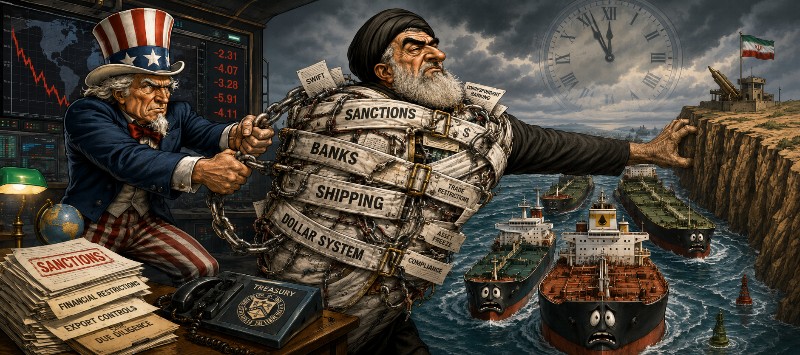
For its part, the U.S. is betting that a financial and economic war can win what a kinetic war could not. To wit, U.S. Treasury Secretary Scott Bessent has announced what he calls the “toughest sanctions in history” against Iran.
These sanctions are expected to include obvious steps such as bans on Iranian exports and on imports into Iran except for humanitarian purposes; further isolation of Iranian banks from global payment systems, including SWIFT; and facilities that settle transactions in U.S. dollars, including Fedwire.
The U.S. may also try to ban Iranian flights from airports worldwide and, to the extent possible, deny Iranian officials access to personal credit cards and accounts.
Beyond that, the U.S. will employ secondary sanctions. These are sanctions imposed on third parties that do business with Iran. For example, if a Chinese shipping line carries cargo to or from Iran, the vessels of that line could be banned from U.S. ports and from ports such as Rotterdam, Piraeus, and Stockholm.
The U.S. message to countries around the world is: “You’re either with us, or you’re against us.”
Countries that are against us will face additional U.S. sanctions. This is really World War III using finance instead of firebombing.
Most importantly, the U.S. will target banks that do any business with Iran or with countries that do not join the sanctions. Many of the largest banks in Europe, Asia, and Australia have substantial operations in the U.S., including lucrative wealth management businesses. This puts them under the thumb of the Federal Reserve and other U.S. banking regulators.
The appropriate officers of those banks will soon be getting phone calls instructing them to join the Iranian sanctions, including secondary sanctions, or be prepared to see their U.S. operations shut down or at least strangled. They will fall in line quickly.
But if enough major countries — including Russia, China, India, Brazil, Turkey and Malaysia — refuse to go along, Iran may have a sufficient network of trading partners and financial channels to weather the sanctions.
U.S. application of secondary sanctions to that same list of countries for failure to be “with us” could result in the greatest contraction of world trade and finance since the Great Depression.
Whether a financial war on Iran can be won in time to impact Republican chances in the midterms favorably is doubtful. Financial war tactics can work, but they can take years to produce hoped-for results.
Investors can prepare for this looming financial Armageddon by increasing allocations to gold, silver, cash, real estate, and U.S. Treasury bills. Those assets will preserve wealth and liquidity and are robust to the inflation that will result from a world with broken supply chains and unprecedented uncertainty.
In any case, the financial war may only be temporary. Once the midterm elections are over, expect the kinetic war to return with a vengeance.
Win or lose, Trump will be out to punish Iran. Even with a partial resupply of critical weapons, Trump will be eager to go back on the attack, blaming Iran for its failure to do a deal.
Trump said he did not want a forever war. But he appears to be getting one — despite his best intentions.

Sell Promises, Buy Things
Posted September 01, 2026
By Sean Ring

The Smoke Detector Is Beeping
Posted August 31, 2026
By Sean Ring
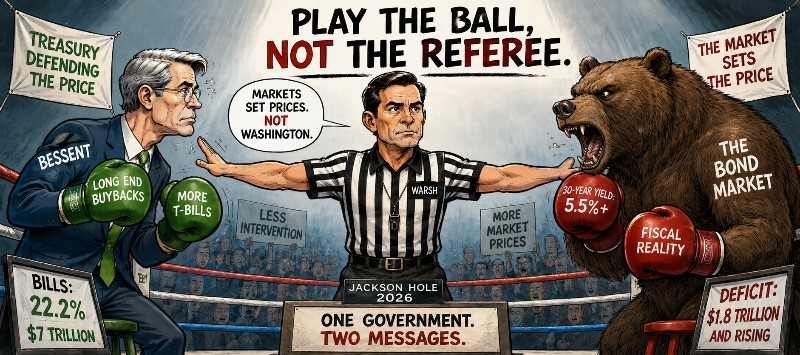
Play the Ball, Not the Referee
Posted August 28, 2026
By Sean Ring

Gentleman’s Price Control
Posted August 27, 2026
By Sean Ring
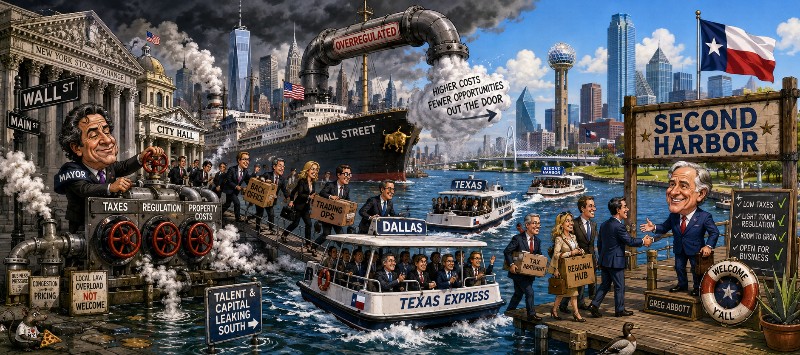
Second Harbor
Posted August 26, 2026
By Sean Ring