Posted September 22, 2026

By Jim Rickards
The Price Behind the Price
Editor’s Note: In the past few months, Matt Badiali and I have written in the Rude about the crack spreads blowing out and how that affects our everyday lives. But with the reduction in refining capacity, diesel continues its relentless rise. Jim Rickards was generous enough to allow me to share his thoughts about this phenomenon from the most recent issue of Strategic Intelligence. Enjoy.
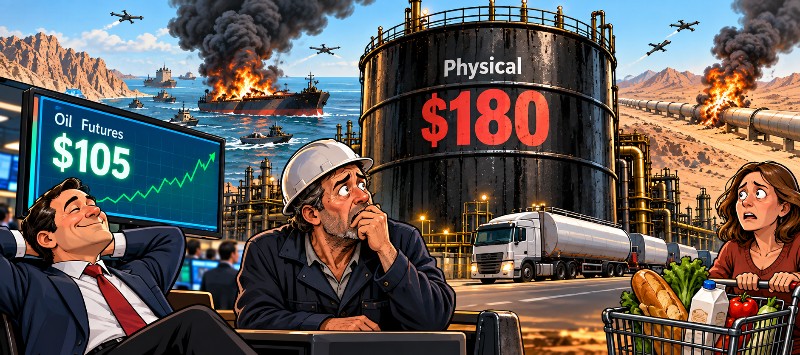
We’ve all seen oil prices move from $70 per barrel to over $105 per barrel in a matter of months, with much of the latest surge occurring in a matter of days.
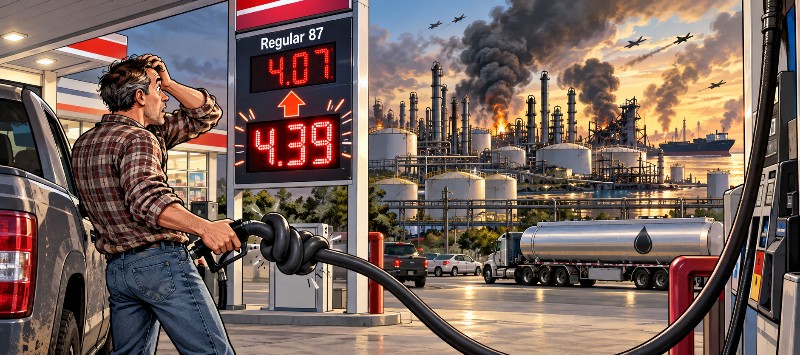
We understand the implications of that for the price at the pump and inflation more generally, since higher fuel prices are passed through to the price of everything that moves by truck. But the situation is worse than the headlines reveal.
The price you read about is typically a futures contract price based on either West Texas Intermediate or Brent crude oil. Those are the two leading oil benchmarks. They refer to specific grades, delivery terms and locations of oil, and they are legitimate market prices.
But the widely quoted futures contracts are basically bets about where oil prices will be at the time of delivery in the weeks and months ahead. They reflect a mix of hedging, speculation and expectations about future supply and demand. But they are not necessarily the price of actual oil available for immediate delivery.
If you want physical oil delivered to your refinery next week, you have to enter the physical market and buy an available cargo, including cargoes already underway at sea.
What’s the price of these wet cargoes on the physical market? Depending on the grade, location, freight costs and availability, physical crude can trade at substantial premiums to benchmark futures.
Another measure is the so-called crack spread, named for the process of “cracking” crude oil into refined fuels. The crack spread is the difference between the price of crude oil and the value of refined products, including gasoline, kerosene (jet fuel) and diesel.
Normally, refining margins are much tighter than we’ve seen recently.
Diesel has traded at the equivalent of roughly $180 per barrel or even higher during this year’s disruptions, while crude prices have been far lower. At times, that has produced extraordinary crack spreads approaching $100.00 per barrel.
Put differently, physical market activity is telling us the cost of crude oil is much higher than the futures prices you read about in the headlines. That’s the reality behind higher inflation, and it’s not going away soon.
Since the war in Iran started in February, Trump has had no good options for ending it. Iran is winning the war not by invading New Jersey, but simply by living to fight another day.
Iran’s regime is still intact. Iran still has highly enriched uranium (HEU). And Iran has retained a substantial ballistic missile arsenal and thousands of drones, with the ability to manufacture more.
The Strait of Hormuz remains severely disrupted. The diminished supply of oil, natural gas, nitrates, sulfur, helium and other critical commodities is damaging to Western developed economies, albeit reduced oil exports are damaging Iran’s economy as well.
As for Trump’s options, he could agree to Iran’s demands to end the war. But those demands include withdrawal of U.S. forces from the Middle East and billions of dollars in reparations and war damages.
Trump could finesse some kind of unofficial ceasefire until after the election, but Iran won’t cooperate. Iran keeps attacking tankers even as Trump tries to demonstrate he’s amenable to a time-out in the shooting.
Finally, Trump could escalate attacks. On September 8, the U.S. destroyed five Iranian crude oil carriers after the IRGC targeted a U.S. Navy warship with ballistic missiles. More attacks by the U.S. and Iran have happened in the days since.
Escalation of this type, however, won’t work in the long run. Bombing did not win the Vietnam War, for instance, even after years of sustained air campaigns.
It would take a major land invasion, perhaps involving 100,000 or more U.S. troops, to attempt to occupy significant Iranian territory. That’s not happening. So, the war will drag on. And energy prices will remain high as a result.
One persistent question is why the world is not suffering even more economic dislocation, given the amount of critical energy and chemical resources that come out of the Persian Gulf.
There are three reasons for this: The U.S. and Russia have increased energy output. The world has drawn down strategic oil reserves. And some countries have been able to substitute one resource, such as coal, for another, such as oil.
But all of those strategies have limits. Reserves eventually run low, oil production can only be increased so much and substitutes such as coal can only fill part of the gap.
One strategy that kept the oil flowing was for Saudi Arabia to divert exports from tankers leaving the Persian Gulf to its East-West Pipeline, which runs across the Saudi Arabian desert to the Red Sea port of Yanbu, with no need to transit the Strait of Hormuz.
That pipeline can carry roughly 5 million barrels per day and became a critical alternative to the roughly 20 million barrels per day of total oil and petroleum-product flows that historically transited the Strait.
But Iran-aligned militias operating from Iraq launched drone attacks on the Saudi pipeline. That pipeline has now been disabled and the Saudis have shut it down. Even if they can repair it, there’s nothing stopping Iran from attacking again.
All of which makes Trump’s promises about the war increasingly difficult to believe.
Early in the war, he said it would be over in weeks. Later, he modified that to say the U.S. would win “in a few days.” He said the Strait of Hormuz was open and also said the Strait was under U.S. control. Events since then have not supported those claims.
The war is more than six months old and is turning into another forever war. The Strait remains closed, with no end in sight.
Trump now says the war will end immediately after Election Day on November 3.
I wouldn’t count on it.
Trump wants a time-out in the war, but Iran won’t give it to him. The full impact of the war on the economy has been delayed, but not eliminated. It’s hitting home now.

Baptists, Bootleggers, and Bots
Posted September 21, 2026
By Sean Ring
A Squeeze, Refined
Posted September 18, 2026
By Matt Badiali

The Real Fed Chairman
Posted September 17, 2026
By Sean Ring

The Untied Kingdom
Posted September 16, 2026
By Sean Ring

The Great AI Alibi
Posted September 15, 2026
By Byron King
