
Posted September 29, 2026

By Sean Ring
The Pentagon’s Velvet Rope
On October 12, 2023, I told you why I loved Palantir (as a stock, not as a company).
PLTR traded in the teens back then. Yesterday, it closed at $187.48. If you made that trade and held on, you roughly 10Xed your money.
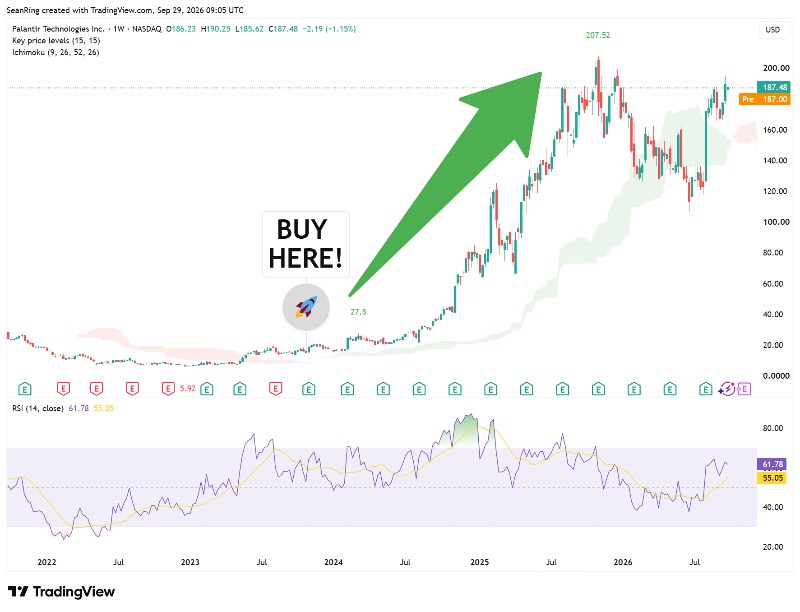
I’d love to tell you what a genius I am, but sadly, that’s not the case. I just followed a map drawn by a man most investors have never heard of.
His name is Richard Maybury. And rereading his map is about to pay off again.
Uncle Eric’s Cones
Maybury wrote a series of small books told through a wise old uncle named Eric. These little books hold more sound economics than most of today’s Federal Reserve-funded PhD programs.
In The Clipper Ship Strategy, Maybury took an old idea and simplified it.
The old idea belongs to Richard Cantillon, an Irish-French banker from the 1700s. He saw that new money doesn’t spread evenly. The people who get it first spend it before prices rise. Everyone downstream pays higher prices.
That’s the Cantillon Effect.
Cantillon didn’t just discover and describe it. He wielded it.
In 1719, a Scotsman named John Law flooded France with paper money to pump up shares in his Mississippi Company. A banker in Paris at the time, Cantillon stood right next to the all-important money spigot. Cantillon bought early, sold before the bubble burst, and moved his gains out of France. He walked away an obscenely wealthy man while the French public was left holding worthless paper.
Maybury added to the picture. He wrote that the government doesn’t sprinkle money evenly across the land like a soft rain. It pours money into its favorite spots, like water through a funnel. The money lands at the tip of the cone and spreads out from there.
Lower Manhattan is the biggest cone on earth. The Fed’s freshly printed money hits the banks first. That’s why Wall Street booms while Main Street can’t afford a starter home.
Maybury’s advice boils down to one idea: watch where the government pours money, and invest there.
He added 4 rules:
- Find the cone.
- Tap into it.
- Don’t expect it to last.
- Always look for the next one.
Why Palantir Paid
In 2023, the cone was easy to spot. The Swamp couldn’t stop spending taxpayer funds on spying, data, and defense. Palantir sat right at the tip. Its biggest customers were the Pentagon and the spy agencies. The money didn’t trickle down to Palantir. It landed there first.
Palantir already had a real business. It had contracts, revenue, and software that worked. The government-funded cone acted like Miracle-Gro for its business. To be sure, PLTR didn’t build something from nothing. Its “something” just got a whole lot bigger because the government dumped a load of taxpayer cash in PLTR’s coffers.
But as Reggie Jackson once said, “You’re only as good as your last at-bat.”
That’s where Rule 4 comes in: you need to keep looking. So we kept looking.
Luckily, my friend and colleague Jim Rickards found the next cone, and it’s different from any cone Maybury described.
A Cone With a Fence
Most cones work by adding money. This cone adds an important feature: it removes the competition.
Starting January 1st, Pentagon contractors can’t deliver certain magnets, tungsten, or tantalum if their supply chains run through China, Russia, Iran, or North Korea. For the most common rare earth magnets, the ban covers every step from the mine to the finished part.
Mined there? Banned.
Refined there? Banned.
Melted there? Banned.
That’s a big deal, because China doesn’t just mine these metals. In 2023, it processed about 90% of the world’s rare earth supply.
My friend and former Naval aviator Byron King often talks about what military assets like fighter jets need. For example, jet engines and guidance systems need rare earth magnets. If the USG bans the Chinese supply, the demand doesn’t go away.
It gets squeezed through a much smaller hole: a short list of American and allied suppliers who can prove they have clean hands from mine to finished magnet.
That’s the new cone. But this time, DC isn’t just pouring heaps of money onto a cone. It’s putting a wall around the cone.
Incentives Align In Our Favor
I’m no fan of The Swamp picking winners. When I wrote about the tungsten deal the Trump kids made a few months back, I didn’t like how close policy sat to family portfolios. And I still don’t.
But I must learn (and relearn) to separate what I’d like a government to do from what it will do.
Congress first banned Chinese magnets in the defense bill passed in late 2017, during President Trump’s first year. It widened the ban in the defense bill that passed over his veto in January 2021. Then, under Joke Biden, the 2024 defense bill set the final start date of January 1, 2027.
3 defense bills. 2 presidents. 1 big, happy uniparty.
Nobody in DC loses votes by taking a hard line on Chinese supply chains. Defense hawks want it. Factory towns want it. Each party needs both groups to win. The men in charge are just doing what keeps them in office.
Beijing plays the same game from the other side. In December 2024, it banned exports of gallium, germanium, and antimony to America. Neither government can back down without looking weak at home, so neither will.
Where to Stand
The cone exists already. Its fence goes up January 1st.
The biggest winners at the tip won’t be the giants. When a trillion-dollar company lands a new contract, it barely moves the needle. But when a company worth a few hundred million lands the same contract, it changes the company’s fortunes.
One more piece of the puzzle: timing. Money moves on a calendar, and DC’s calendar has a date on it that most investors ignore.
That date is tomorrow, and I’ll follow up on it in tomorrow’s Rude.
Wrap Up
If you followed the PLTR call in 2023, you saw the map.
That map still works. Only the cone has moved from the spy budget to the mine, the refinery, and the magnet factory. Most investors are still staring at Lower Manhattan.
You don’t have to love government policy to see who it pays. I certainly don’t. But you want to be in the right place at the right time: when the money pours in.
Have a great day ahead.

From Athens with Contempt
Posted September 28, 2026
By Sean Ring

The Lost Round Trip
Posted September 25, 2026
By Sean Ring

The Hunt for Red November
Posted September 24, 2026
By Sean Ring

The Straits Strangle
Posted September 23, 2026
By Sean Ring

The Price Behind the Price
Posted September 22, 2026
By Jim Rickards
