
Posted March 06, 2026

By Byron King
The Pentagon Pays the Piper
Military power is a first derivative of industrial and energy power.
That may sound abstract, but modern “national security” — the polite phrase for the ability to project force and impose outcomes — rests on factories, shipyards, refineries, electrical grids, rail lines, and skilled labor.
It depends on steel mills, machine shops, heavy equipment, and the men and women who know how to run them.
In short, military strategy begins upstream — with resources, production, logistics, and sustainment. If those weaken, the sharp end eventually dulls.
Consider World War II and America’s “Arsenal of Democracy.” Millions of people worked in thousands of factories across the country. They built ships, aircraft, tanks, trucks, engines, radios, and mountains of ammunition.
That output depended on vast hydroelectric projects, coal-fired plants, oil fields in Texas and California, and refineries running around the clock.
The military miracle of the 1940s was industrial before it was martial.
Today, that industrial base is more vulnerable than most Americans realize.
Eight Shipyards for the U.S. Navy
Earlier this year, after more than twenty years, the Department of Transportation’s Maritime Administration (MARAD) finally released an updated survey of U.S. shipbuilding.
By statute, that report is supposed to be annual… The last one came out in 2004.
That amounts to a bipartisan, 21-year attention gap across the George W. Bush, Obama, Trump, and Biden administrations.
The reporting requirement never went away. Yet the reports did. Had MARAD published proper numbers year after year, perhaps at least a few people in authority might have noticed — if not been shocked into action.
During that period, shipyards closed, skilled workers retired, and suppliers folded. Capabilities drifted away quietly, without headlines or fanfare.
And the new numbers tell the story.
The United States has just eight active shipyards capable of building large vessels.
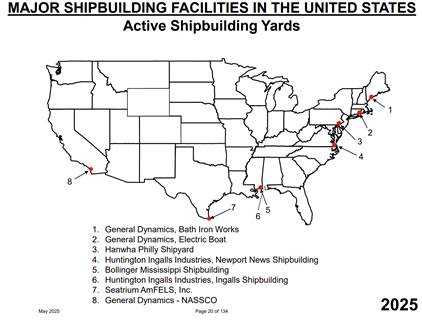 MARAD 2025 Survey of U.S. Shipbuilding
Courtesy: U.S. Department of Transportation
One. That’s the number of major shipbuilding yards on the entire West Coast: NASSCO in San Diego, a division of General Dynamics.
General Dynamics’ Electric Boat in Connecticut builds submarines. Huntington Ingalls (HII) in Newport News builds submarines and nuclear-powered aircraft carriers. So, in practical terms, the eight yards are closer to six when it comes to constructing large, conventionally powered surface ships.
Note that most of the existing capacity is devoted to Navy and Coast Guard work. Civilian shipbuilding is a sideshow.
Yes, other facilities perform drydock work, repair, overhaul, and limited construction. In total, MARAD counts 64 yards “suitable” for large vessels.
Sixty-four for a nation that spans a continent, commands the world’s most powerful Navy, and depends on maritime trade for everything from crude oil to consumer goods.
And even that number obscures reality. A yard with a “build position” but no active contract is not the same as a yard with a hot production line. You cannot flip a switch and lay a keel.
Restarting heavy construction takes months, often years. Capital must flow. Suppliers must ramp up. Skilled labor must be recruited and trained.
And that relates to something larger — serious deficits in the U.S. education and training pipeline. Welding, electrical systems, pipefitting, heavy machinery installation — these skills require apprenticeships, repetition, and institutional memory.
The competency pipeline has narrowed, and it shows. Over the past decade, the U.S. has launched roughly half a dozen large commercial ships per year — about one every two years.
Now compare that with China.
According to Maritime Executive, in 2025, Chinese shipyards took orders for over 1,500 new-build large ships, out of over 2,500 global orders. By tonnage, China controls about 70% of global new order volume, according to China’s Ministry of Industry and Information. And Chinese yards delivered 56% of all completed ships last year.
That is not incremental dominance. That is gravitational pull.
Beyond commercial vessels, China’s naval construction program is nothing short of awesome — in the literal sense of the word. Entire industrial cities are configured to support sustained naval output. The operational tempo resembles wartime mobilization.
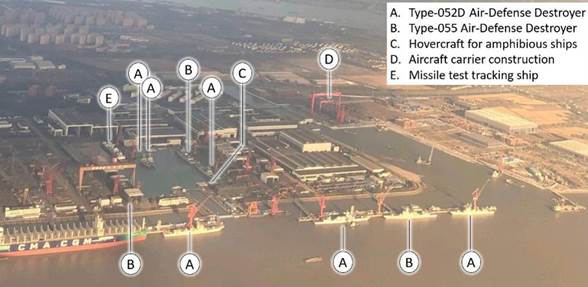 Chinese shipyard near Shanghai showing 12 warships under construction
Courtesy: H.I. Sutton
American naval construction, by contrast, is bespoke, slow, and expensive. Our ships are superb. They are also few.
The operational implications are not theoretical. The Pacific theater is vast. U.S. forces based in San Diego, Bremerton, and elsewhere would require repair and rapid replacement in the event of conflict. Yet the West Coast has just one major yard building large ships.
During World War II and the Cold War, places like Long Beach, Hunters Point, Mare Island, Portland, and Puget Sound sustained enormous throughput. Today, most of that infrastructure is gone, replaced by office parks, housing developments, and waterfront retail.
Rebuilding would take decades.
The Other Crisis: From 42 to Six
Shipyards are one piece of the puzzle. Fuel is another.
Ships run on refined petroleum. Aircraft run on refined petroleum. Armored vehicles run on refined petroleum. Even a modern “green” military platform ultimately depends on hydrocarbons somewhere upstream in its supply chain.
California once understood this.
The state has produced oil since the 1870s. In the early 1980s, California operated 42 refineries. It was an industrial heavyweight.
Today it has six.
With the recent closure of a refinery in Benicia, capacity has tightened further. Phillips 66 (PSX) has closed its Los Angeles refinery. Chevron (CVX) has moved its headquarters to Houston.
The result is visible at every California gas pump. But the larger issue is structural.
Bloomberg recently ran the headline: “Gasoline-Starved California Is Turning to Fuel from the Bahamas.”
More precisely, California increasingly imports refined product from the Gulf Coast. Some cargo moves first to the Bahamas for blending, then transits the Panama Canal before reaching the West Coast.
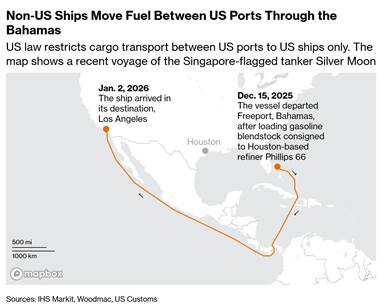 Map of the recent tanker route to supply fuel to California
Source: Bloomberg
It’s a route shaped, in part, by the Jones Act of 1919, which restricts foreign-flagged vessels from transporting goods between U.S. ports. It’s a long journey for a state that once refined abundantly on its own soil.
For motorists, the cost shows up as high gasoline prices. For businesses, it shows up in operating margins. For the military, it shows up as vulnerability.
Refineries are not convenience stores. They are multibillion-dollar industrial complexes that require permits, pipelines, environmental compliance, skilled operators, and years of construction. Once closed, they are rarely reopened. More often, they are dismantled.
California’s regulatory posture toward oil and gas has steadily raised costs and uncertainty. Layers of taxes, regulations, permitting hurdles, and litigation have discouraged investment.
This is as much a cultural and generational issue as it is an economic one. Industrial ecosystems take decades to build and can dissipate surprisingly fast.
Companies have responded rationally. Some pull back. Some exit. Over time, capacity shrinks. The result is a West Coast with limited refining redundancy.
No fuel, no movement.
In peacetime, that means price volatility and dependence on long logistics chains. In wartime, it means something far more serious.
The 47% Problem
The third industrial constraint is strategic airlift.
The Air Force’s C-17 and C-5M fleets move troops, equipment, and heavy machinery across oceans at speed. In recent months, those aircraft have flown repeatedly to Europe and the Middle East. The same aircraft are central to war plans in the Pacific.
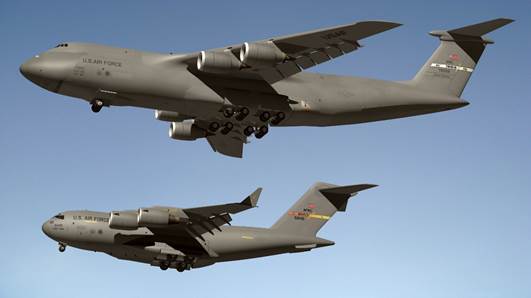 USAF airlifters: C-5M (above) and C-17 (below)
Courtesy: U.S. Department of War
In just the past 72 hours, events in Iran have underscored the point. C-17 and C-5M aircraft have moved ammunition, missile defense components, and personnel to key hubs such as Al Udeid Air Base in Qatar and Prince Sultan Air Base in Saudi Arabia.
These flights carry real firepower, including Patriot and THAAD systems, along with the sustainment packages that keep them operational. And their transport depends on a finite fleet of aging aircraft already tasked with global commitments elsewhere.
But airplanes can’t be in two places at once.
The C-17 production line, inherited from McDonnell Douglas and now part of Boeing (BA), closed years ago. The C-5M fleet consists of upgraded aircraft originally designed in the 1960s and 1970s by Lockheed Martin (LMT). That production line closed decades ago.
If a reboot of the heavy airlift program is underway, the details are buried deep in the bowels of the Pentagon. What surfaces publicly tends to be glossy brochures at trade shows — not production lines.
Maintenance crews perform impressive work keeping aging fleets operational. But readiness rates fluctuate, and public estimates have placed C-5 mission-capable rates at 47% readiness, per a recently retired Air Force general.
Again, this is not a criticism of pilots, crews, or mechanics. It is a structural observation: You cannot surge what you do not produce.
Designing and fielding a new heavy airlifter would take billions of dollars and many years. To my knowledge, no such program exists.
No Production. No National Security.
Shipyards are scarce. Refineries are closing. Airlift fleets are aging.
None of this happened overnight. It reflects decades of policy decisions, economic incentives, and cultural drift away from heavy industry, along with the quiet assumption that global supply chains would always function in America’s favor.
The United States remains wealthy. It retains extraordinary engineering talent, capital markets, natural resources, and technological capacity.
But industrial depth — the ability to build, repair, fuel, and sustain at scale — is not a theoretical asset. It’s measured in docks, production lines, and skilled labor.
Strategy rests on that foundation.
As someone who once wore a Navy uniform, I can tell you that ships and aircraft get the headlines. But the industrial tail determines how long they can operate.
If the country chooses to rebuild that industrial base, the process will take years, likely decades. It will require political will, capital investment, regulatory reform, educational focus, and respect for industrial work.
Recognizing where we stand is not defeatism. It’s realism. And realism is the starting point for any serious discussion of national security.
After more than twenty years of writing for what’s now become Paradigm Press, I have tried to look for the upside, even in uncomfortable trends.
Industrial scarcity creates strategic vulnerability. But for investors, it also creates long-term opportunities.
Thank you for reading.

Vicious Patriotism
Posted March 05, 2026
By Sean Ring

Don’t Overprice Risk with Mining Companies
Posted March 04, 2026
By Matt Badiali

America First!
Posted March 03, 2026
By Sean Ring

WAR! What’s It Good For?
Posted March 02, 2026
By Sean Ring

The Biggest RINO of Them All
Posted February 27, 2026
By Sean Ring
