Posted January 09, 2026

By Sean Ring
The Next Commodity Supercycle Winner
I can’t tell you how much I regret not studying geology at university.
It’s not that I hate commerce and finance. Of course, I love them.
But after nearly five years as the Rude’s editor, I’m still on a steep learning curve in earth sciences and how they affect our material well-being.
And anyway, most of the finance you learn in the classroom isn’t worth the paper it’s printed on.
The efficient markets hypothesis, no-arbitrage pricing, and the capital asset pricing model go right out the window when reality arrives.
But geology? Boy, that comes in handy, doesn’t it?
London, Mid-2000s
I remember having dinner at my friend Arthur’s house in London many years ago.
Art was a chef and always cooked the best meals.
His friends were delightful, and all always had a good time.
At one such dinner, I sat across from a geologist named Mark.
I found him utterly fascinating.
I remember how his wife and toddler were upset that he had to fly to Chile the following Monday for a long geological survey trip.
He worked for Shell, so I assumed he was looking for oil deposits.
I remember thinking, “Wow, that’s much more interesting than sitting at my desk watching numbers and shouting at clients all day.”
And mind you, I worked for one of the world’s largest investment banks in one of the world’s best cities.
But people like Mark genuinely understand what minerals do for our world.
You Say POTash. I say potASH.
Let’s turn our attention to one such mineral, which most people around the world have no idea how important it is.
Potash is the building block for many fertilizers.
It’s a group of minerals that contain potassium, which is critical for the growth of our crops.
Without potash, we – and by “we,” I mean “the planet’s farmers” – simply can’t grow enough food for all of us to eat.
While Canada is the number one potash producer in the world, potash is also a naturally occurring substance in two countries the Western world has been sanctioning for years: Russia and Belarus.
One of Russia’s negotiating points about the sanctions is, “You guys need this stuff.”
But the “English majors” running the government have no idea what stuff farmers need and what they don’t.
A few years ago, I thought the sanctions against Russia and Belarus would cause a famine. But while Africa has seen some mini-famines over the last few years, none are directly attributable to the lack of potash.
I’m glad, because food deprivation is one of those things a person, or a population of persons, never forgets.
Remember an uncle or grandparent who suffered during the Depression?
Remember how they used to scrimp and save, never leaving a morsel on their plates?
They were always so grateful for food and admonished those who weren’t.
“You kids have no idea how lucky you are! We didn’t have anything when I was growing up!”
But most Americans didn’t blame anyone for the Great Depression. To them, it just happened.
Let me relay a story about a purposeful food robbery that one nation has never forgotten.
When Churchill Diverted Food from India to England
The parallel isn’t exact, but I’m thrilled America avoided England’s fate when it came to depriving a country of its food.
Indulge me here: what do you think when you read this name?
Winston Churchill.
If you’re a Westerner and learned the mainstream version of World War II history, you’d probably think, “That’s the man who saved the world.”
While Pat Buchanan and Peter Hitchens disagree, Churchill’s name is synonymous with bravery, persistence, and strength.
Churchill is the one who held Britain together long enough to get America invested in the war.
He stood up to Adolf Hitler while the Americans watched from afar.
If he hadn’t, we’d all be speaking German right now.
But that’s just one view.
Here’s another: Winston Churchill was a bully who purposely took food from a starving India and diverted it to England.
Churchill caused millions of deaths on the subcontinent because he robbed wheat from India to feed England at the height of the war.
To this day, Winston Churchill’s name is cursed when someone even dares bring it up at an Indian dinner table.
From Al-Jazeera:
Nobel Prize-winning economist Amartya Sen had argued in 1981 that there should have been enough supplies to feed Bengal in 1943.
According to Indian politician Shashi Tharoor, “Churchill has the blood of millions on his hands whom the British prefer to forget.”
“Churchill deliberately ordered the diversion of food from starving Indian civilians to well-supplied British soldiers and even to top up European stockpiles, meant for yet-to-be-liberated Greeks and Yugoslavs,” Tharoor, the author of “Inglorious Empire: What the British Did to India,” wrote.
Churchill is routinely at the top of Most Hated Persons lists in India to this day.
That happens when food, that most essential and sacred part of civilization, is taken away from a nation.
And people never, ever forget. Especially if there’s one specific, purposeful reason for it.
Significantly, potash doesn’t grow in Africa at all.
But luckily, Africa avoided the worst this time around because it was able to replace Russia and Belarus’ potash with potash from other sources.
A Domestic Potash Play
Potash may be the next segment of the commodity supercycle to rally. Intrepid Potash (IPI) is coming off its lows and targeting its recent highs.
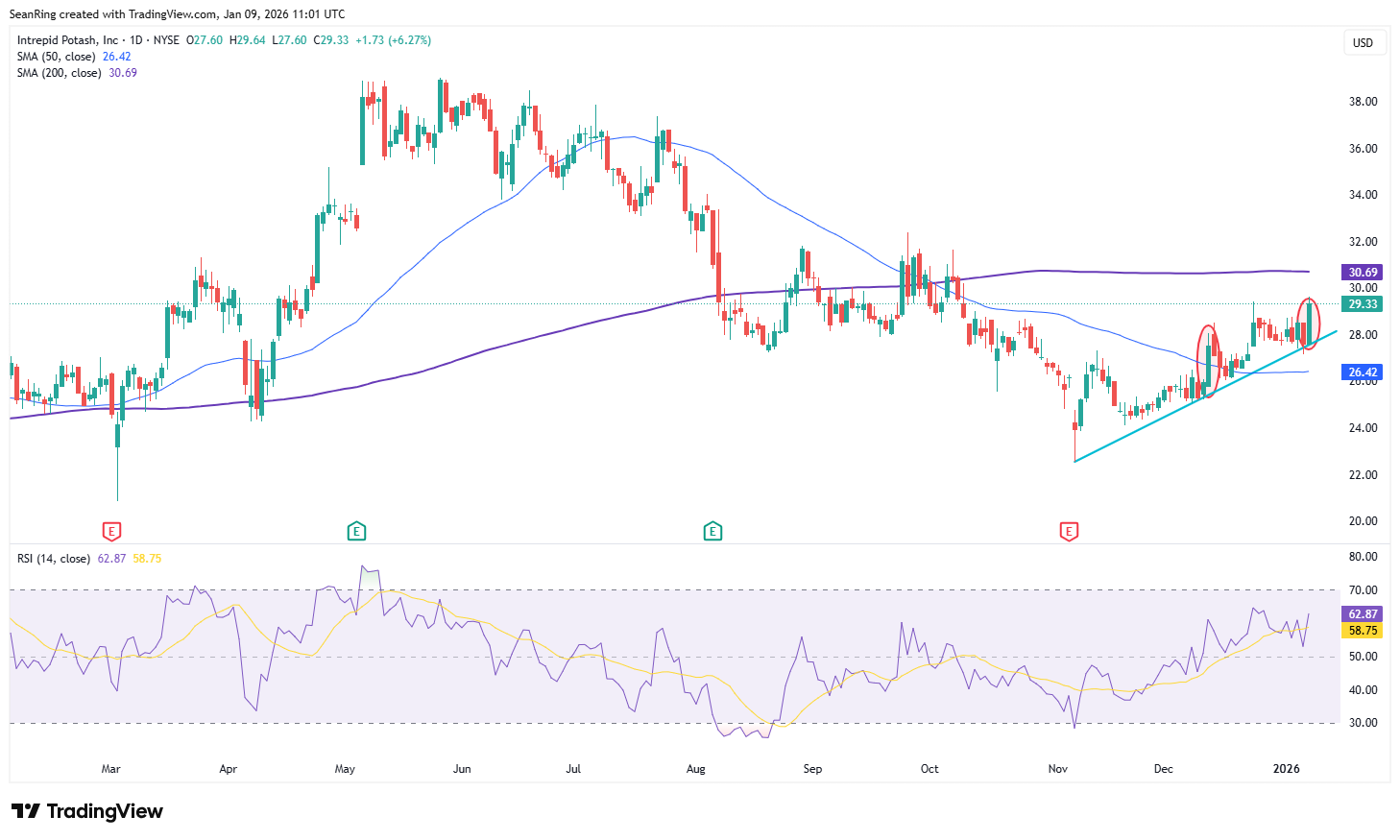
It closed at $29.33 yesterday, but is targeting $32.40, $34.80, and then $45.60 on the upside.
I like the chart plenty, and its fundamentals are attractive as well. IPI trades at a low multiple of earnings (trailing and forward P/E around 10 in the cited period) and at roughly 0.4–0.5 times book value, with assets of about $800 million, liabilities near $125 million, and essentially no long‑term debt. That’s great for any business, let alone a commodities business.
If global potash prices recover from the softer conditions seen after the 2022–2023 spike, IPI’s earnings could grow disproportionately.
I see at least two opportunities here. One idea is buying the stock outright. But if you want to play the upside with options, look at the June 35 calls, which closed at $2.05 yesterday. If IPI hits $45.60, that would be a 4-to-1 risk-to-reward play (Risk $2.05 to receive $8.55). As this is just an opportunity, I won’t be tracking this in our unofficial Rude portfolio.
Wrap Up
Canada is the number one exporter of potash in the world. Russia and Belarus are persona non grata in the United States, though the U.S. just eased sanctions on Belarus.
The Donald is serious about America First, as we can see from the seizure of Venezuelan Presidents and Russian tankers.
Play the game accordingly.
And have a great weekend!

RIP, Scott Adams
Posted January 14, 2026
By Sean Ring

Worldwide Whack-A-Mole
Posted January 13, 2026
By Sean Ring

The Best Stocks, Countries, and Books
Posted January 08, 2026
By Sean Ring

From The Shores of Tripoli to Caracas
Posted January 07, 2026
By Sean Ring
¡Seremos Bienvenidos Como Libertadores!
Posted January 06, 2026
By Sean Ring