Posted February 18, 2026

By Sean Ring
The Most Expensive Way to Go Broke
I don’t do celebrity outrage, but this one got me.
Let's start with a name you know.
Dawson. From Dawson's Creek. The face that launched a thousand memes and at least one generation of unrealistic expectations about teenage emotional intelligence.
James Van Der Beek. Successful actor. Household name. Decades of work. Loving husband and father. The kind of guy the American healthcare system was supposedly built for.
He got colon cancer. He fought hard. He died a week ago. And along the way, his family had to rely on donations, public appeals, and the generosity of strangers to stay financially afloat.
Read that again.
A famous person — with industry connections, name recognition, and presumably access to the "best" hospitals — needed a GoFundMe.
So what exactly does that tell us about the rest of us? The teachers, the truck drivers, the small business owners whose names nobody knows and whose medical billing nightmares will never make headlines?
Nothing good, that’s for sure.
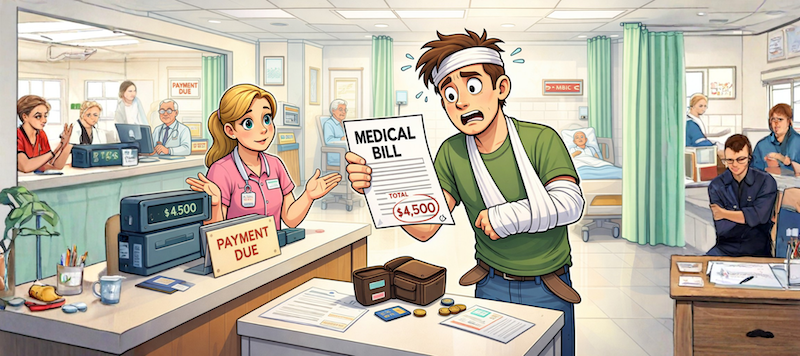
Congrats, You Have Cancer. Here's Your Bill.
Here's how a cancer "journey" works in America — and yes, the industry actually calls it a journey, as if you packed a carry-on and booked an aisle seat.
You get the diagnosis. Then come the specialists, the scans, the surgeries, the chemo, the radiation, the biologics, the follow-up scans to see if the first scans were right, the complications from the treatment, the hospitalizations for the complications, and then — just when you thought it was over — the bills.
Not one bill. Dozens of bills. From the surgeon. From the anesthesiologist. From the hospital. From the radiologist who looked at your scan for eleven seconds. From the pathology lab. From a company called something like "Advanced Facility Solutions" that you've never heard of and never consented to.
Each one arrives weeks apart, formatted differently, referencing codes you cannot decode, referencing insurers who may or may not have already paid some portion of something. By month three, managing your medical bills is a part-time job, which is fantastic timing. After all, you can no longer work your actual job because you're exhausted from chemotherapy.
And if you happen to be the primary earner in your household? Congratulations. You've now lost both the breadwinner and the paycheck simultaneously. The mortgage company would like to express its deepest sympathies and also its firm expectation that you make your payment by the 15th.
The System Is Working Exactly As Designed
Here's the part where I'm supposed to say "the system is broken."
I'm not going to say that.
The American healthcare finance machine isn’t broken. It is functioning perfectly… for the people it was designed to benefit, which is not you.
Consider the fee-for-service model, which is the beating heart of American medical billing. Every visit, every test, every scan, every procedure is a revenue event. Do more, bill more. It's elegant, really, if you squint and tilt your head and have no soul.
Hospitals rationally built entire empires around volume. They didn't hire armies of administrative staff to improve your care. They hired them to capture, code, and squeeze every billable unit out of your misfortune. American hospitals employ more billing administrators than doctors. Let that sit with you.
Now here's my personal favorite piece of insanity: for many surgical procedures, we have years of evidence that minimally invasive techniques — smaller cuts, fewer complications, shorter hospital stays, faster recovery — are safer and cheaper for the overall system.
So naturally, reimbursement schedules pay surgeons more for the older, more invasive, more dangerous open surgery.
You read that correctly. The surgeon gets paid more for doing the thing that hurts you more, risks your life more, and costs everyone more. The incentive structure is so perfectly, magnificently backwards that you almost have to admire it the way you'd admire a car crash in slow motion. It's horrible. But you can't look away.
GoFundMe Is Not a Healthcare System
When a famous person's family turns to crowdfunding to survive a medical crisis, we are, as a society, tacitly admitting something deeply embarrassing.
We admit we don’t have a coherent, dignified way to address catastrophic medical risk. We've outsourced the safety net to the generosity of strangers online. The plan is: get sick, go viral, and hope people feel bad enough to click Donate.
That's not a healthcare system. That's a telethon. That's Jerry Lewis in 1987, except now it's your neighbors on Facebook, the desperation is more visible, and the money doesn't go as far because the bills are bigger.
And here's the thing — Van Der Beek had name recognition. His GoFundMe had built-in reach because people actually knew who he was. What happens when it's someone whose name means nothing to strangers scrolling their feed? What happens when the sympathy economy doesn't click your way?
You know what happens. We just don't talk about it.
The Sane Alternative Nobody Wants to Discuss
Buried under all this carnage is a genuinely obvious insight that the healthcare lobby works very hard to keep you from noticing:
Some of this is just not that complicated.
Cash-based primary care clinics — Direct Primary Care practices, cash surgery centers, transparent-price urgent care — have quietly demonstrated that you can deliver safe, high-quality medical care at a fraction of the insured price when you simply remove the billing bureaucracy.
Post the price. Take the payment. Treat the patient. Revolutionary.
Without armies of coders and without the need to inflate list prices as negotiating leverage against insurers, these clinics charge cash prices that are often half or less of what the same service "costs" through insurance. And because patients are paying a known, transparent amount, the doctor's incentive flips: solve the problem efficiently, keep the patient healthy, don't manufacture reasons to bill for seventeen more things.
This isn’t a radical idea. This is how every other functioning market works. You buy a tire. You know what the tire costs. The tire shop doesn’t submit a claim to your Vehicle Maintenance Insurer and wait four months to get paid 40% of an inflated list price they made up specifically to negotiate down from.
We've just decided, as a policy matter, to route everything — routine checkups, basic bloodwork, elective surgeries you can schedule six months in advance — through the most expensive, most opaque, most administratively bloated financing system imaginable. And then we act surprised when it costs a fortune and bankrupts families.
What Actually Needs to Happen
None of this is a mystery. The reforms aren’t complicated to describe; they’re only politically impossible to pass because the people who benefit from the current disaster have lobbyists, and the people being bankrupted by it are busy managing their billing disputes.
But since we're here, let’s strip insurance back to its actual job: covering catastrophic, unpredictable, financially ruinous events.
To reform the current system:
- Promote Market Competition in Healthcare: Establish a transparent cash market for primary and elective care to foster genuine price competition.
- Incentivize Quality Outcomes: Restructure payment models to reward safer and better patient outcomes with higher reimbursement.
- Decouple Health Insurance from Employment: Separate health coverage from jobs, ensuring that a serious illness doesn't result in the simultaneous loss of both income and insurance.
Then maybe — maybe — we could build a country where a household doesn't have to crowdfund its way through a cancer diagnosis because the person who spent thirty years working their way to a level of recognizable success still couldn't outrun the bill.
Wrap Up
Van Der Beek's story will eventually settle into memory. The memes will fade. The tributes will quiet down.

The Bears Gather
Posted February 17, 2026
By Sean Ring

Omar Khayyam: Poet, Rebel, Astronomer
Posted February 16, 2026
By Sean Ring
The Devil in Mexican Mining
Posted February 13, 2026
By Matt Badiali

Is Civil War on the Cards?
Posted February 12, 2026
By Jim Rickards

Isn’t Mining Dangerous Enough?
Posted February 11, 2026
By Sean Ring
