Posted August 24, 2026

By Sean Ring
The Man Who Cooled the World
Living in Italy has taught me many things.
The food is better. The wine is cheaper. The bureaucracy isn’t so much a contact sport as a collision sport.
And air conditioning is treated like a vice.
Italians will warn you about the dreaded colpo d'aria, the "hit of air" that supposedly causes everything from stiff necks to pneumonia. A cold draft is a health hazard. A ceiling fan is a gamble. An AC unit set below 26C (that’s 78.8F, you imperial standard lovers!) is practically a death wish.
To be fair, in Northern Europe, you don’t really need AC. But in the South, it’s a must.
And yet, Europe just lived through another killer summer. The June heatwave claimed an estimated 20,000 lives across the continent. Only about 20% of European homes have air conditioning. In America, it's over 90%.
Heat kills roughly 11 people per 100,000 in Europe. In the United States, it kills about 2.
That gap isn't luck, and it isn't weather. It's a machine and the Yank who built it.
Since it's Monday, let me tell you a feelgood story about the man Europe should be thanking rather than blaming.
A Printing Problem in Brooklyn
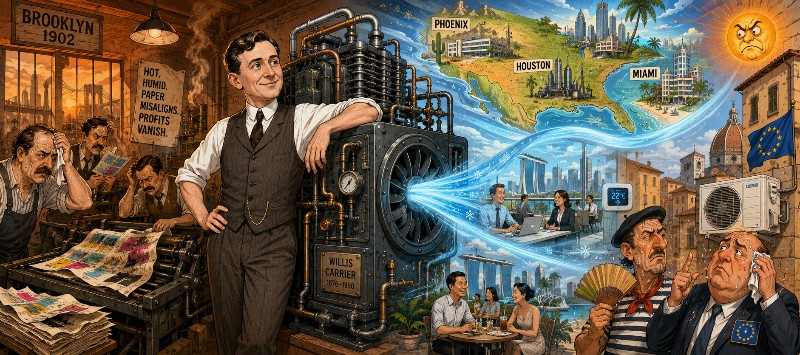
In the spring of 1902, a Brooklyn printer called Sackett & Wilhelms faced a crisis.
The company printed fine color work, including the humor magazine Judge. Color printing meant running the same sheet through the press several times, once for each ink.
The problem was that Brooklyn's humid summers caused the paper to swell and shrink between runs. As a result, the colors didn’t line up. Pages came out looking like a toddler's fingerpainting. Scrap piled up, deadlines slipped, and money burned.
The printer didn't need cool air. It needed dry air.
The job landed on the desk of a 25-year-old engineer at the Buffalo Forge Company, one year out of Cornell. His name was Willis Haviland Carrier.
Carrier's insight was simple and brilliant. His company had already made heating systems that blew air over steam-filled coils. What if you ran cold water through those coils instead?
Cold air holds less moisture than warm air. If humid air passes over chilled coils, the water magically falls out of it. You get dry air and, as a happy side effect, cool air, too.
Carrier submitted his drawings on July 17, 1902. Modern air conditioning was born, not to keep anyone comfortable, but to keep ink on paper.
By 1906, he had his patent, an "Apparatus for Treating Air." By 1911, he'd written the engineering formulas the whole industry still uses. By 1915, he and six colleagues had founded the Carrier Engineering Corporation.
Candymakers raced to sign up because chocolate melts quickly in humid weather. Next were the textile mills. Then movie theaters, which discovered that "cooled by refrigeration" sold more tickets in July than any movie star.
The comfort revolution had begun. Almost nobody understood how big it would get.
The Landes Case for Cold Air
Here's where our story graduates from trivia to economics.
David Landes, the great Harvard economic historian, opened his masterwork The Wealth and Poverty of Nations with an unfashionable argument: geography matters. Climate matters.
Rich countries cluster in the temperate zones. Poor countries cluster in the tropics. That's not a coincidence, Landes argued. Heat is a tax on human effort.
Hard labor in serious heat drains the body. Work slows, hours shrink, and everyone with the option retreats to the shade. For most of human history, the siesta wasn't laziness. It was survival. Whole civilizations organized themselves around the simple fact that man wilts at 95 degrees.
Carrier's machine repealed that law of nature. Landes pointed to air conditioning as the technology that broke the climate barrier, and to the American South as proof.
He wasn't alone. Lee Kuan Yew, the father of modern Singapore, called the air conditioner one of the most important inventions in history. He said it made development possible in the tropics, and one of his early moves in office was putting AC in the civil service buildings. He wanted his bureaucrats working at full speed at noon, not napping through the equatorial heat.
Having lived and worked in Singapore myself, I can confirm the man was right. Nobody builds a financial capital one degree north of the equator on ceiling fans.
The Sunbelt Miracle
Now look at what happened at home.
Before Carrier's invention spread, the American South was the poorest region in the country. Summers dictated everything. Factories struggled, offices emptied, and ambitious young people headed north.
Then the window unit arrived in the 1950s, and central air followed. The results were staggering.
Houston became the energy capital of the world. Atlanta became a corporate headquarters town. Phoenix grew from a dusty outpost of about 100,000 people in 1950 into one of America's largest cities. Florida turned from a swampy afterthought into a retirement paradise and the third most populous state in the Union.
Economists gave this migration a name: the Sunbelt boom. Millions of Americans and trillions in wealth moved toward the heat because an engineer from upstate New York had made it optional.
No air conditioning, no modern Texas. No modern Florida. No Phoenix, no Vegas, no Atlanta as we know them.
One humidity problem in a Brooklyn print shop reshaped the map of American prosperity.
Meanwhile, in Brussels
Europe knows all this. It simply refuses to act on it.
While thousands died this summer, officials across the continent urged citizens to use fans and drink water.
The German environment ministry warned against AC from its own climate-controlled headquarters.
The European Commission reportedly shut down the air conditioning on the lower floors of its Brussels building while keeping it humming on the upper floors, where the senior officials sit. One staffer called the arrangement "feudalism."
He wasn't wrong.
Germany shut down its nuclear plants, which made its grid dirtier and its power more expensive. This expensive, carbon-heavy electricity made AC look like a sin. Now the same officials who caused the problem lecture grandma about her fan settings. Each intervention sets up the next one.
To its credit, the French government just scrambled 100 million euros to put air conditioning in its hospitals. It took 20,000 deaths to buy what every Holiday Inn in Ohio installed decades ago.
Wrap Up
The next time someone sneers at American excess, at its frosty malls and arctic movie theaters, smile.
Your thermostat isn't a moral failing. It's a monument.
It stands for a country that saw a problem, solved it, sold the solution to the world, and got rich doing it. Willis Carrier never set out to change civilization. He set out to fix a printing press.
American abundance usually happens one practical fix at a time.
Europe will eventually come around. The heat has the final say.
Until then, set your thermostat to 72, pour something cold, and enjoy your week in comfort.
You Don't Own Your Stocks
Posted August 21, 2026
By Sean Ring

Buy Now, Pay Later
Posted August 20, 2026
By Sean Ring

The Empty Vault
Posted August 19, 2026
By Sean Ring

The $54.6 Billion Bottleneck
Posted August 18, 2026
By Sean Ring

Expensive Bread & Unaffordable Circuses
Posted August 17, 2026
By Matt Badiali