
Posted May 25, 2026

By Sean Ring
The Knowledge Problem
In March 2021, the Federal Reserve released its official inflation forecast.
Inflation would peak at 2.4% by year-end. Then subside. Completely under control. Nothing to worry about.
By December 2021, inflation hit 7%.
By June 2022, it hit 9.1%. The highest in 40 years.
The Federal Reserve — some 500 economists armed with PhDs, the most sophisticated monetary modeling infrastructure on earth, with access to every data point in the American economy — was wrong by a factor of 3.
This wasn’t a rounding error, nor was it bad luck or a black swan.
It was a predictable, inevitable consequence of something Friedrich von Hayek identified 80 years ago in what may be the most important economics paper ever written.
He called the problem the Use of Knowledge in Society.
Most people now call it the Knowledge Problem.
And once you understand it, you will never again trust an expert consensus the way you used to. Not because experts are stupid or corrupt, though some are.
But because the knowledge they claim to possess cannot exist in the form they claim to possess it.
The Unbuildable Library
Imagine you wanted to know the right price for a cup of coffee in Cincinnati on a Tuesday morning in November.
Simple question. What’s the price of one cup in one city?
To answer it correctly, you'd need to know:
- The current price of Arabica beans in Colombia.
- The fuel cost for the truck that delivered them.
- The lease rate for the café on Fourth Street.
- The barista's wage expectations, given her other options.
- The customer's mood, schedule, and how much she values the 15 minutes of warmth.
- The competing café two blocks away that just hired a better roaster.
- The weather, which affects foot traffic.
- The new office building opening next month that will bring 400 new customers to the neighborhood.
- And 10,000 other variables, each held in a different mind, each changing by the hour.
Now multiply that by 330 million people, by 10 million distinct goods and services, by 24 hours a day, and by 365 days a year.
That’s the information problem facing any central planner.
Hayek's simple, devastating, permanent insight was this:
The knowledge required to run an economy isn’t concentrated anywhere. It’s dispersed across millions of individual minds, embedded in constantly changing local circumstances, and largely impossible to articulate, even for those who hold it.
The coffee shop owner doesn't record why she charges $4.75 instead of $4.50. Her knowledge is tacit, intuited through years of experience. You can’t upload that to a government database.
The Fed's 500 economists can’t access that knowledge because it doesn't exist in an accessible form.
That information lives in prices.
When the market sets a price freely, it compresses all that dispersed, tacit, constantly changing knowledge into a single number that everyone can act on. The price of coffee reflects the Colombian weather, the barista's wage, the competitor down the block — all of it, automatically, without anyone having to know any of it explicitly.
That's the miracle of the price system. And it works. It aggregates and transmits more information than any human institution could ever consciously process.
And when the expert steps in and says I know better than this price, you don't replace the information.
You destroy it.
The Fatal Conceit
Hayek had a name for the belief that experts can consciously direct an economy better than dispersed price signals.
He called it the fatal conceit.
Fatal because it kills. Literally.
Experts ran the Soviet Union. Genuine experts — engineers, economists, planners with advanced degrees and total commitment to the project. They built the most comprehensive central planning apparatus in history. Gosplan employed thousands of statisticians processing millions of data points.
They still couldn't figure out how many shoes to make, in what sizes, for which regions.
Soviet citizens stood in lines for shoes that didn't fit because the planners in Moscow couldn’t access the dispersed local knowledge about what people in Vladivostok needed in October.
You might say, “That was the Soviets, an extreme case. It doesn't apply here.”
But the mechanism operates anywhere central planning overrides dispersed price signals, even in alleged market economies.
Two Expert Failures
The Fed's inflation call. 2021-2022.
We covered this. 2.4% forecast. 9.1% actual. The experts didn't see it coming because the information that would have predicted it was dispersed across the economy in exactly the way Hayek described. No model, no matter how sophisticated, could aggregate it in time.
The CDC's COVID response. 2020-2021.
The Centers for Disease Control issued guidance that changed weekly. Masks don't work. Masks are essential. Six feet of distance. Three feet is fine. Schools must close. Schools are safe. Outdoor transmission is a major risk. Outdoor transmission is negligible.
This was the Knowledge Problem in real time. The dispersed, local, constantly changing information about how a virus spread through communities, buildings, and ventilation systems couldn't be centralized fast enough for top-down guidance to be coherent.
The people who actually knew things, such as the ER nurses, the building managers, the school principals watching their specific student bodies, held knowledge the CDC couldn't access. The CDC issued mandates anyway.
Why They'll Never Admit It
Here's the uncomfortable part.
The Knowledge Problem isn't going away. The experts aren't going to read Hayek and stand down.
That’s because the problem is incentivized.
If the Fed admits it can’t forecast inflation with meaningful accuracy, then its entire institutional justification collapses. What is a central bank for, if not to manage the economy?
If the CDC admits it can’t issue reliable top-down guidance for a novel pathogen, then its authority evaporates.
If the IMF admits its models cannot capture how real humans in real communities respond to policy, then who needs the IMF?
The experts won’t admit this. They’ll convene more panels, publish more white papers, and hold more conferences in pleasant European cities.
And they’ll be wrong again. The experts will be systematically, predictably wrong about the things that matter most because those are precisely the things where dispersed local knowledge is richest and central modeling is blindest.
Hayek called this in 1945.
The parade of failures since has been his proof.
What Actually Works
Hayek wasn't arguing for chaos. He was saying that the only mechanism capable of aggregating dispersed knowledge across a complex economy is the price system… and that any institution claiming to improve on it needs to answer a very specific question:
Where is the knowledge coming from that your experts have, and the market doesn't?
In practice, there are narrow domains where centralized expertise genuinely adds value. Epidemiological surveillance is different from mandating how every school in America should respond to it. Monitoring systemic financial risk is different from setting the price of money for 330 million people.
The error isn't expertise. The error is believing that because expertise works in a laboratory, it works across an entire economy.
It can't be because the knowledge isn't in a lab.
Wrap Up
You now have a permanent framework for evaluating any expert claim about economic management.
Ask three questions.
One: Where is the knowledge this policy requires? Is it genuinely available to the planner? Or is it dispersed across millions of local actors who can't be surveyed in time?
Two: What price signal is this policy overriding? Every intervention overrides something. What information is being destroyed?
Three: What's the feedback mechanism? In a market, bad decisions get punished through losses. They self-correct (absent Fed intervention, of course). What punishes the expert when the central plan fails? If the answer is nothing, the incentives guarantee more failure.
The Knowledge Problem is everywhere. Seeing it isn’t cynicism or pessimism. It's the beginning of wisdom.
I hope you got something out of the Rude’s new map. The five concepts we covered (time preference, interventionism, capital consumption, malinvestment, and the knowledge problem) open up a new world for anyone who understands what to look for.

The False Boom
Posted May 22, 2026
By Sean Ring

Who Ate the Seed Corn?
Posted May 21, 2026
By Sean Ring
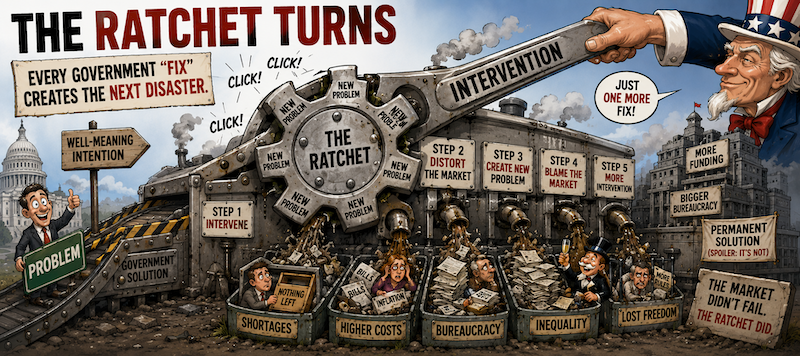
The Ratchet Turns
Posted May 20, 2026
By Sean Ring

The War on Waiting
Posted May 19, 2026
By Sean Ring

Dr. No: The Man With the Golden Parachute
Posted May 18, 2026
By Ray Blanco
