Posted July 10, 2026

By Sean Ring
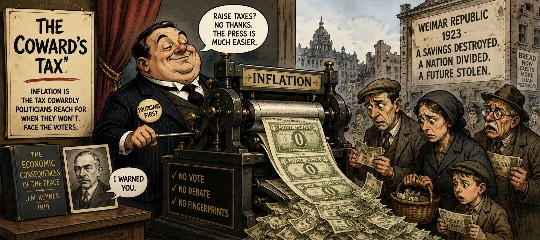
The Coward's Tax
In May 1919, John Maynard Keynes quit.
He was the senior Treasury man at the Paris Peace Conference. He had a seat in the room where the great powers carved up a beaten Germany. And he walked out, sick at what he saw, sure it would end in ruin.
Then he went home and wrote a book. The Economic Consequences of the Peace hit shelves that December. It sold like a thriller. It made him famous.
You don't have to love any of Keynes’ nonsense economics to tip your hat here. On this, he was right. Unfortunately, the men who could have listened waited until it no longer mattered.
You Heard the Story
The Allies (with the French at the forefront) stuck Germany with a bill it couldn't afford. Next, Germany fired up the printing press. Then, the mark turned to confetti.
In 1921, the reparations commission fixed the bill at 132 billion gold marks, a crushing figure. Yet Keynes had already spotted something sharper. Paying at home was one problem; paying abroad was another.
The Transfer Problem
To settle the debt, Germany couldn't just collect marks from Germans. It had to turn those marks into gold and foreign currency, which was money the Allies would actually take. And there was only one way to earn that: sell more abroad than you buy. Run large trade surpluses year after year and ship the proceeds west.
But the same countries demanding payment had walls up against German goods: Tariffs, quotas, and protected factories. They wanted the cash and slammed the door on the only way to earn it.
So the trap wasn't that Germany was too poor to pay, but that the system was built so it couldn't pay even if it could afford to. Keynes saw the whole rigged machine. The politicians saw a headline number and a cheering crowd.
Berlin Chose the Presses
Then came the part that gets blamed entirely on Versailles — and shouldn't be.
Germany printed, but not because a treaty forced its hand. Berlin chose the presses. It ran huge deficits and refused to tax its own people to close them. That was partly to keep peace at home, partly to prove to the Allies that payment was impossible.
Then, in 1923, France marched into the Ruhr to seize payment in coal and steel. Germany answered with a general strike and paid the striking workers with fresh printed money.
The result is the number you've seen on the old banknotes. By November 1923, a single dollar cost 4.2 trillion marks. Workers were paid twice a day and spent it before the ink dried. The careful, the thrifty, the people who did everything right, watched a lifetime of work vanish in a season.

Lapdog Loop
Posted July 09, 2026
By Sean Ring
China’s Touch of Death
Posted July 08, 2026
By Byron King

The Lowest Bar
Posted July 07, 2026
By Sean Ring

Silicon Valley Starts Underground
Posted July 06, 2026
By Matt Badiali
America’s Seapower Company
Posted July 04, 2026
By Byron King
