Posted June 12, 2026
By Ray Blanco
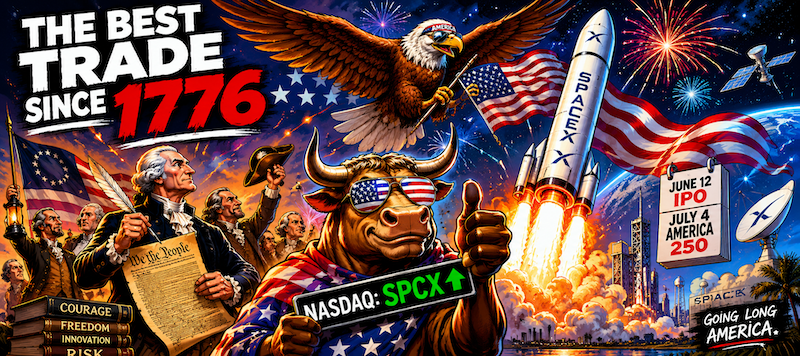
The Best Trade Since 1776
We’ve been kicking around for two and a half centuries.
We went from the Thirteen Colonies to a global superpower. We went from expanding into the western frontier to Armstrong walking on the Moon.
And then — for a while — something got stuck.
I think we all felt it. Peter Thiel put it best:
“We wanted flying cars; we got 140 characters.”
He wasn’t wrong. From roughly 1970 to 2010, the most powerful civilization in human history optimized for the virtual and the frictionless.
We went from atoms to bits. Apps. Platforms. The “knowledge economy” — which was, if we’re honest, a polite way to rebrand forgetting how to build things.
Frederick Jackson Turner saw this coming in 1893. When the frontier closes, he argued, something essential about America closes with it. The restlessness. The reinvention. The bias toward the impossible.
He was right, too. For a while.
Then a South African-Canadian with a physics degree and a messiah complex decided to go atoms.
Hard atoms.
The hardest atoms that exist — orbital mechanics, reusable rockets, the most unforgiving engineering environment in the known universe.
The frontier didn’t close. It just moved to higher ground.
And just before the 250th anniversary of this magnificent, infuriating, inexhaustible republic — it’s going public.
Ticker: SPCX
Exchange: Nasdaq
Valuation: $1.77 trillion
The listing date is June 12th. Independence Day is July 4th. Twenty-two days apart.
The most consequential American IPO in history opens for business three weeks before the country turns 250.
That's not a coincidence. That's a timestamp.
Let’s be clear about what SpaceX actually is.
It’s not a rocket company. It isn’t a satellite internet company.
It’s not even, really, a technology company in the way Wall Street calls it.
SpaceX is what America looks like when it stops apologizing for its ambitions.
The original American project was an act of civilizational audacity. A handful of farmers, lawyers, and printers in Philadelphia decided the old order — the one that controlled trade routes, taxation, and the terms of human movement — was finished.
They were outgunned, outfinanced, and given no chance by the consensus of their time.
They gave the most powerful empire on earth the finger and made it stick.
Sound familiar?
When Elon Musk founded SpaceX in 2002, NASA gave him six months before he’d quit.
The aerospace establishment — Boeing, Lockheed, the whole cost-plus cartel bleeding the government dry — dismissed him completely.
Three rockets blew up, and bankruptcy was howling just outside the door. But the fourth one made orbit and changed everything.
The Founders didn’t win on the first try either.
This is what American reinvention actually looks like up close.
It’s ugly. It’s expensive. It fails publicly and spectacularly.
And then it works — at a scale and speed that leaves the old order standing in the rubble of its own certainty.
There’s a certain type of investor who looks at SpaceX at $1.75 trillion and sees a bubble.
They see Musk risk. Execution risk. Valuation risk. Geopolitical risk. They build their bear case in a spreadsheet and feel very smart about it.
They are making the same mistake people have made about America every single generation.
In 1776, the smart money was on the Crown. In 1863, the smart money was on disunion. In 1941, the smart money was on the Axis. In 1979, the smart money was on Soviet supremacy and American decline. In 2002, the smart money was on NASA and the cost-plus cartel.
The smart money has a perfect record of being wrong about America at the moments that matter most.
Because they always do the same thing: they look at where America is and extrapolate forward.
They never account for what America does — which is to reinvent itself, violently and repeatedly, the moment the old frontier closes, and a new one opens.
The America shorts never learn this lesson. They see the explosions and miss the trajectory. They see the valuation and miss the frontier.
SpaceX is not a bet on Elon Musk. It’s not even a bet on rockets.
It’s a bet on the oldest trade in financial history.
Going long America. 🇺🇸🚀
Happy 250th, America.
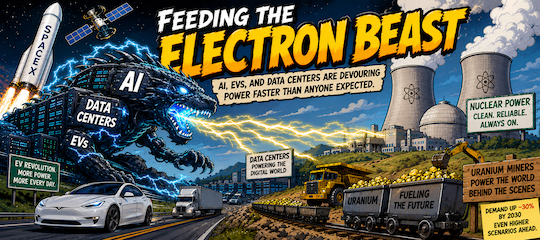
Feeding the Electron Beast
Posted June 11, 2026
By Matt Badiali
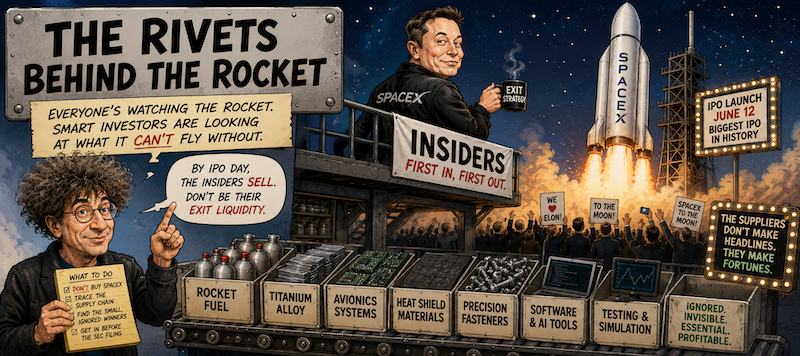
The Rivets Behind the Rocket
Posted June 10, 2026
By James Altucher

One Small Float for Man
Posted June 09, 2026
By Byron King
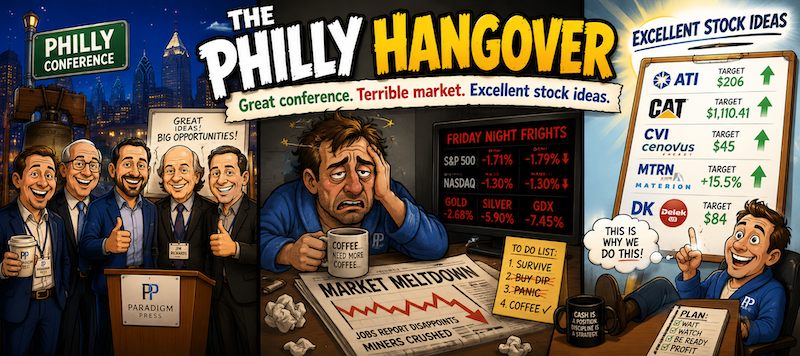
The Philly Hangover
Posted June 08, 2026
By Sean Ring

The Philadelphia Stories
Posted June 05, 2026
By Sean Ring
