Posted November 04, 2026

By Sean Ring
The 87% Solution
At 8 AM Friday morning, the London Stock Exchange opened. A little product called INT3 was already in the ditch.
INT3 is a 3x leveraged bet on Intel. It promises three times Intel’s daily move. If Intel rises 5%, you make 15%. If it falls 5%, you lose 15%.
On Thursday night, Intel told Wall Street its next quarter would come in light. On Friday, the stock fell 28.6%. It was Intel’s worst day since the 1970s.
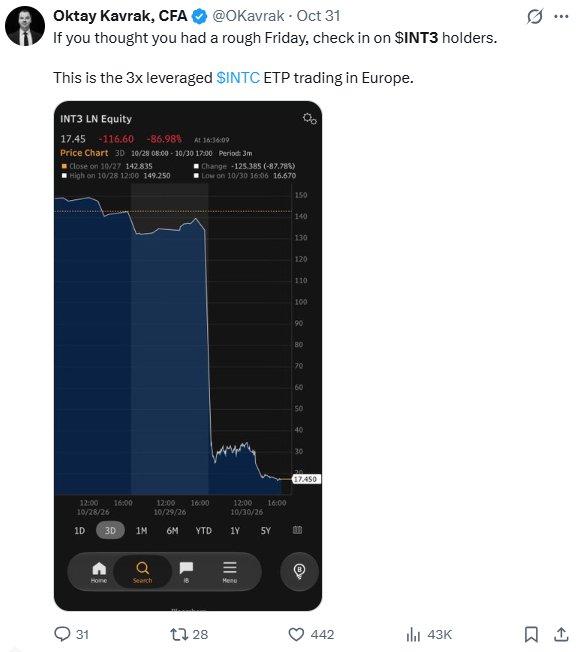
But INT3 fell a whopping 87%.
If you held $10,000 of it Thursday afternoon, you had about $1,300 by Friday’s close.
An analyst named Oktay Kavrak posted the chart on X with a line that made me laugh out loud. He wrote, “If you thought your Friday was rough, check in on the INT3 holders.”
 Credit: @OKavrak
The Airbag
Let's do some nightmare math for the issuer. Three times a 33.3% drop is a 100% drop. So if Intel ever fell a third in a day, INT3 would go to zero.
So Leverage Shares, the Dublin-based issuer, built in an airbag. If Intel falls 16.67% from the prior close during the day, the issuer rebalances on the spot. It cuts the exposure, so a second leg down can’t finish the job.
On a normal bad day, that works. Intel slides, the airbag fires, and the product lives to trade tomorrow.
Friday wasn’t a normal bad day. In fact, it was less a “gap down” than a “yawning chasm.”
Intel reported at 8 p.m. London time on Thursday. London opened at 8 a.m. Friday. But the New York market didn’t open until 1:30 p.m. London time.
For five and a half hours, INT3 traded in London while the shares it tracked sat behind a locked door. Dealers priced it off the premarket, where Intel was already down more than 20%.
When the bell finally rang in New York, Intel’s first trade printed at $68.41. That was down 25.7% from Thursday’s close of $92.07. The airbag fired one second later.
By then, it was too late. Leverage Shares sold the position at an average of $65.50, resetting INT3’s value to $17.80. Thursday’s price had been above $134.
An airbag is built for a skid. It does little once the car is already through the wall.
Both Sides of the Road
You might think the smart move was to bet the other way. Leverage Shares sells that, too. It’s called the -3x Short Intel.
Here’s how that went. Intel nearly quadrupled from January to its late-June record. The short product got crushed so hard that in June, the issuer glued 333 old units into one new one. That’s a reverse split, and you don’t do one of those when things are going well.
So in one year, Intel crushed the bears by June and the bulls in October. The issuer collected its 0.75% annual fee from both.
I don’t say that to call anyone a crook. The products do what the prospectus says. The trouble is that most buyers never read the prospectus.
Why DC Says No
In America, you can’t buy a 3x single-stock fund. The SEC holds most new funds to 2x under a rule called 18f-4. Last year, issuers filed for 3x and even 5x funds. The SEC sent warning letters and told them to fix the filings or pull them.
Europe gets around this with packaging. INT3 is a note, a kind of debt, issued by an Irish company. That lets the issuers offer 3x on single stocks and 5x on indexes like the Nasdaq 100 and the FTSE 100. Leverage Shares lists more than 180 of them.
You know I’m no fan of regulators deciding what grown adults can buy. I’d rather you be free and informed than shielded and ignorant.
But being free means doing your own math. Here’s some more math from Morningstar’s Bryan Armour:
Indeed, 13% of the 518 single-stock ETFs in my study have already closed. Of these 65 ETFs, the median lost 25% and lasted just 206 days on the market.
The greater the volatility of the underlying security, the faster the ETF performance decays. It’s partly why 24% of all leveraged ETFs—not just single-stock ETFs—that launched over three years ago have lost over 90% of their value.
The River Runs Four Feet Deep
Author and professor Nassim Taleb warns people never to cross a river because it’s four feet deep on average. The average doesn’t drown you. The one deep spot does.
A 3x product doesn’t own Intel’s average day. It owns every day, one after another, including the deepest one. And it only takes one.
Look at what each holder needs to get back to even. Intel’s plain shareholders need a 40% gain. That hurts, but a good quarter or two could do it.
INT3 holders need a gain of about 680% to break even.
Plain Intel stockholders had an awful Friday. INT3 holders had a fatal one.
Wrap Up
Prudence is the charioteer of the virtues. It holds the reins so the other horses don’t run you off a cliff. In markets, prudence looks boring. That’s the point.
If you want a big bet on a big idea, buy a call option. See my colleagues Alan Knuckman and Nick Riso about them. They know their stuff.
If you’re in doubt, own the real thing. Shares in a business can come back from a bad day. A product that loses 87% in one session mostly can’t, which is why I never trade leveraged ETFs.
Now you have the math on these things. I’m thrilled you watched the crash test from a safe distance.

Warsaw Unpacked
Posted November 03, 2026
By Sean Ring

A Crude Tax
Posted November 02, 2026
By Sean Ring

You Can't Eat Conviction
Posted October 30, 2026
By Sean Ring

In God We Trust. In Gold We Hedge.
Posted October 29, 2026
By Matt Badiali

Make America Make Again
Posted October 28, 2026
By Sean Ring