Posted July 29, 2026

By Sean Ring
Sacrifice Arbitrage
JP Morgan CEO Jamie Dimon has a plan for the Iran war: You pay for it.
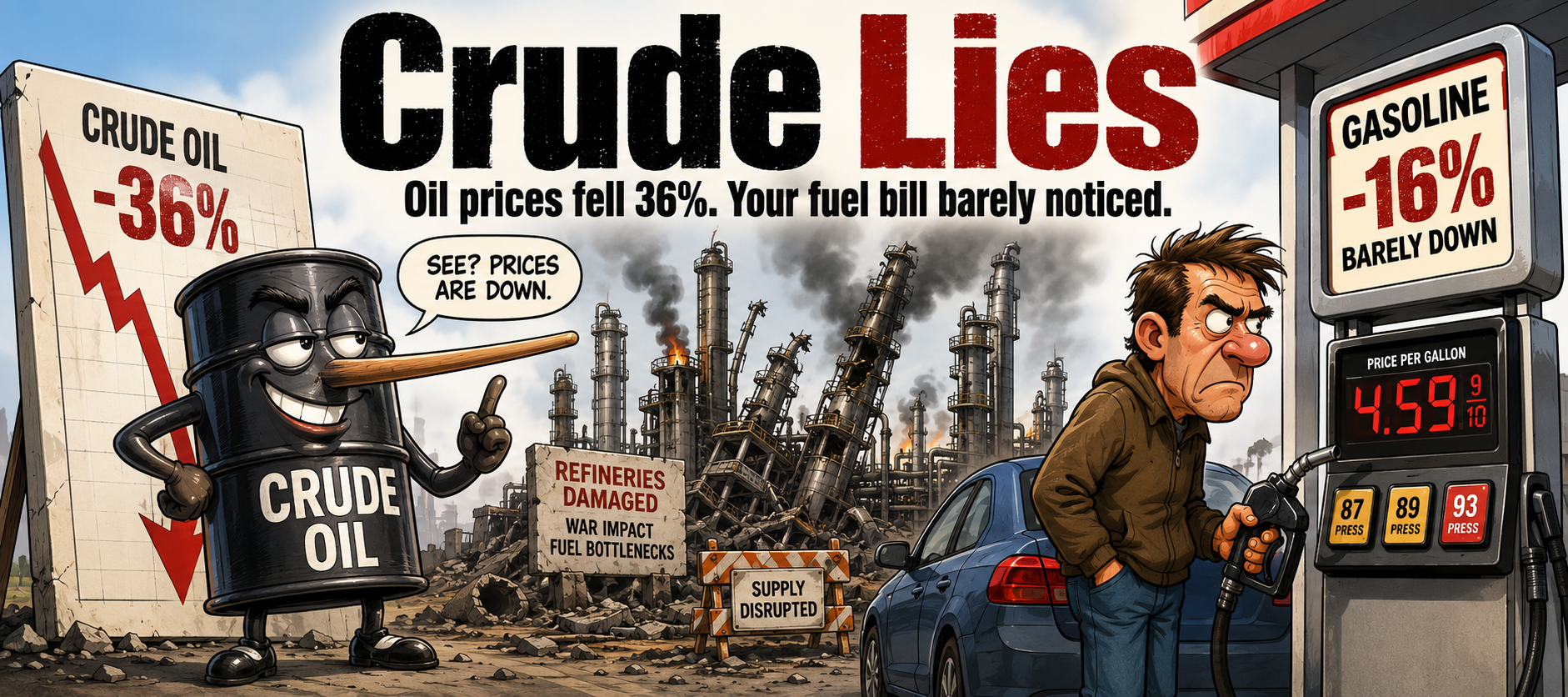
This month, the national average for a gallon of gas crossed $4.00 for the first time since 2022. In plenty of states, it's a good deal higher. You felt that at every fill-up. Every delivery. Every grocery run that rode in on a diesel truck.
Dimon didn't feel a thing.
The head of America's largest bank runs his empire from a gleaming new tower on Park Avenue. To a man in that chair, the price at the pump is a rounding error. He could fill every tank in his motorcade for what he spends on lunch.
And from that height, he has been telling the rest of us to tough it out.
The Case He Makes
Dimon came out for the war plainly. He said tolerating Iran for 45 years was “kind of beyond me.” He pointed to the ballistic missiles, the funded proxies, and the long march toward a bomb.
And he's not wrong that a nuclear-armed Iran would be an ugly thing. Reasonable, patriotic people can look at that threat and decide it must be faced. That's a fair argument. Hold onto it.
Because the war isn't the tell, it’s who he nominated to pay for it.
The Skunk He Can't Smell
Asked about Americans who already feel like they're in a recession, Dimon didn't dodge. He agreed. For parts of society “not doing very well,” he said, “I completely acknowledge that.”
Then he argued we press on anyway with higher gas and stickier inflation. A year of it, if that's the price.
In his shareholder letter, he called the coming inflation “the skunk at the garden party.”
Nice line. Here's the problem: he's not the one who'll smell it.
The Sacrifice Arbitrage
Arbitrage is when you buy a thing cheaply in one place and sell it expensively in another, pocketing the spread. It's the oldest trade on Wall Street.
Dimon has found a new one. Call it the sacrifice arbitrage.
The sacrifice is cheap for him and expensive for you. He supplies the sacrifice, while you supply the suffering. He keeps the spread.
Remember, Dimon doesn't have to skip a vacation, delay a repair, or juggle a grocery list to endorse this year of pain. He just says °resolve° and is happy to let 150 million other people carry it.
“Give Me Your Money, Or Your Kids Get It!”
Dimon frames it as a hard choice. If we squeeze Iran's economy and let the pressure grind for a year, we avoid the other thing: American boots on the ground… which means American kids coming home in boxes. Pay at the pump, he says, and we won't have to pay in blood.
Sounds generous. Except it isn't.
Look hard at the menu. Column one: you pay with higher gas, higher prices, a thinner paycheck for a year. Column two: you pay with your sons and daughters. Two options. Same customer. You.
That's the false choice. He dresses it up as picking the cheaper bill. But both bills are mailed to the same house — yours. In neither column does the man offering the choice put in a dime. He doesn't fill a tank. He doesn't send a child. He just decides which way you bleed and calls it prudence.
A real menu would have a third column. The one where the people who wanted this war, and who profit most from the order it protects, carry a real piece of the cost themselves.
Unfortunately, the war profiteers never print that column.
Whose Bill Is It, Really?
Wars get paid for with printed money and higher prices. And that bill never lands evenly. It hits the wage earner and the saver first — the people furthest from the money spigot. It touches the asset-rich last, if it touches them at all.
Dimon sits closer to that spigot than almost anyone alive.
The same machine that has quietly moved wealth upward for 20 years is the machine he's now asking you to salute. Cheap money floats his assets. Rising prices sink your paycheck. He calls that a trade-off worth making.
Of course he does. He's on the right side of it.
An Older Word Than “Unfair”
Medieval thinkers called it a failure of distributive justice. Authority exists to carry the common good and spread the burden of the community, not to shove it onto the shoulders least able to hold it and least asked for their opinion.
A leader who orders a sacrifice he will never feel, for people who were never consulted, isn't leading.
He's billing.
Getting Used
Now, you love America. You'd carry your fair share of a real burden and never say a word. That's who reads the Rude. That instinct is honorable.
And it's the instinct that others use.
The men who benefit most from your willingness to sacrifice are the ones who quietly arrange to never sacrifice themselves. Perhaps you’ve always sensed that the loudest voices for “toughing it out” were the ones who'd never feel the tough part.
Remember, leaders answer to the small circle that keeps them in power. The taxpayer at the pump was never in that room. He just gets the invoice slid under the door.
Wrap Up
You can't lower the price of gas by being angry at a banker, so don't waste the energy.
nInstead, Learn to name the trade the second you see it. When a man insulated from a cost tells you to carry the cost, ask him the one question that ends the con:
What will it cost you?
If the answer is “nothing,” you've discovered the true trade.
Then position accordingly. If oil stays bid on Hormuz risk, energy is the rare place where the pain and your portfolio point the same way. Own it.
As I’ve long said, you can’t save the world, but you can save yourself.
You get to keep the dignity of a man who would sacrifice for something real and who flatly refuses to be volunteered for something that just pads another man's bonus.
The pump doesn't lie. Watch who flinches when the number climbs.

The Last Great Crack
Posted July 28, 2026
By Matt Badiali

The Consent Nobody Gave
Posted July 27, 2026
By Sean Ring

The Market Nobody Ordered
Posted July 24, 2026
By Sean Ring
The Magic Pill’s Real Trick
Posted July 23, 2026
By Ray Blanco
Dead Cat Bounces
Posted July 22, 2026
By Sean Ring