Posted September 03, 2026

By Sean Ring
Obey, But Don’t Comply
I was walking down Bilbao’s main shopping street with Pam and Micah on Monday evening, dodging shoppers, tourists, and cafe umbrellas, when a familiar face stopped me cold.
It was none other than John Adams’ wizened old mug. In bronze, on a stone plinth, in the middle of Basque Country.
It wasn’t the Francophile Jefferson, nor Franklin, the celebrity. It was Adams, the grumpy, unfashionable, indispensable one. He was the man Congress sent wherever nobody else wanted to go.
The plaque quotes him. “This extraordinary people have preserved their ancient language, genius, laws, government and manners without innovation, longer than any other nation of Europe.”
So why does a Basque city in northern Spain keep a monument to America’s second president?
Because Adams found something here in 1780 that most economists still haven’t figured out: Liberty isn’t a feeling or a predisposition. It’s a mechanism.
Today, I’ll show you that mechanism. The Basques ran it for 5 centuries. They called it the fueros, and it made kings ask permission.
The Worst Business Trip in American History
First, how did Adams get here?
In November 1779, Congress sent Adams back to Europe to negotiate peace with Britain, whenever Britain got around to losing. He sailed on the French frigate Sensible with his sons John Quincy and Charles.
The ship sprang a leak in the mid-Atlantic. Passengers took shifts at the pumps. The captain made for the nearest friendly port, El Ferrol, on Spain's northwest tip. They landed in December.
Paris was a thousand miles away, overland, in winter, and across the Cantabrian mountains.
Adams bought mules and carriages and set off with his two boys through mud and ice. They slept at inns that were barely fit for animals. The trip took weeks.
Then, in mid-January 1780, he came down out of the hills into Bilbao.
Everything changed.
Here was a clean, busy, prosperous merchant port, full of warehouses, working shipyards, and competent traders. After weeks of misery, Adams had stumbled into one of the richest little corners of Europe.
He asked the question every good traveler asks. Why here?
The House That Armed the Revolution
His hosts had part of the answer.
Adams stayed with the house of Joseph Gardoqui and Sons, Bilbao's most powerful merchant family. If the name doesn't ring a bell, that’s fine.
Before France signed anything, and before Spain officially joined the war, the Gardoquis were quietly shipping muskets, gunpowder, blankets, and shoes to the American rebels.
Much of it moved through this very port. Bilbao was a supply line for the American Revolution while London still thought the whole thing would blow over.
Diego de Gardoqui, the son who showed Adams around town, later became Spain's first minister to the United States. He stood near Washington at the first inauguration. The link between this city and the American founding is genuine, and we’ve got the shipping records to prove it.
But the merchants weren't the real story. The real story was the system they lived under.
The Mechanism
Biscay was technically under the Spanish crown. In practice, it ran itself. The instrument was the fueros, ancient written charters that spelled out what the sovereign could and couldn't do here.
Consider what those charters actually said.
No taxation without local consent. The crown couldn't levy a new tax on Biscay. It had to ask the Juntas Generales, the assembly of local delegates who met under an oak tree in Gernika.
The king swore first. Before a new monarch could exercise authority as Lord of Biscay, he or his agent had to stand under that tree and swear to uphold the fueros. The oath came before the obedience.
And then the right of refusal. This one is my favorite. Under the pase foral, if a royal decree violated the charters, the Basques could set it aside with a magnificent formula. Se obedece, pero no se cumple. “It is obeyed but not complied with.”
We honor you, Your Majesty, but your order goes in the drawer.
Add customs autonomy, an exemption from forced military service beyond their borders, and universal nobility, meaning every Biscayan was legally an hidalgo and equal before the law, and you get something remarkable: A constitutional order inside an absolute monarchy.
While Madrid ran on divine right, Bilbao ran on a contract, and the contract had teeth.
What Adams Did With It
Adams filed all of this away. Seven years later, he came out swinging.
In 1787, while the Constitutional Convention was meeting in Philadelphia, Adams published ADefence of the Constitutions of Government of the United States of America from London. It's a giant survey of every republic he could find, ancient and modern. Letter IV is Biscay.
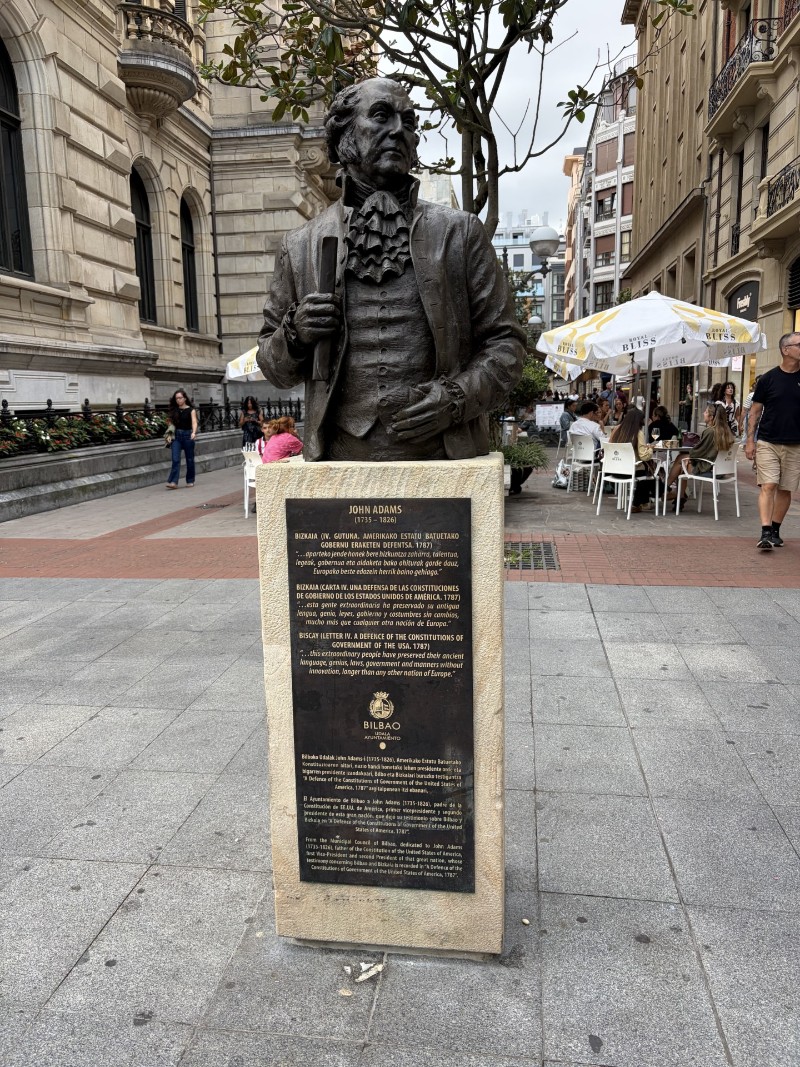 The John Adams statue in Bilbao. Credit: Sean Ring
That’s the letter quoted on the statue. Structure, not luck or virtue, preserved the oldest free people in Europe.
Now, Adams being Adams, he didn't gush. He looked under the hood and noted that Biscay's "democracy" was really run by a narrow set of landed families. The assemblies were real, but the winning coalition was small.
Yet Adams told the delegates in Philadelphia what they needed to hear. Parchment protects nothing. The fueros worked because strong institutions enforced them. Power negotiated because it had to.
Checks and balances aren’t an American invention. Adams saw a working model on his way to Paris, run by shepherds and shipbuilders, older than the printing press, and ran with it.
How It Died
So what happened? The same thing that always happens. The center won.
Madrid spent the 19th century centralizing, and the Basques spent it fighting back. They picked the losing side in the Carlist Wars, in part, to defend their charters. After the final defeat in 1876, the Spanish government abolished the fueros outright.
Five hundred years of contract, gone by decree. Centralizers are patient. They only have to win once.
But here’s the twist the Rude exists to reveal. The mechanism didn’t die. It merely changed shape.
Two years later, Madrid and the Basque provinces struck the concierto economico, the economic agreement. It survives to this day, with interruptions. Franco punished Bizkaia and Gipuzkoa by revoking theirs. Democracy gave it back.
Under the concierto, the three Basque provinces collect almost all major taxes, including income, corporate, VAT, and excise taxes. Social security and customs stay with Madrid. What’s left over goes north as the cupo, a fixed 6.24% share of everything the State still does for them.
That’s the opposite of how most of the rest of the world works. The capital usually collects, and the regions beg. Here, the region collects, and the capital sends an invoice. The money flows uphill.
Whoever collects the taxes holds the leverage. Every negotiation starts from that fact. The Basques understood it 500 years before public choice theory got tenure. It's why this remains one of the wealthiest, most industrial corners of Spain. It’s also why every other Spanish region quietly envies the deal.
Wrap Up
Adams left Bilbao in late January 1780 and made his way to Paris, where the glamorous diplomatic work was. But Biscay stayed with him.
The lesson he carried home is simple. Liberty survives where power is forced to negotiate.
Sentiment fades. Virtue fails. But mechanisms can endure for 5 centuries if you build them right and defend them like your mother tongue depends on it.
The Basques kept their language, laws, and tax authority through empires, wars, and one very determined dictator. That's proper constitutional engineering.
And somewhere on a shopping street in Bilbao, between a cafe terrace and a department store, stands the crankiest of the Founders. He’s honored not for what he wrote about America, but for what he learned and relayed about the Basque people.
Have a great day ahead.
The Straitjacket
Posted September 02, 2026
By Jim Rickards

Sell Promises, Buy Things
Posted September 01, 2026
By Sean Ring

The Smoke Detector Is Beeping
Posted August 31, 2026
By Sean Ring

Play the Ball, Not the Referee
Posted August 28, 2026
By Sean Ring
Gentleman’s Price Control
Posted August 27, 2026
By Sean Ring