
Posted May 15, 2026

By Matt Badiali
Mine Games
In 2008, I packed up my family and moved to Vancouver, British Columbia. For them, it was an extended vacation. An exotic locale as far from their home as they’d ever been. For me, it was an intense job training program.
I spent that time borrowing a cubicle from a well-known mining company expert. He was a self-proclaimed lender of last resort. He wrote “save the company” checks when no other investors would. And he made a fortune from that business. But he loved nothing more than putting on a proverbial green eyeshade and digging into the books.
I spent my days in Vancouver walking from one mining company to another. I listened to all their pitches, collected stories, and parsed what I thought was good from what I thought wasn’t.
And then I’d take the best stories back to the office. Every so often, the mining company expert would invite me into his office to tell him what I found. He’d often let out his iconic chuckle and say, “This is how ol’ Charlie fooled you…”
And off we’d go.
Ore Else?
I learned more about dodgy half-truths and spin that summer than I ever thought existed. We’d diagram drill hole patterns. Talk about economic rock versus uneconomic rock. But the thing that got him mad, like “fire your ass mad,” was something called “G&A.”
G&A stands for general and administrative expenses. It’s a very bland name that hides a multitude of sins. And with junior mining companies, that’s where they hide all the costs they don’t want to detail.
When we’d go over a company’s books, he’d look there first.
Here’s the thing: junior mining companies have no revenue. They don’t sell anything. They are pure research. The goal is to find something of value, worth more per share than the investors paid.
My friend’s goal was to identify companies that had a real chance of doubling their money in a year and could potentially make 1,000% if they were ultimately successful. The companies that spent the bulk of their money on G&A aren’t likely to do that.
He saw excessive G&A as corporate mismanagement. And I’ve come to agree with him. During the lean years, it wasn’t as big a problem. You couldn’t raise enough money to spend it wastefully. But today it’s game on.
One particularly egregious example came across my desk recently. If you follow junior mining companies, you probably saw some of their marketing. Lord knows they paid a fortune for it.
West Red Lake Gold (TSXV: WRLG) is a small gold miner operating the Madsen mine in Red Lake, Ontario. The company runs some tricky numbers. You see, they publish an “All In Sustaining Cost” of $2,800 to $3,600 per ounce of gold. That’s supposed to be the cost of everything. But they call it “Mine AISC” and don’t add in G&A… And they spent a ton of money on G&A.
In 2025, the company earned $103.4 million in revenue. They generated $45.2 million in income from that revenue. Out of that $45.2 million, they spent $13.6 million on G&A.
That’s 13% of top-line revenue and a whopping 30% of operating income. However, we know where much of it went.
Prospector Or Pretender?
Like most junior mining companies, West Red Lake uses paid marketing services. These companies all claim to be able to extend the reach of news reports. And many of these companies will write truthy articles puffing up the company and its assets.
They are essential when you’re a small company seeking traction in the mining sector. However, most companies approach them like you would a luxury item. You spend the money strategically.
That’s not what West Red Lake did. The company went much further than most. They paid for a dozen pieces over the past year. As well as several sponsorships, videos, and sponsored reports across multiple marketing platforms.
By my best estimate, this company dropped around $10 million on paid advertising in the past year. They enticed a lot of investors. And then failed to deliver the goods:
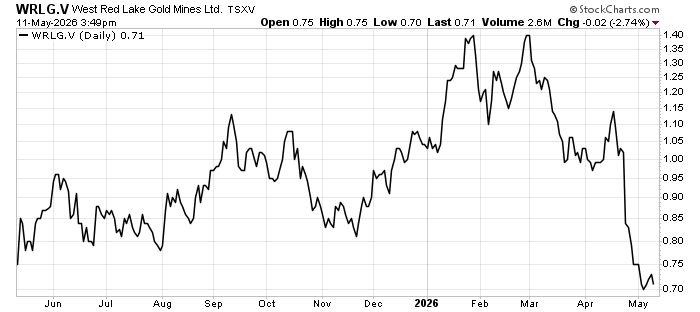
That resulted in a massive collapse in the share price.
Wrap Up
The dichotomy of glowing marketing copy, $10 million spent on something other than the rocks, and the failure to perform is why investors hate junior mining companies.
They told us that it costs up to $3,600 per ounce of gold production. And that’s quite high. Which is probably why they didn’t include G&A in the number.
But if they did spend $10 million on marketing, then that is $500 per ounce of gold that they failed to disclose in their AISC. So that jumps to $4,100 per ounce. That’s more than double the high-end estimates among its peers.
Regardless of how much they spent on marketing, failing to include G&A in the AISC is deceptive. Sneaky isn’t a good quality in management. It’s a bad look, and it reflects poorly on the whole sector.

Micron: Impossible
Posted May 14, 2026
By Nick Riso

Not All Who Wander Are Behind
Posted May 13, 2026
By Sean Ring

Music for Nothing and Your Streams for Free
Posted May 12, 2026
By Sean Ring

Keto by Force
Posted May 11, 2026
By Matt Badiali

Fake Crazy, Change the World
Posted May 08, 2026
By Sean Ring
