Posted October 08, 2026

By Sean Ring
Just Blew It.
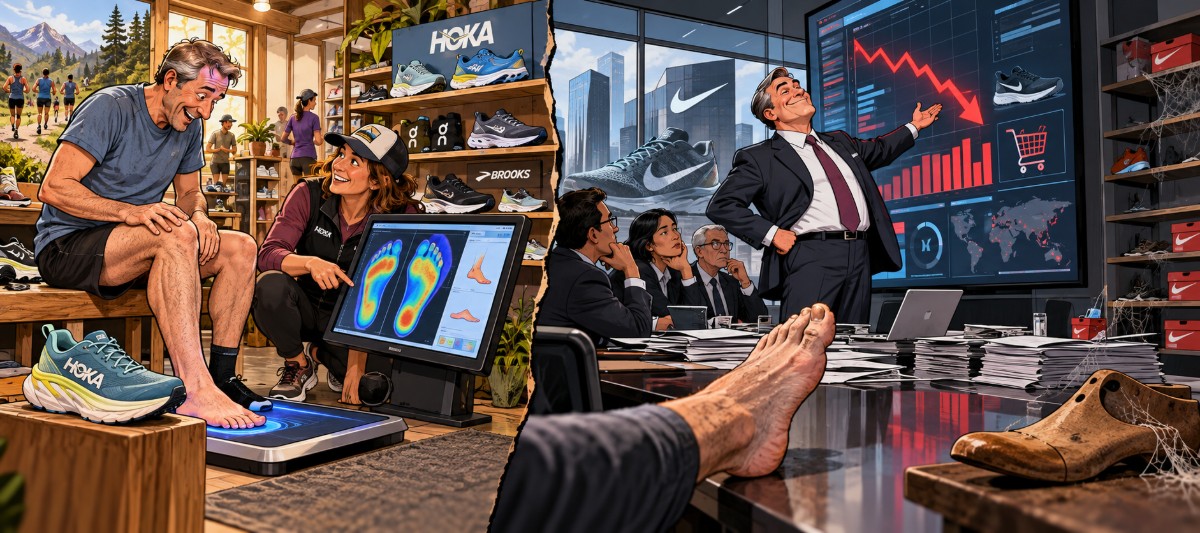
This summer, the machine in the Hoka flagship store on 5th Avenue in New York asked me one question before it measured me.
What will you use these shoes for?
Filled with the skepticism of a man who changes his workout routine weekly, I pressed the “running” button. Then I stepped onto the scanner, and it mapped both my feet in 3D – length, width, height, and arch.
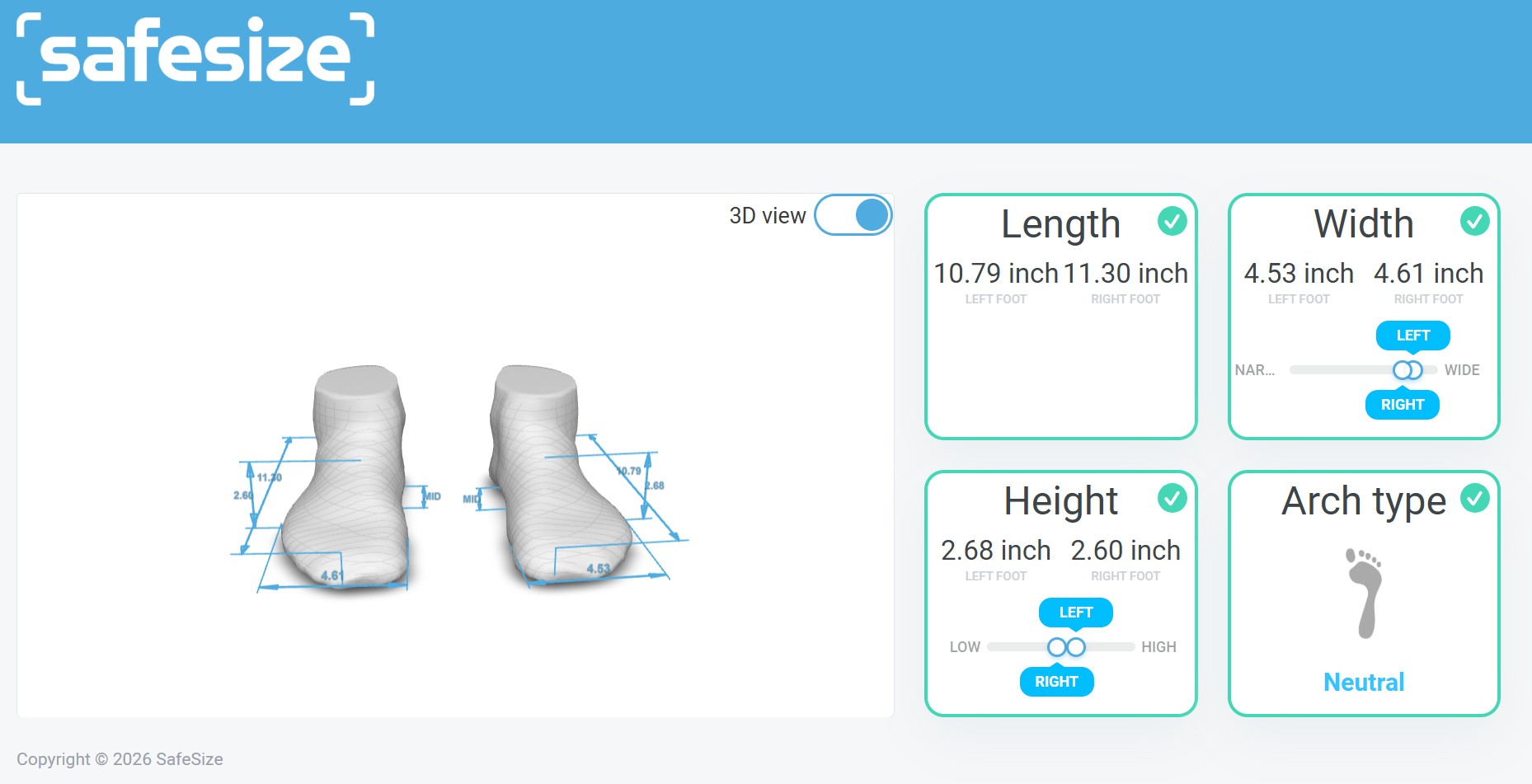
My uneven feet, courtesy of Hoka. Credit: Hoka and SafeSize
After this wondrous exhibition of modern technology, the machine recommended a handful of shoes best built for my feet. To be sure, the sneakers wouldn’t be tailor-made. But they’d be the best the company can offer for my profile.
I walked out of the store with a pair that ran about $160. That’s what a decent pair of Nikes costs. They’re the most comfortable sneakers I’ve ever owned. I know they’ll last because shoes made for your feet aren’t stressed and worn out like standard shoes.
The Mighty Has Fallen
Thirty-five years and fourscore pounds ago, I played football and ran track in high school. Back then, Nike was the brand to wear. Nothing else came close, not even those upstarts at Reebok.
How the scoreboard has changed!
Nike's stock peaked at $179.10 in November 2021. Last week, after its latest earnings report, it slid to about $32. That’s an 80% swan dive. The shares now trade where they did in 2014.
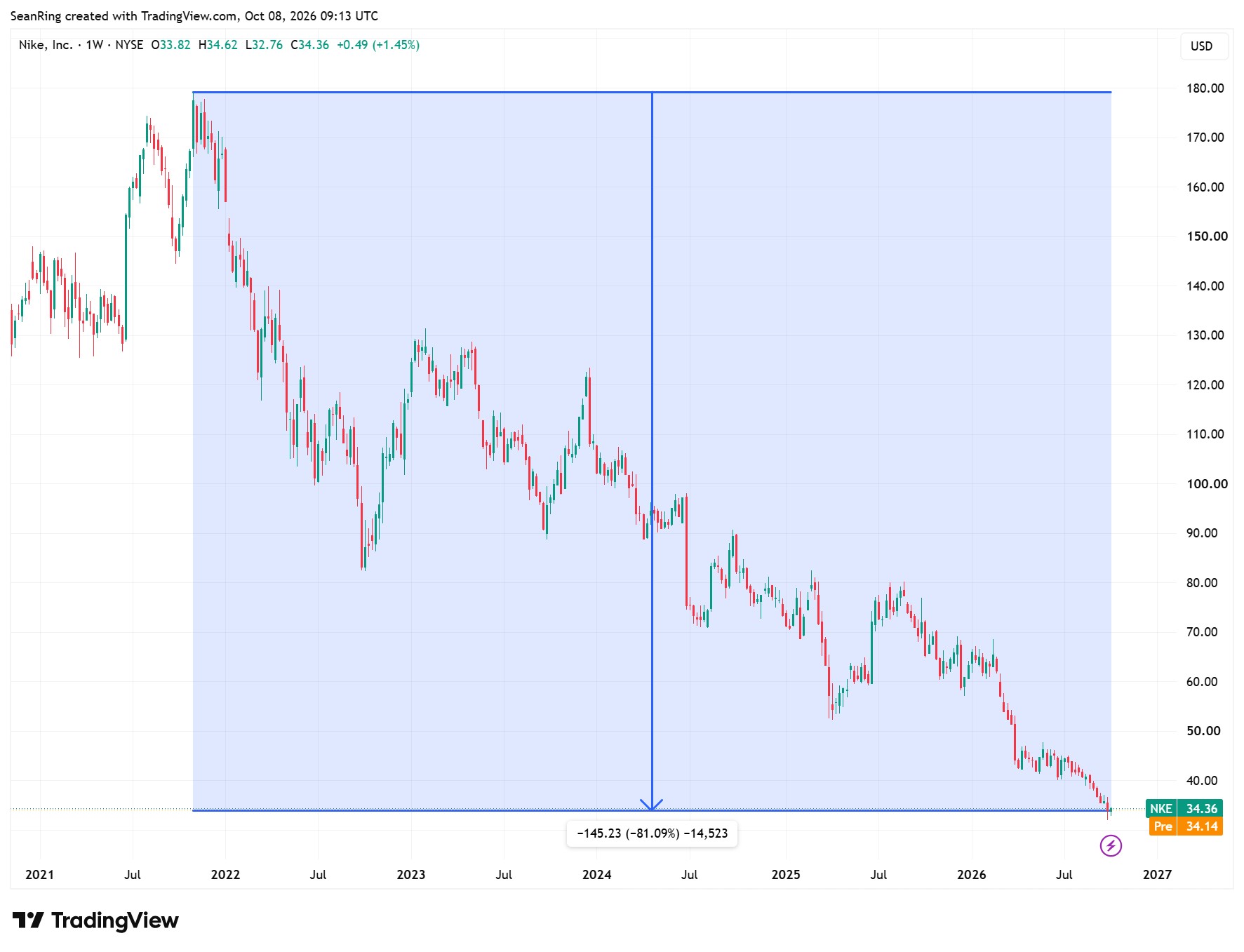
NKE fell 81.09% from peak to trough over 5 years. Credit: TradingView
Nike told investors last Thursday that sales will fall by a high-single-digit percentage this fiscal year. Quarterly revenue fell 4% to $11.2 billion. Sales in China have now fallen for 9 straight quarters.
Hoka went the other way. Its revenue grew 16% last fiscal year to nearly $2.6 billion. In 2020, it was $352 million.
How does the most famous shoe company on earth lose the very people it was built for?
It forgot the last.
The Wooden Foot
Long before scanners, cobblers carved a last for each customer. A last is a wooden model of your foot. The cobbler built your shoe around it. Every bump and quirk of your foot lived in that block of wood.
The last held knowledge. It was local, specific, and personal. You couldn’t get it from a ledger. You got it by holding the foot.
Nike was born that way. Bill Bowerman coached track at the University of Oregon. He tore shoes apart and rebuilt them by hand for his runners. In 1971, he poured rubber into his wife's waffle iron to make a better sole. One of his former runners, some guy named Phil Knight, sold shoes out of his car at track meets.
That was a company that held the foot.
Hoka’s scanner is a digital last. It doesn’t make Hoka smarter than Nike. But it puts Hoka closer to you.
The Spreadsheet Takeover
In January 2020, Nike made John Donahoe its CEO. He had run eBay and the software firm ServiceNow. He was a sharp operator who saw the world through data.
His plan had a name: Consumer Direct Acceleration. Sell through Nike's own app, website, and stores. Cut out the middleman. Keep the full margin. Own the customer data.
On paper, it worked. Nike said it could make more than double its profit selling through its own channels than through a retailer. So it cut about half its wholesale partners, many of them small independent shops. It pulled back from Foot Locker and cut off Macy’s and DSW.
Wall Street loved it. Online sales soared during the lockdowns. The stock hit its all-time high in late 2021.
Then shoppers walked back into stores.
Who Held the Knowledge
The spreadsheet missed something. It always does.
The guy at your local running store held knowledge Nike couldn’t buy. He watched you jog across the floor. He knew which shoe the marathon crowd in his town swore by this year. Nobody writes that stuff down anywhere. That knowledge lives in the eyes and hands of the salesman.
These details are scattered across millions of people and places. No one office can gather them all. Yes, it’s Hayek’s knowledge problem all over again, this time biting Nike’s sculpted behind.
Nike tried to pull that knowledge into a database in Beaverton, Oregon. Instead, it cut the cord and left thousands of shelves half empty.
So Hoka and On filled them. A runner walked into his usual store and found nothing new from Nike worth buying. So he tried the odd-looking shoe with the thick sole. It felt great. He gave them a run. Then he came back… with all his running mates.
Shelf space is a seat at the table. Leave it, and someone else sits down.
Nike made digital sales the target. It hit its target, but lost future customers.
By April 2024, Donahoe admitted Nike had “over-rotated away from wholesale.” Of course, only consultants - Donahoe is a former Bain employee - use stupid words like “over-rotate.” I’ll never understand why big companies hire these guys in the first place. He was gone by October.
His replacement, Elliott Hill, is a Nike lifer who started as an intern in 1988. He has spent 2 years winning back the stores.
The Number That Matters Now
Hill’s fix is working at the margins. Wholesale is growing again. But the crown jewel of the old plan keeps shrinking. Nike’s digital sales fell 13% last quarter.
Income investors should watch one number. Nike pays $0.41 a share every quarter. That's $1.64 a year. Management now expects adjusted earnings of $1.15 to $1.35 a share this year.
A dividend that’s bigger than its profit? No bueno.
Nike has about $9 billion in cash, so the check won't bounce tomorrow. But no company can pay out more than it earns forever. Something has to give. Whether it’s the dividend, the balance sheet, or the turnaround clock remains to be seen.
NKE is trading pre-market at $34.23 as I write, yielding about 4.79%. That looks juicy until you see it beside the guidance. The gap sits in plain sight in Nike’s own outlook.
Wrap Up
Nike isn’t finished. It still sells over $40 billion a year under the most famous logo on earth. Jordan still sells. The swoosh still means something to my generation. Great American companies have come back from worse, and Hill seems to know what went wrong.
In a lesson conglomerates need to learn over and over again, brand moats don’t vanish overnight. They fade away one customer at a time, in places the Pinstriped ones never deign to visit. The clerk sees it first. The runner feels it first.
The spreadsheet is always the last to know.
Nike’s competitors like Hoka have scanners, and they make shoes just for me. Well, maybe not… but it feels that way. And my old feet have never been happier.
Have a great day ahead.
Fission Accomplished?
Posted October 07, 2026
By Sean Ring

The Lease of Their Worries
Posted October 06, 2026
By Sean Ring

You Can’t Print a Smelter
Posted October 05, 2026
By Sean Ring

Pardon My Financial French
Posted October 02, 2026
By Sean Ring

For Whom the Debt Tolls
Posted October 01, 2026
By Sean Ring
