Posted December 12, 2025

By Byron King
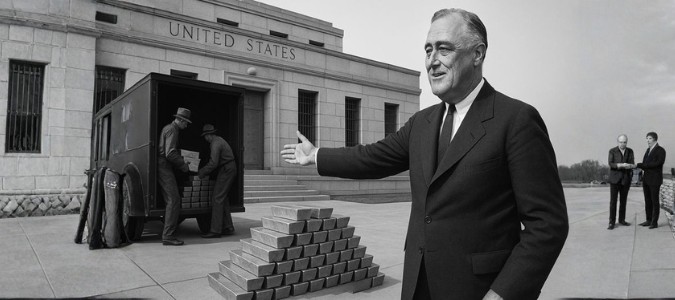
How FDR Put America Behind Golden Bars
Recently, I attended the annual New Orleans Investment Conference, formerly just “the Gold Conference.” Plenty was going down in the Big Easy, so this month I’d like to address gold, which is the only true money according to no less than banker J.P. Morgan: “Gold is money, and everything else is credit.”
We’ll start with the monetary legacy of President Franklin D. Roosevelt (FDR) and look back at how he undermined American wealth during the depths of the Great Depression. We’ll also discuss how, across several generations, gold ownership has come around full circle for investors. And of course, I’ll present ideas about how you can and should own gold and build wealth. So, let’s get started.
FDR and Why – Long Ago – You Could Not Own Gold
Let’s begin in New Orleans, the venue of the recent conference, which traces its roots to a dedicated man who made it possible for you to own gold today legally. That is, the New Orleans Gold Conference was created in 1974 by the late Jim Blanchard (1943-1999), whose ghost you can thank for your ability to own yellow metal. Absent this guy, you’d be a criminal for preserving your wealth.
As a young man, Blanchard was in an auto accident that broke his back and put him in a wheelchair. This reshaped his view of life, and among other things, Blanchard became a keen student of history and economics. Then, to earn his keep in the world, he went into the coin business.
Today, many don’t know, or perhaps only dimly recall, that for many decades of the mid-20th century, it was illegal for most Americans to own gold. In fact, unless you were a jeweler or dentist, or required gold in, say, electronics, or were a coin dealer or collector with a license from the U.S. Treasury Department, you could be prosecuted for owning gold. Incredible as it may seem now, for over 40 years, U.S. law called for fines and even jail time for gold bugs.
The prohibition on gold ownership dated to April 5, 1933, and was an executive action by newly inaugurated President Roosevelt. In 1932, a significant focus of FDR’s campaign was to repeal the 18th Amendment to the Constitution and end America’s so-called “Prohibition” on alcohol; this indeed occurred under his presidency.
After assuming office, FDR issued Executive Order 6102. In essence, FDR prohibited private ownership of gold, which, of course, made up a big whack of the nation’s wealth. FDR banned ownership of gold coins and bullion, along with currency in the form of gold certificates.
 FDR’s Executive Order 6102, April 5, 1933. Source: U.S. National Archives.
FDR’s Order allowed a short window of 25 days for Americans to “hand it over,” so to speak. He circulated his presidential edict via mass media such as newspapers and the then-novel radio, and posted the Order in every federal building and post office in the land. In short, the new president required Americans to turn in gold coins, bullion, and gold certificates to the nearest bank or federal depository. His legal basis was a World War I espionage law, as well as the “Emergency Banking Act,” which Congress hastily passed in March 1933.
In return for gold coins, bullion, and certificates, the U.S. government paid out paper currency, just run-of-the-press greenbacks. If someone handed in a shiny $20 gold piece, they received an inky $20 bill in return.
 FDR to America: “Hand it in for paper… or else.” BWK photo.
As 1933 unfolded, with no rhyme or reason, FDR arbitrarily revalued the so-called “official” price of gold to the upside, dollar by dollar: $21 per ounce, $22, $23, and so on. No kidding: according to many historians of the time, he did this, literally, over breakfast in his bedroom at the White House.
Then, in January 1934, Congress passed the Gold Reserve Act, which legislatively devalued the U.S. dollar to $35 per ounce of gold, a 40% loss compared with the pre-FDR fixed price of $20.67 per ounce.
In other words, within one year of assuming power, FDR instigated a monetary revolution. He confiscated the nation’s gold monetary base and gave the country a 40% wealth haircut. And no, unlike with the 18th Amendment, he sure as hell did NOT campaign on this idea in 1932. No one saw it coming.
Again, to restate what occurred, by May 1933, FDR confiscated the nation’s gold, and only a few favored people and institutions were permitted to own any. Then came his crackpot, progressive, and arbitrary downward revaluation of wealth, meaning the reduced dollar value of gold. And to be clear, a loss of wealth is still a loss of wealth, whoever holds it.
To compound this monetary upheaval – and more than likely, to prevent a future president from reversing the gold confiscation – FDR ordered that America’s seized gold be melted into bars. In other words, America’s new president obliterated the nation’s monetary base of publicly held gold coinage as a primary form of circulating money.
In due course, these so-called “melt-bars” (at 400 ounces each) went into storage at the hastily built, but very sturdy, gold depository at Fort Knox, Kentucky.
 Fort Knox Depository, Kentucky. Courtesy U.S. Army.
The bottom line was that America’s overall national accumulation of gold in whatever form was rapidly revalued in terms of dollars. Yes, there were “more dollars” after a fashion, but they were all worth much less.
Then, after confiscating the nation’s primary gold wealth and arbitrarily resetting its dollar value, FDR and his so-called “brain trust” of political and economic advisers were stuck about what to do next. Bewildered and pretty much clueless, they wondered why the stock market crash of 1929-30, and the panic of the early 1930s, transformed into the decade-long Great Depression.
In essence, by grabbing America’s privately held gold and then devaluing the dollar, FDR took a bad situation and made it worse. He destroyed confidence in the U.S. currency and undermined a collective sense that the country was a jurisdiction of predictable money, law, and property rights. In hindsight, and to some, at least, it seems like a case of a sick patient who went to a doctor for anemia, but the physician was a total quack who prescribed bloodletting.
Truly, FDR and his team of economic policymakers didn’t know what they were doing. They just sort of made it up as they went along, and later in life, many of them actually admitted as much. Looking back with a current perspective, America’s Depression-era monetary policy was little more than voodoo economics, a legacy that lingers to the present.
Here’s Why You Can Own Gold Today
There’s more to discuss about FDR’s gold confiscation, but not just now. Instead, let’s return to the above-noted Jim Blanchard, who, from his reading of history and work within the 1960s-era coin industry, quickly became disenchanted with America’s Depression-era, nationwide prohibition on public ownership of gold.
Consider also that, back then, America began to experience inflation due to President Lyndon B. Johnson’s (LBJ’s) blowout spending on both the so-called “Great Society” big-government programs and the intractable, outrageously expensive Vietnam War.
As events unfolded, Blanchard began a political effort to spur Congress to undo FDR’s 1933 handiwork. Blanchard urged the passage of new legislation to legitimize private ownership of gold. For example, at public events, Blanchard occasionally displayed bars of gold or gold coins he had brought into the U.S. from overseas and dared the Treasury Department to arrest him.
In one colorful stunt during the second inauguration of President Richard Nixon in January 1973, Blanchard hired an airplane to fly over the event, towing a banner that said, “Legalize Gold.”
Eventually, President Gerald Ford saw a television show in which Blanchard held up a gold bar and asked, “Why can I not own this?” And to his credit, Ford liked the idea and backed legislation to change U.S. law on gold ownership. The result was that, after about 40 years, the FDR ban on owning gold expired on Dec. 31, 1974.
Of course, any worthwhile accounting process for capital and investment requires stable and predictable money, meaning that a dollar today will be worth something like a dollar tomorrow, next year, ten years from now, and so on. This function used to be served by gold (and silver), or, if not by precious metals, then at least by some semblance of a stable currency, which, as we saw, FDR all but dismantled in the 1930s.
Fortunately, Jim Blanchard devoted himself to reversing FDR’s monetary quackery, and today it’s legal for individuals and businesses to own gold. And it’s the height of prudence to own yellow metal, certainly in the current environment of astronomical national debt and blowout annual federal spending.
At this point, I hope I’ve helped spur some thinking about where we are in owning gold and how we arrived here. Now, let’s transition to some gold-backed ideas…
We Live in a Fortunate Time
In the past, we’ve often discussed the importance of owning physical gold. And I hope that describing FDR’s 1933 confiscation and Jim Blanchard’s efforts to re-legalize ownership gives you a sense of how fortunate we are to be able to own the metal legally.
Meanwhile, if you want to invest in the future upside of gold prices, one way is through gold royalty companies, of which there are many. Right now, I like OR Royalties, Inc. (OR), with a market cap of $6.75 billion and a share price around $36, down from its October highs and a relative bargain as compared with peers. It’s well run and diversified, with a mix of projects and a broad geographic footprint.
Another royalty play I like is smaller but positioned to become takeover bait in a rising gold market. That’s Empress Royalty Corp. (OTC: EMPYF), with a market cap of $102 million and a share price around $0.81, down from its November high. Much like Osisko, Empress is well run, with a strong book of projects spanning a variety of jurisdictions, at varying stages of development or operations.
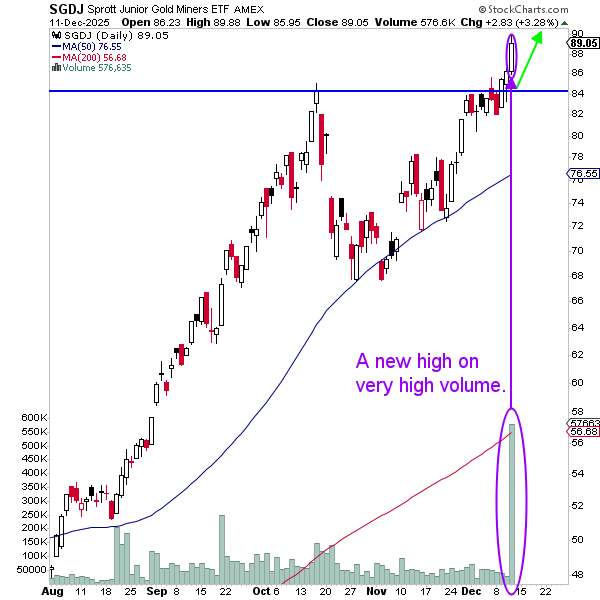
Finally, I’ll give a plug to the Sprott Junior Gold Miners ETF (SGDJ), with a market cap of $313.25 million and a share price around $89. This is a professionally managed fund of 25 different junior mining plays, all with solid management and significant exploration and development upside, certainly in the current strong market for gold and mining plays. Owning an exchange-traded fund (ETF) like this eliminates the problem of stock picking among junior companies while still offering exposure to a strong part of the sector.
Sean tells me this stock looks excellent chart-wise, hitting new highs yesterday on massive volume and targeting $100.33 first, and then $107.05, a 20% upside.
To be clear, these names are not part of any official Paradigm Press portfolio, but they are ideas with merit and upside in the current gold environment.
If you buy shares, be sure to watch the charts, wait for down days in the market, always use limit orders, and never chase momentum. That, and be patient while America’s ongoing monetary circumstances play out. We’ll have up days and down days, but for gold, the best days remain ahead.
That’s all for now. Thank you for subscribing and reading.

8 Things That Will Turbocharge The Gold Price
Posted December 16, 2025
By Jim Rickards
Swamp Thing
Posted December 11, 2025
By Sean Ring
A Sliver of Silver
Posted December 10, 2025
By Sean Ring
The Public Service of Pushing Brains Into Industry
Posted December 09, 2025
By Sean Ring

Did America Just Lose The Great Game?
Posted December 08, 2025
By Sean Ring
