Posted July 13, 2026

By Matt Badiali
Gas, Guns, and Profits
The Iran war is back on.
On Tuesday, July 7th, Iran struck a Qatari liquefied natural gas (LNG) tanker as it tried to move through the Strait of Hormuz. Fortunately, the attack didn’t breach the main storage tank. However, the ship’s engine is on fire and could still explode.
Qatar is the world’s third-largest LNG exporter after the U.S. and Australia. And its natural gas is stuck behind the Strait of Hormuz, within reach of Iranian attacks.
That creates a huge supply deficit for LNG importers like China, Japan, and Europe.
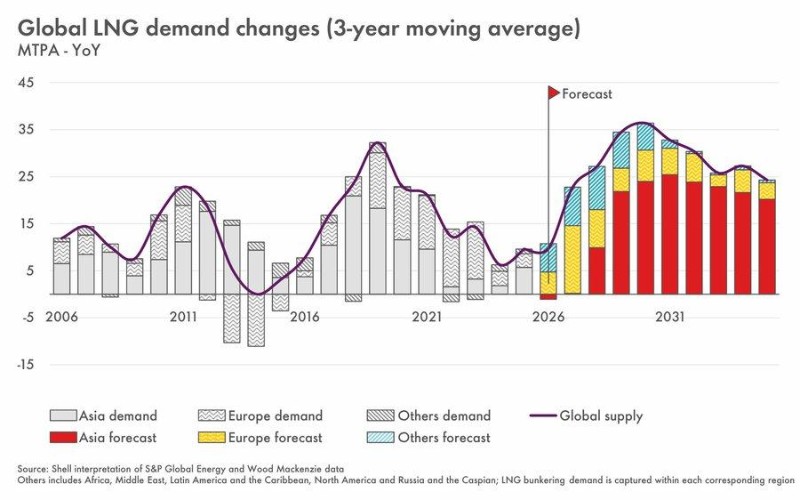
LNG is a major fuel source for both electric generation and home heating. And the demand isn’t going down. Major oil and gas company Shell published a chart showing a demand forecast:
Making LNG
LNG is difficult to make. You must freeze huge quantities of natural gas to -260 degrees F. At that point, the gas becomes a liquid, and its volume shrinks by a factor of 600. In other words, you can put 1,000 cubic feet of natural gas into just 1.6 cubic feet of LNG.
The cost adds several dollars per thousand cubic feet, which is the common measure of volume (MMCF). When you see natural gas prices, it is per thousand cubic feet. So, while the price of natural gas
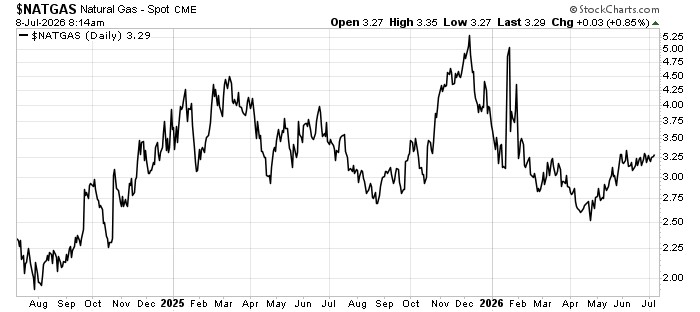
As we can see, the price of natural gas here in the U.S. is $3.29 per MMCF. The spot price for LNG in Asia is between $11 and $13 per MMCF.
And that opportunity spurred growth in U.S. exports. Cheniere Energy (NYSE: LNG) just opened two new export trains. And the company received government approval to increase its exports. Investors approved:
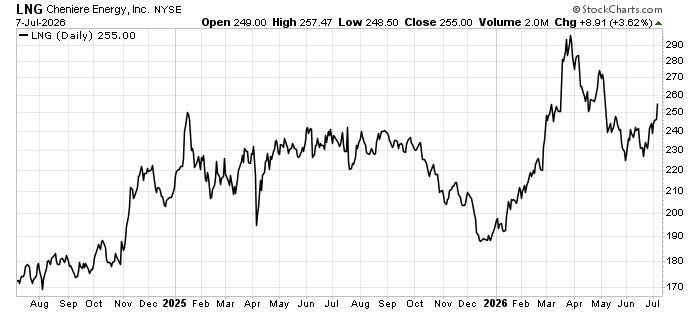
LNG exporters like Cheniere Energy earn the difference between the cost of making and shipping the LNG and the price at the other end. And today, there isn’t enough LNG to meet demand.
Keeping the Lights On
As we said, most LNG imports are used to generate electricity in countries such as China, Japan, Korea, and Europe. These are places where people want the lights to come on when they flip the switch. And they are rich enough to pay for it.
Electricity is a necessity. And in places that import LNG, they must pay up. Like oil, LNG prices are global. The ships can go to any port, so there is a competitive spot market. And with Qatar’s exports limited by the war, the spot market ripped higher.
LNG prices hit four-year highs of more than $25 per MCF. That’s up from $10.40 per MCF in February 2026. That’s a 140% jump in just a few months.
As you can imagine, LNG exporters like Cheniere are making a lot of money today. The company increased its full-year earnings estimate by 7% from $6.75 billion to $7.25 billion. That came after the first quarter results. It will be interesting to see if they increase it again after the second quarter. Those data should be out in August 2026.
Wrap Up
LNG exporters could be an excellent speculation right now. They will enjoy much larger margins through the second half of 2026. And that will generate some surprising earnings in the next few quarters.

The Coward's Tax
Posted July 10, 2026
By Sean Ring

Lapdog Loop
Posted July 09, 2026
By Sean Ring

China’s Touch of Death
Posted July 08, 2026
By Byron King

The Lowest Bar
Posted July 07, 2026
By Sean Ring

Silicon Valley Starts Underground
Posted July 06, 2026
By Matt Badiali