
Posted May 06, 2026

By Byron King
From Bad Debt to Hard Money
“April is the cruelest month,” wrote T.S. Eliot in his 1922 poem The Waste Land.
Eliot, welcome to May 2026.
This month in our sister publication, Strategic Intelligence, Jim Rickards zeroes in on the private credit crisis — and it’s a bad one. But private credit is one element of what I’d call the Periodic Table of Bad Debt.
And this table is full of unstable elements.
Here’s one sample: Americans — young and not-so-young — now carry $1.84 trillion in combined federal and private student loan debt, and nearly 10% of federal borrowers are 90-plus days delinquent.
Automobile loans add another $1.6 trillion to the pile. And a large number of loans were already edging toward delinquency before fuel costs started impoverishing U.S. households, one fill-up at a time.
How about the staggering capital commitments tech companies have made to develop AI and build out data centers?
Many of these ventures give old-fashioned carnival barkers a run for their money, competing in markets where products are interchangeable, and pricing power barely exists.
Sooner or later, expect massive write-downs, project cancellations, and an investor reckoning across this overextended sector.
Then there’s the federal government itself: a spending machine in constant overdrive, cranking out dollars of diminishing purchasing power year after year. At this point, about 40 cents of every federal dollar paid out rests on borrowed money.
Interest alone on the national debt now runs over a trillion dollars annually — before we even get to the rest of the budget.
The upshot: More dollars chasing the same goods, as energy costs push prices higher and real productivity lags.
The private credit crisis might be the biggest crack in the dam, but make no mistake, the whole structure is compromised.
Your Inflation Playbook… And Playboy?
It’s a grim picture, I know. The takeaway, in two words: inflation ahead.
So what do you do? In short, de-risk your holdings, keep cash on hand, and focus on ideas that represent long-term wealth protection. Let's take those one at a time.
On de-risking: Everyone is different — there’s no one-size-fits-all here, and we don’t do personal financial advice. Still, it’s time to take a hard look at every position in your portfolio and ask the “why” question.
Once upon a time, you bought shares of XYZ Company. Maybe you’ve done well, maybe not so well. But you bought shares — you didn’t get married. Do you hold? Unload? Where is XYZ going from here? Would you buy those shares again today?
Unless you have compelling reasons to hold, it may be time to let go. De-risk to cash. The worst-case scenario is that you end up with cash, which is not a bad thing.
And if you sell and miss a little more upside, is that the worst thing? Especially weighed against the risk of a market tumble driven by economy-wide debt problems — or a wild-card event like the Strait of Hormuz being closed indefinitely.
On holding cash: Cash loses purchasing power over the long haul, but along the way, it's enormously useful. It relieves pressure and stress. It offers daily confidence that you can pay your bills. And it even opens options for bargain hunting.
This brings to mind Donald Trump, from his 1990 Playboy interview, during a period of tight credit: “Cash is king. People who have cash are going to be able to buy things very inexpensively in a down market.”
Here we are, 36 years later, putting that to the test.
Rule No. 1: Don’t Lose Big
It’s great to make money in the markets. But the foundational principle is to avoid big losses. So if rule No. 2 is to make money, rule No. 1 is don’t lose big whacks.
What’s the key metric for valuing any investment? Earnings — or at least future earnings. Companies that make money are more valuable than companies that don’t. Simple as that.
Which brings me to where I’m finding both protection and upside right now: mining.
Solid mining ideas are beginning to show remarkable — if not eye-popping — revenues and profits, driven by the price surge in gold, silver, and copper over the past 18 months.
It was one thing to run the numbers when gold was around $2,600 in early 2025. It’s quite another when that same gold sells near $4,800 today. Yes, costs have risen — diesel, labor, steel pipe, and concrete. But that extra $2,000-plus per ounce makes an enormous difference on the bottom line, and it’s just starting to show up in earnings.
Rising profits alone make miners attractive. But there's more: Capital is rotating out of riskier sectors and into mining. New money is coming in.
Over the past 15 years, the S&P 500 outperformed mining companies by roughly 500%.
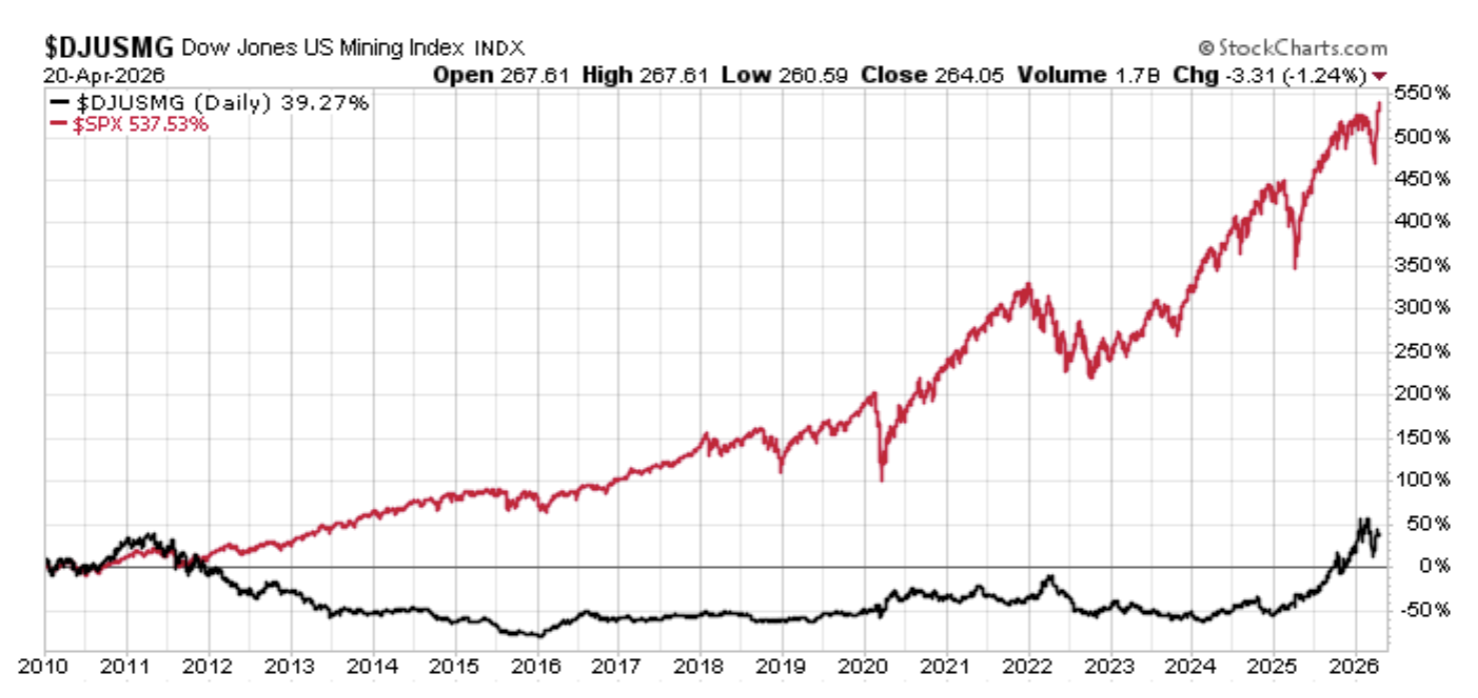
Big Money starved the sector, and mining requires a lot of capital.
The Wreckage Has a Silver Lining
Remember the Wall Street adage: Sell in May and go away? Like many old ideas, there’s some truth to it. Summer doldrums are real.
But here’s what that advice misses entirely: not all sectors move together. While the private credit crisis unwinds — and it will unwind — capital has to go somewhere.
The money fleeing overextended tech ventures, bloated data center projects, and crumbling private credit structures doesn’t simply evaporate. It rotates. And right now, it’s rotating into hard assets that miners pull out of the ground — including gold, silver, and copper — at prices few predicted two years ago.
So yes, sell in May if you’re holding positions you can’t defend. De-risk, hold cash, and stay nimble. But go away? Not entirely. The investors who come out ahead won’t be the ones who went to the beach. They'll be the ones who understood that a dam full of cracks is also, for the prepared investor, full of opportunity.
Cash is king. Precious metals are right up there. And the summer doldrums may turn out to be the best buying opportunity of the year.
Thank you for subscribing and reading.

Trumps, Tungsten, and Tax Dollars
Posted May 05, 2026
By Sean Ring

The Spirit of Capitalism
Posted May 04, 2026
By Sean Ring

The Everything Rally Resumes
Posted May 01, 2026
By Sean Ring

The Coming Shale Fail
Posted April 30, 2026
By Matt Badiali

Five Cent Bull
Posted April 29, 2026
By Sean Ring
