Posted August 14, 2026

By Sean Ring
Confession Day
Sometime tonight, in the final hours before the cutoff, a compliance officer at one of the world's biggest funds will press a button.
A form will land on the SEC's servers, joining thousands of others arriving in the same last minute flood. Nobody will ring a bell. There's no press conference. Just a quiet avalanche of sworn documents, each one confessing what a 9- or 10-figure portfolio actually owned on June 30.
Today is the 45th day after the end of the quarter (June 30, 2026). The deadline we've been building toward all week is here.
The big funds wait until the last hours on purpose. They're required to confess, but nothing says they must confess early, and every extra day their positions stay hidden is a day nobody can front-run them. So the most interesting filings arrive at the very end, after the market closes, when the reporters have gone home.
Which is exactly when we go to work.
This issue is your field guide. Clip it, save it, and use it this weekend.
Where to Look
First, the mechanics. You don't need a Bloomberg terminal for this.
Every filing is posted to EDGAR, the SEC's public database, at SEC's public database at sec.gov. Use the full-text search, type in a fund's name, and filter for Form 13F-HR. It's free, it's instant, and it's the same raw document the professionals read.
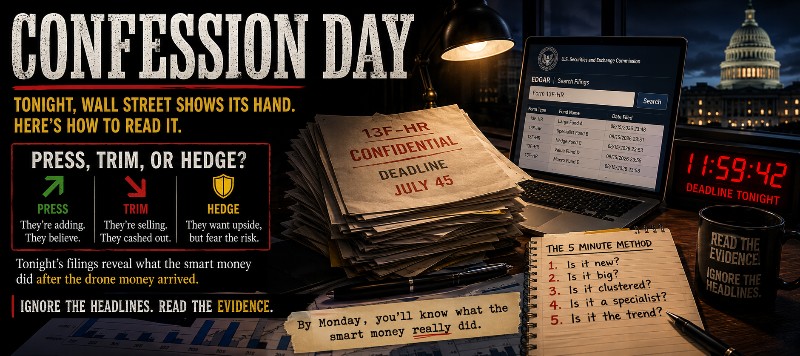
The 5 Minute Method
For any fund or any stock you check this weekend, ask these five questions in order. They're the method from Wednesday, compressed for deadline day.
Is it new? A brand-new position opened the same quarter a $54.6 billion budget request dropped is a decision. A position held for 6 years is furniture.
Is it big? Measure the position relative to the fund's entire portfolio. A 0.2% toehold means they're watching. A 4% stake means they're persuaded. Aggregators show this to you in one column.
Is it clustered? One fund buying is a story. Five specialist funds independently initiating the same name is a signal. Errors are random. Conviction clusters.
Is it a specialist? A generalist megafund owning a defense prime tells you nothing. Funds that live and breathe government contracts, leaning the same way, are trading their own expertise. Weight their filings accordingly.
Is it the trend? Pull the same fund's previous filing and compare. Adding, trimming, or exiting matters more than owning. One filing is a photograph. Two or more are a film.
The Traps, One Last Time
Before you draw any conclusions, remember what the confession leaves out.
The data is 45 days old. You're seeing June 30, not today. No short positions appear, so a fund that looks bullish on paper can be net short in reality. Cash doesn't appear; options can make a bearish bet look like a bullish holding, and a June buyer may have been a July seller.
The biggest trap of all arrives Monday morning, when the headlines get read.
The Sunday Misread
Here's my prediction, and you can grade me on it.
By Sunday evening, the financial press will have skimmed the famous filers and produced headlines like "Legendary Investor Buys Drone Stock." By Monday's open, tourists will be chasing those names, paying Monday prices for June information that was stale before they read it.
The famous filers are the least interesting. The drone story is in the least known specialist funds. The real tell is the pattern across dozens of filings: pressing, trimming, or hedging.
Pressing, meaning the first-quarter buyers added after April's budget detail, suggests the professionals believe the money survives Congress. Trimming says they sold the news to the crowd. Hedging, such as puts that accompany long positions, suggests they want the upside but fear the October 1 appropriations calendar we flagged on Tuesday.
That's the question tonight answers. Not "who bought what." Press, trim, or hedge.
Your Weekend, and Mine
So here's the division of labor.
If you enjoy this kind of thing, you now have the tools, the method, and the traps. EDGAR is free and open all weekend. Check the names you care about, run the five questions, and ignore the headlines.
Spend the next few days going through the flood, fund by fund, sector by sector, applying exactly the method you just read. On Monday, you get the receipts: what the professional money actually did in the quarter the drone era got funded, stripped of the weekend hype.
Either way, refuse to form an opinion from a headline this weekend. That's the only rule.
Wrap Up
Monday, it was the broken economics. Tuesday, it was the $54.6 billion answer and the side door it travels through. Wednesday: how to read a forced confession. Yesterday, it was the proof the smart money moved before the announcement. Today, the field guide for the flood.
In fact, Jim Rickards tells you what’s what right here.
Incentives created the problem. Money is chasing the fix. And tonight, under penalty of law, the people managing trillions must show you what they really think of it.
Most investors will spend this weekend reading opinions. You'll spend it reading evidence.
Have a wonderful weekend!

War Money Moved Early
Posted August 13, 2026
By Sean Ring

Wall Street's Forced Confession
Posted August 12, 2026
By Sean Ring

The $53 Billion Side Door
Posted August 11, 2026
By Sean Ring

The $2 Million Fly Swatter
Posted August 10, 2026
By Sean Ring

The Magnet That Breaks China’s Grip
Posted August 07, 2026
By Matt Badiali