Posted November 10, 2026

By Sean Ring
Cash Isn’t Cowardice
Last Thursday at 8 a.m., I stood in a Nashville ballroom and asked the first five rows a question.
About 60 people sat in those rows. What are the odds that two of them share a birthday? Day and month only.
Then I asked who was born in January. A few hands went up. I asked for dates.
We had a match before we got out of January.
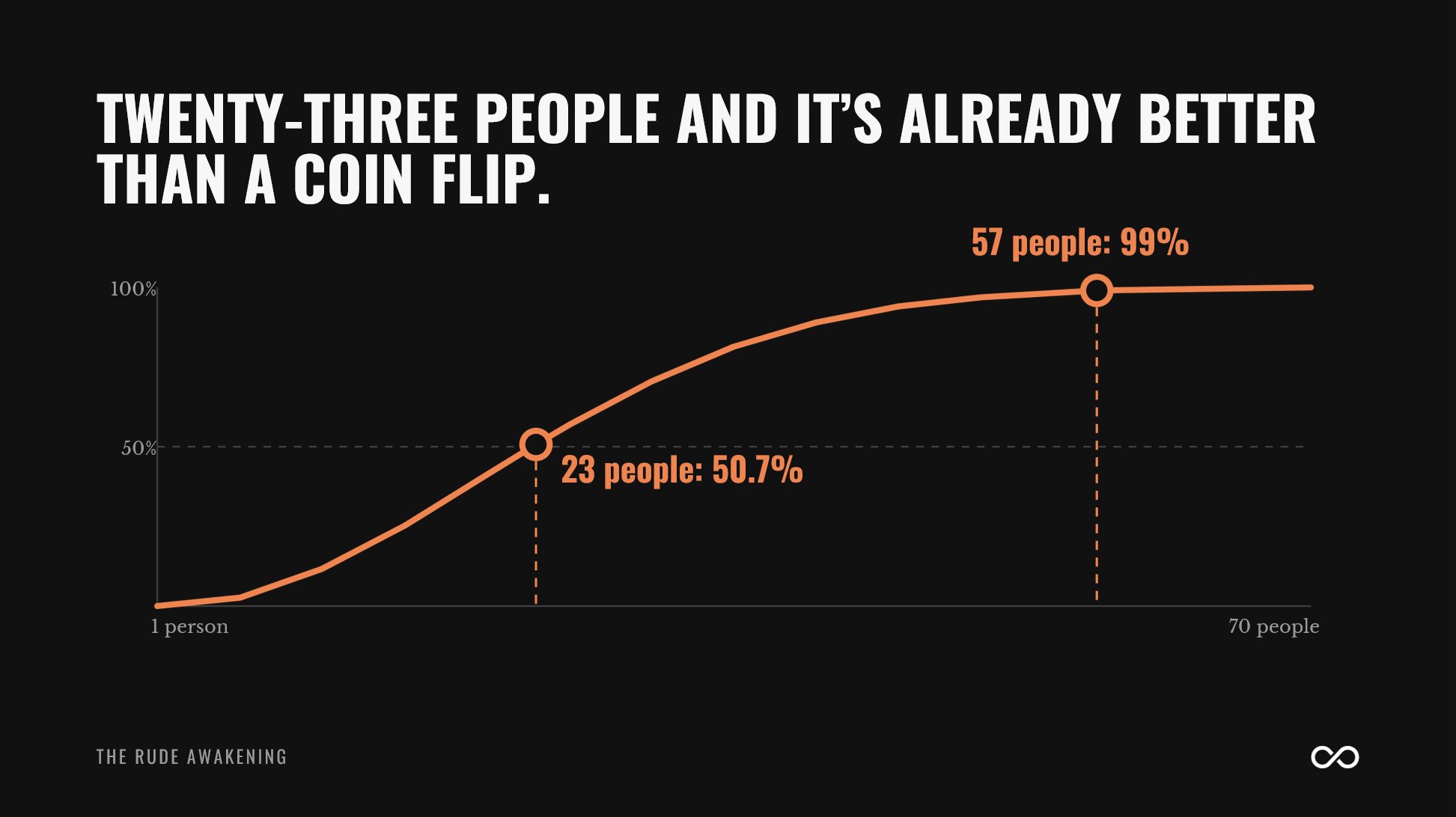
The math says we should have. With 23 people in a room, the odds are better than even. With 57, they’re 99%. The first time someone asked me, I guessed one in a million.
I didn’t open the Paradigm Shift Summit with statistics’ famous Birthday Problem just for fun. I did it to make a point about investor “feels.”
Everyone in that room had all the facts. Sixty people. 365 days. Math that was settled ages ago. I didn’t take a vote, but I’d bet most people would get the probability wrong.
Now think about the market. You never have all the facts there. And the people on the other side of your trade are the smartest, richest, most ruthless players on earth.
Since you’re dealing with incomplete information, “unsure” is your default setting.
My Tuition Bill
Before that dreadful Friday in late January, I was sure that as governments print money, silver’s price had to rise. On January 30th, silver fell from about $120 to $78 in a single day. It trades in the low $50s now. I told you that story two weeks ago, so I’ll spare you the replay. I got out by February 8 and kept most of my gains. The cream on top was gone.
I was sure about Intel, too. In July of last year, my colleague Alan Knuckman told me to buy it near $20. I told him it was a lousy company. By late June, it had touched $142. That’s seven times Alan’s entry price. Even after its recent awful earnings announcement, it sits near $59… still a 3x gain.
One mistake cost me money I had. The other cost me money I never made. Both came from the same place. I trusted what I believed over what I saw.
Aristotle warned about this 2,300 years ago. “Credit must be given to observations rather than to theories,” he wrote, “and to theories only if what they affirm agrees with the observed facts.”
He never traded silver. He might have been good at it.
The Line I Keep Hearing
“For every ten-bagger I ever had, I took a 50% loss at one time or another.”
I admire the mining magnates who’ve been through those times. Some have helped me personally, and they’re generous with what they know. I don’t doubt the line for a second. In the 1970s bull market, 50% drops came with the territory.
My trouble is with what you hear when they say it. You hear a rule. If you want the ten-bagger, you must sit through the 50% loss. Selling means you lack the stomach for investing.
I’m telling you that you don’t have to sit through it. And the reason has nothing to do with intestinal fortitude.
The Ten-Cent Seat
The big names don’t buy miners the way you and I do.
A broker calls them. A young company needs money, and they can get in at ten cents a share. They do their homework, they like it, and they buy.
Later, the story gets out. The stock climbs to $2. That’s when you and I hear about it, and that’s when we buy.
Then the stock falls to $1.
The man who paid ten cents has watched his position get cut in half. That’s a 50% loss, and he’s telling the truth. He’s also still up 10x.
You paid $2. You’ve lost half your money, and you need the stock to double just to get even.
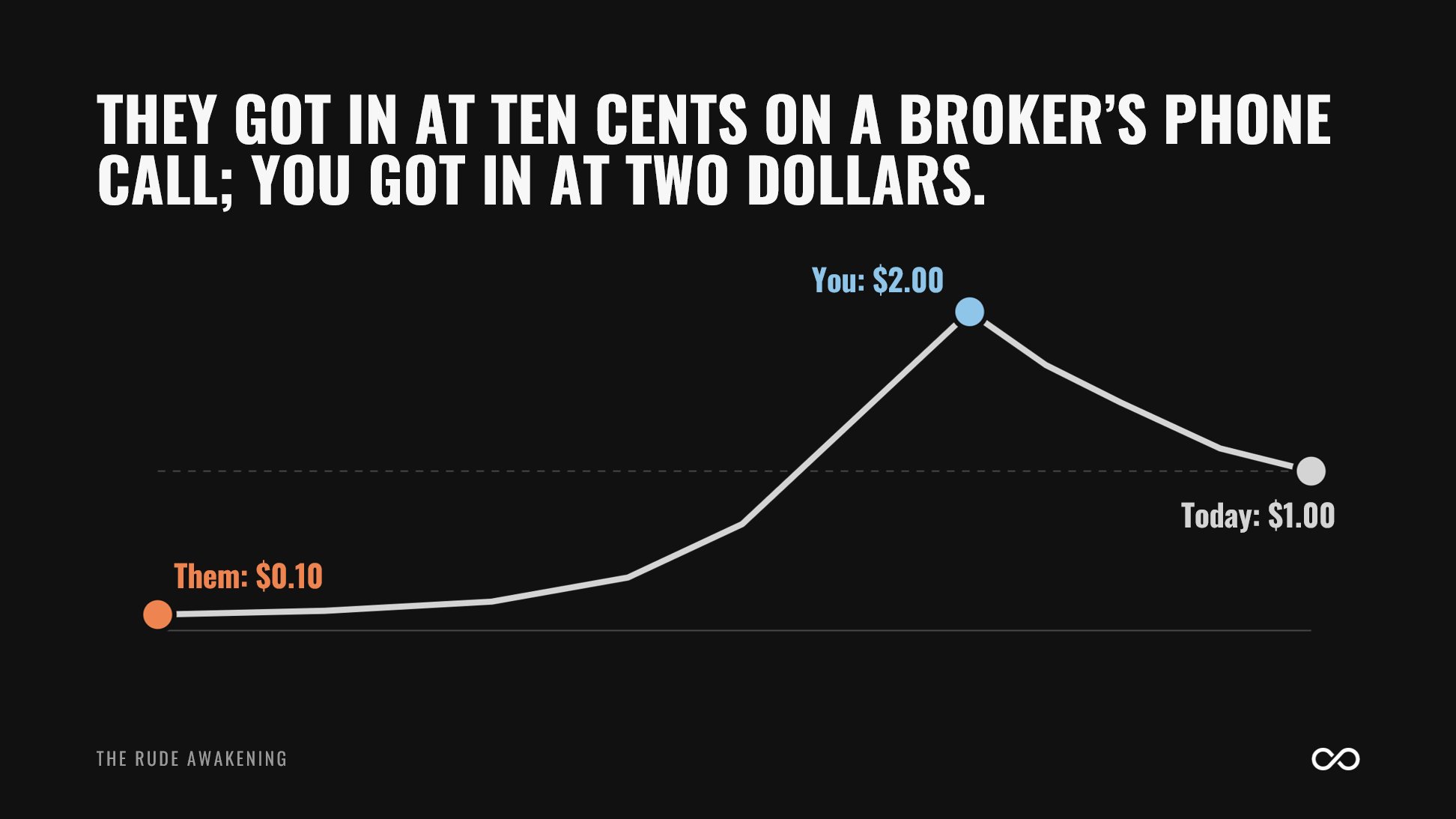
It’s one chart with two different trades on it.
Superstar mining investors earned those phone calls through decades of work and at their own capital’s risk. Maybe they had rough beginnings back in the 70s, but now their patience rests on a low entry price.
What I Do Instead
I’m the most emotional investor I know. I look at a falling stock and think it might still love me. So I have to take the decision out of my own hands.
When I buy, I place two more orders in the same breath. One sells at a profit I’d be happy with. The other sells at a loss I can live with. Brokers call it a bracket order. After that, I don’t have to be brave or clever. I just have to leave it alone.
My colleague Matt Badiali keeps a simpler rule. When a position falls 25% from its high, he’s out. That rule got me out of silver in February with most of my gains.
A stop isn’t armor. A stock can gap down through it overnight. But it lets you choose while you’re calm, before fear or regret chooses for you.
I told the room I’m a coward when it comes to investing. I meant it. Cowards live to fight another day.
Half a Portfolio Doing Nothing
If you still think cash is for the timid, look at Berkshire Hathaway.
I reviewed its June 30th filing before the talk. Berkshire held about $359 billion in cash and Treasury bills. That was 51.3% of its liquid portfolio, more than its stocks and bonds combined.
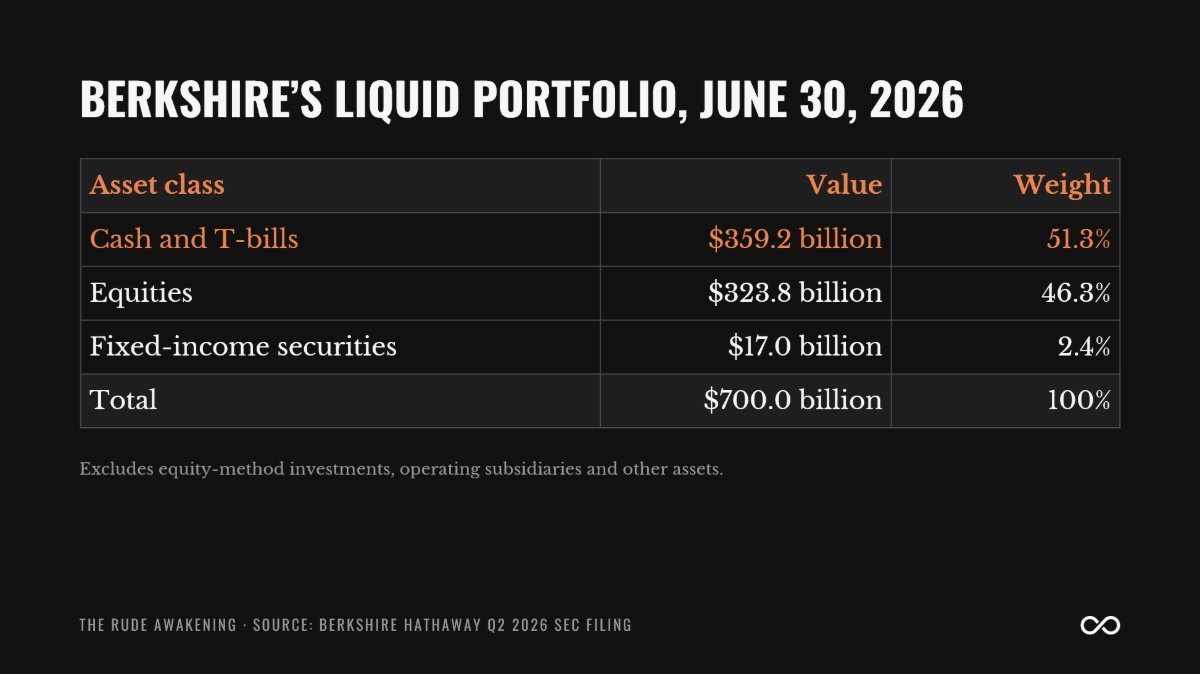
The best investment company in history had over half its chips off the table.
Then Berkshire reported again on Saturday. The pile grew. The Associated Press put it at $377 billion at the end of September.
Yes, inflation eats cash. Over 20 years, it’ll chew through your savings like termites through a barn. It won’t ruin you in three months. Berkshire’s managers know that, and they’re essentially paying “inflation” for the right to wait.
Wrap Up
Look at what’s in front of us.
We’ve got a new Congress on the way and two wars. Brent crude sat near $100 the morning I spoke. It’s trading at $92 this morning.
Silver’s chart is still broken, but the recent hourly charts suggest we've hit the bottom. Of course, it may just be a bear market rally.
I don’t know what happens next. I told the room so, straight out. My colleagues who spoke after me had plenty of good ideas.
But you don’t owe any idea your money on the day you hear it.
Preserving your capital must be your number one goal. Then, when you’re ready, make a decision you’re comfortable with. And win.
Have a great day ahead.

Be the House
Posted November 09, 2026
By Sean Ring

The Yuan Trap
Posted November 06, 2026
By Sean Ring

The 16,000 Who Rule America
Posted November 05, 2026
By Sean Ring
The 87% Solution
Posted November 04, 2026
By Sean Ring

Warsaw Unpacked
Posted November 03, 2026
By Sean Ring