Posted March 31, 2026

By Sean Ring
Bessent Misses the Mark
I’m not sure whether Scott Bessent is Trump’s company man or just a man with zero self-respect. The Donald trots Bessent out, willingly, I’m sure, whenever he needs some intellectual heft behind his failing policies.
I mean, why is the Secretary of the Treasury going on Fox News to say the U.S. “will eventually retake the Straits?”
And this is after he announced on March 27th that “U.S. does not view the Strait of Hormuz as a 'choke point' for the global economy.”
On March 26th, he said, “Many people, especially the Democrats, underestimate the will of the American people for short-term volatility for 50 years of safety that we are gonna have on the other side of this.”
How’s that working out for everyone?
To be fair, I was a huge fan of Bessent when the President announced he’d be Secretary of the Treasury. A former fund manager who learned at the feet of the master, George Soros, I thought he’d be the perfect guy for the job. His macroeconomic knowledge is immense, and there was no better place to learn it than at Soros Fund Management, where he had also worked with Stanley Druckenmiller.
When Bessent slammed the Fed’s useless PhDs, I was even happier.
But let’s face it, Bessent’s grandiose plans for the U.S. economy haven’t come to pass. That may be far more his boss’s fault than his own.
In fact, Bessent’s ideas are so buried down the list of U.S. priorities at the moment, I’d be surprised if you remembered them at all.
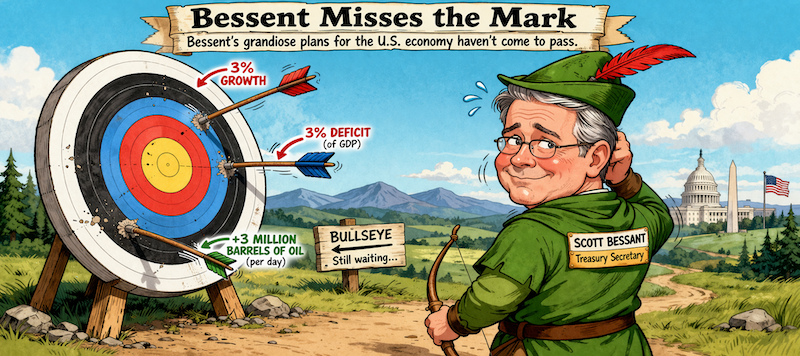
In short, Scott Bessent walked into Treasury with a plan. He called it the "3-3-3."
Three goals. Three numbers. Clean and simple.
- Grow the economy at 3% a year.
- Cut the deficit to 3% of GDP.
- Add 3 million barrels of oil per day to U.S. output.
The plan sounds like a slogan on a campaign button. And yet, just over one year in, not one of the three arrows has hit its target.
Let's go through each of them.
Arrow 1: 3% Growth
Bessent promised 3% GDP growth every year. More jobs. Higher wages. A booming economy.
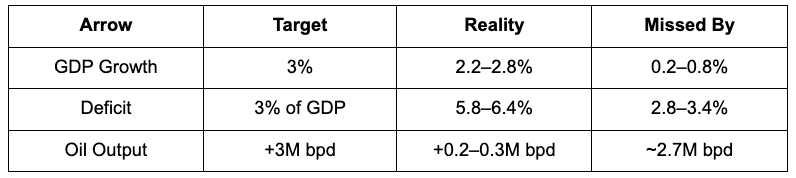
What we got in 2025 was 2.2% real growth. Forecasts for 2026 range from 2.5% to 2.8%. That's not bad. It beats the Congressional Budget Office's (CBO) long-run trend of 1.8%.
But it's not 3%.
Why the gap? Three reasons.
First, the immigration crackdown cut the labor force. Fewer workers mean less output. And since we need to clean out the illegals, that’s forgivable. Second, tariff uncertainty made businesses nervous. When companies don't know what costs will look like next year, they sit on their cash. Third, inflation stayed sticky. That kept interest rates higher than anyone wanted.
Growth is moving in the right direction. But moving and arriving aren’t the same things.
Arrow 2: 3% Deficit
This is where things go off the rails.
The federal deficit right now sits somewhere between 5.8% and 6.4% of GDP. Bessent wants it at 3% by 2028. That means cutting the gap in half in roughly two years.
Let's run the math.
The federal government spends about 24% of GDP. It takes in about 18%. That leaves a 6% hole. To cut that hole to 3%, you need to either slash spending by 3% of GDP, raise taxes by the same, or some combination of both.
Now look at where the money goes.
Social Security and Medicare eat up 6% of GDP. You can’t cut those without touching retirees (who do little else besides vote). Defense runs at 3% (officially). Cut that, and the chickenhawks who work for the military-industrial complex instead of you will scream. And here's the killer: interest payments on the national debt now run at 2.5% of GDP… and rising. You can’t cut interest payments without defaulting.
The CBO projects average deficits of 6.1% over the next decade. One think tank was blunt about it: hitting 3% would require massive cuts to anti-poverty programs and tax hikes on the middle class. Neither is going to happen.
This arrow was never going to fly.
Arrow 3: +3 Million Barrels Per Day
U.S. crude oil production in 2025 hit a record. Around 13.6 million barrels per day.
That sounds great. But Bessent needed 16.5 million. He wanted to add 3 million barrels per day on top of what was already there.
The actual gain from 2024 to 2025? About 200,000 to 300,000 barrels per day.
The gap is 2.7 million barrels per day, which means the plan is a tad short.
Why can't producers just drill more? Because the easy oil is gone. The wells that were cheap and fast to drill? Already drilled. New wells cost more and produce less. Even with deregulation, permits take months. Equipment is tight. Skilled crews are tight. And capital markets won't fund a drilling spree unless they see stable prices to justify the risk.
Even Exxon's CEO called the 3 million bpd target "quite unrealistic."
That's not an environmentalist talking. That's an oil man.
The Arrows Knock Each Other Off Course
Here's the part no one in DC wants to say out loud.
These three goals aren’t merely hard to hit. They actively work against each other.
Boosting growth and oil production means more economic activity. More activity means more demand. More demand means higher interest rates. Higher rates mean bigger interest payments on the $36 trillion national debt. Bigger interest payments mean a wider deficit, not a narrower one.
Meanwhile, cutting the deficit means cutting spending. Cut spending, and you slow growth.
You can’t step on the gas, hit the brakes, and turn hard right at the same time. The car doesn’t care how bold that plan sounds.
One policy group called them "Treasury's Competing Economic Targets." A report from Standard Chartered Bank mentioned "inherent contradictions." These people do the math for a living.
Why You Should Care
This isn't just Cabinet-level noise.
Slower growth means fewer job gains and weaker wage growth for working Americans. A wider deficit means more debt, higher borrowing costs down the road, and eventual pressure to either raise taxes or cut services. Missing the oil target means the U.S. remains exposed to global energy shocks, as happened when oil prices spiked in late 2021 to mid-2022, and is happening right now.
The Treasury team promised big results. So far, the results are modest growth, a bloated deficit, and a tiny bump in oil output.
Here's the scorecard:
The Bottom Line
Bessent's 3-3-3 plan was clean on paper. The real world is not.
One arrow was difficult but not impossible. One was a mathematical fantasy from day one. And one required physics and market forces to cooperate. Alas, they didn't.
Watch the numbers, not the slogans. Especially now.
The numbers tell a clear story. Three arrows fired. Three arrows missed.
Bessent is smart. The team worked hard. But Bessent built his plan on a foundation of wishful thinking, coupled with events now beyond the administration’s control.
Americans pay the real cost by waiting for the economy to feel as good as the talking points promise.
Don’t hold your breath, especially with what’s going on in the Middle East.
The Iran War Will Drive Costs Higher for Longer
Posted March 30, 2026
By Matt Badiali

The Cavalry Isn’t Coming
Posted March 27, 2026
By Sean Ring
The Looming Price Tsunami
Posted March 26, 2026
By Sean Ring

Loan Shark in a Three Piece
Posted March 25, 2026
By Sean Ring

Do This With Unseen Costs
Posted March 24, 2026
By Sean Ring
