
Posted July 04, 2026

By Byron King
America’s Seapower Company
Recently, I visited the Ingalls Shipyard in Pascagoula, Mississippi, a division of Huntington Ingalls Industries (HII). With more than 11,000 employees working around the clock, Ingalls is Mississippi’s largest manufacturing employer.
Between multibillion-dollar ships under construction and future vessels in the early contract stage, Ingalls has a backlog of over two dozen Navy and Coast Guard deliveries. The company’s vendor base touches all 50 states, with spending measured in the tens of billions.
The financials are impressive, but here I want to focus on what’s required to transform designs, steel plate, pipe, cable, combat systems, and human effort into a U.S. Navy warship. And I’m a Navy guy, awestruck at what I saw!
Pascagoula is no sleepy, run-down, Gulf Coast industrial relic. It’s a modern, working waterfront, a national security factory, and one of the few places in America where the Navy’s conventional surface fleet is born. It’s big, bright, tight, and busy.
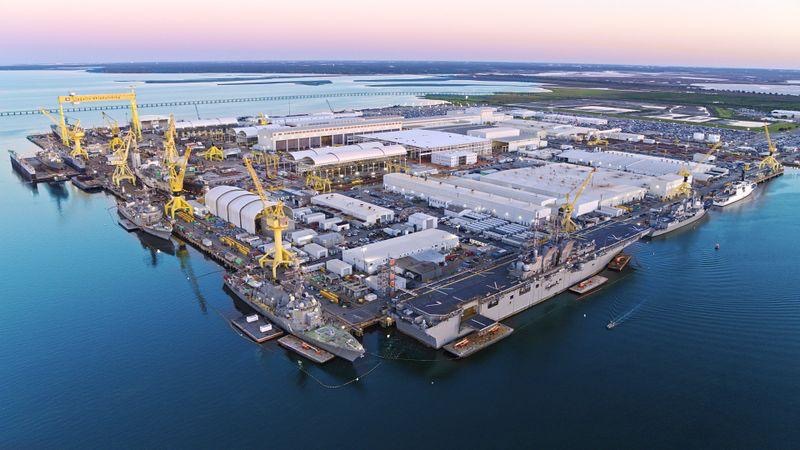 Ingalls Shipyard, Pascagoula, Mississippi. Credit Huntington Ingalls (HII).
From Steel to Seapower
At Newport News in Virginia, HII builds nuclear-powered submarines and aircraft carriers; at Ingalls, down South, it builds conventionally powered warships: destroyers, amphibs, and more. To call HII “America’s Seapower Company” is not marketing fluff.
Ingalls is a gem, a keystone of America’s shipbuilding industrial base that our country could not improvise in a crisis. When the balloon goes up, so to speak, you either have shipyards, workers, suppliers, engineering memory, and Navy program discipline already in place… or you do not. And if not, you lose the war.
Ships from Pascagoula are impressive, but even more impressive is the human effort inside every hull: architects, planners, logisticians, cutters, welders, pipefitters, electricians, riggers, painters, crane operators, inspectors, and sharp-eyed program managers.
Much of the work takes place in heat and humidity, in confined spaces, under tight schedules and exacting Navy standards. A modern warship is not simply “built.” It is created, constructed, integrated, tested, inspected, corrected, tested again, and delivered to the fleet.
USS Pittsburgh (LPD-31)
What took me to Ingalls was a chance to visit the future USS Pittsburgh (LPD-31), now under construction. Because, as a side gig in life, I’m president of the Pittsburgh Council of the U.S. Navy League, a national organization that promotes seapower and the industrial base that supports it. And so, I snagged an invite.
When completed in about two years, Pittsburgh will be an amphibious transport vessel of the San Antonio-class Flight II line (see image below of a recently completed, similar [technically, it’s “Flight I”] vessel).
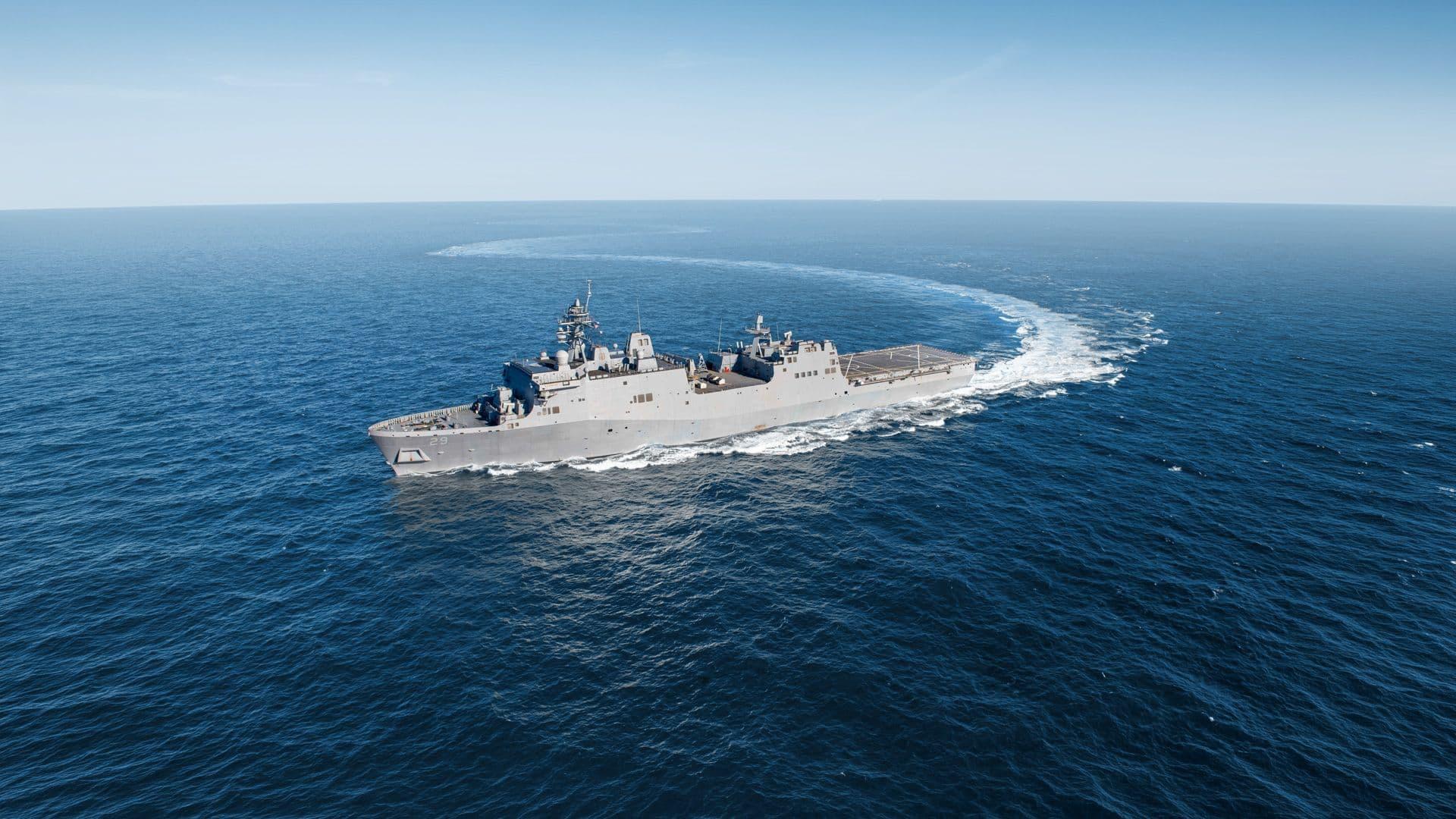 San Antonio-class; LPD-29 USS Richard McCool shown. Credit Huntington Ingalls (HII).
The future USS Pittsburgh will displace about 25,000 tons, move at up to 23 knots, carry about 350 Navy officers and crew, and load out about 500 Marines, plus landing craft and vehicles, aircraft and drones, aviation support gear, command spaces, medical facilities, weapons, and communications systems.
In plain language, an LPD like Pittsburgh is a floating joint-force toolbox, built to move Marines and their gear into contested places, sustain them, command them, and defend them.
This new class of LPD is far beyond old “Gator Navy” ships familiar to those who served long ago: bare-bones, haze-gray hulls that served as floating barracks, armory, and gymnasium for angry Marines.
Anymore, the Navy and Marine Corps expect amphibious ships to serve as command nodes, aviation platforms, drone carriers, logistics bases, medical support hubs, and, when required, fighting ships that can defend themselves and contribute to the larger naval battle.
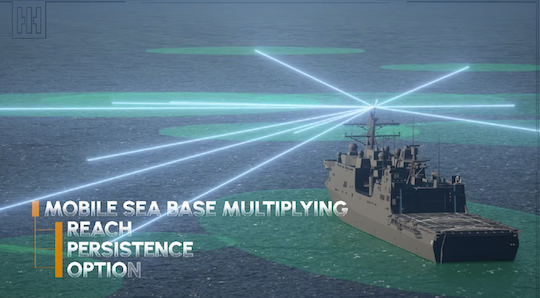 LPD concept: not the old “Gator Navy.” Credit HII, YouTube screen grab.
Among other things, USS Pittsburgh will be a command-and-control vessel packed with gear that talks to systems arrayed from the seabed to outer space. It will generate enough internal power for future weapons like lasers and high-powered microwave systems. And it will hold a large field hospital.
Meanwhile, the hull itself is built with additional structural framing and volume for future upgrades such as a vertical-launch system. This is definitely a fighting ship for modern times.
Depending on the mission, USS Pittsburgh will carry aircraft ranging from small helicopters to giant CH-53s, V-22 tilt-rotors, and drones. In the well deck, it will haul landing craft, Marine equipment, vehicles, supplies, and future unmanned surface and undersea systems – meaning entire families of current and future drones.
That’s why LPDs matter: they give commanders options. In a future fight or crisis, a ship like this can be a bridge, base, hospital, command center, logistics node, and launch point.
The Arsenal by the Sea
Shipbuilding at Ingalls dates to 1938, when Robert Ingersoll Ingalls Sr. set up the Pascagoula Shipyard. The location mattered then and still matters now. It’s right next to where the Pascagoula River flows into the Gulf, which offers deep-water access to the shipyard, room to expand, and multiple transportation links via rail, truck, and barge.
Leading up to and during World War II, Ingalls transformed into a major naval production center. And postwar, Ingalls kept rolling. During the Cold War, Ingalls won major Navy work, and then over the decades, it focused on surface combatants, cruisers, destroyers, amphibious ships, and Coast Guard cutters.
In the early 1960s, Litton Industries acquired Ingalls, and in 2000, Northrop Grumman (NOC) acquired Litton. Then in 2005, the Gulf Coast – and the Ingalls yard – was devastated by Hurricane Katrina.
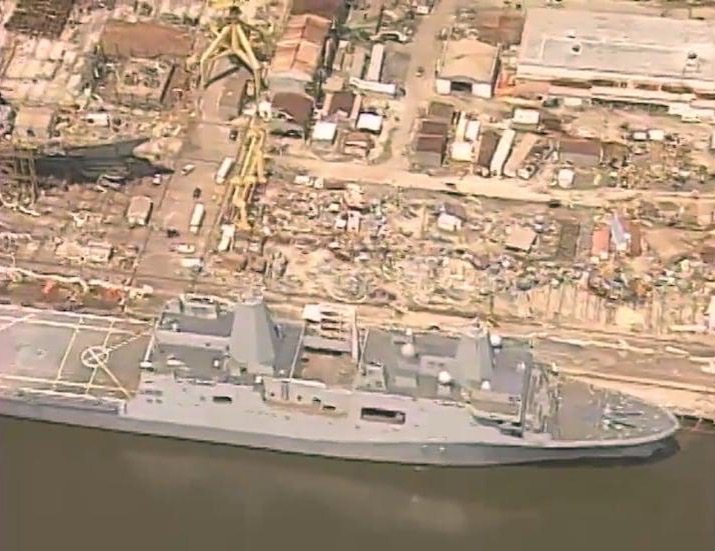 Pierside wreckage at Ingalls, post-Katrina 2005. Credit WLOX.com.
Flooding and wind destroyed many buildings, and heavy equipment was damaged. About 500 employees remained onsite during the storm to protect what they could, and their efforts are legendary.
Afterward, the company and workers began a massive repair effort, and the results went far beyond cleanup and fresh paint. Ingalls management rethought the entire idea behind a “shipyard.” How does one create an integrated production system for ships? Where are materials staged? How does workflow move? How are modules assembled? And how do you put a big ship together?
Ingalls rebuilt damaged facilities, erected sunshades, rearranged storage, upgraded piers, smoothed product flow, and refocused on safety, efficiency, and Navy-spec quality.
In other words – and ironically – for all the damage of Katrina, the disaster led to a “shipyard of the future.” And today, the yard is an integrated workflow engine, purpose-built to construct and deliver Navy and Coast Guard ships.
In 2011, Northrop Grumman spun off Ingalls and Newport News as Huntington Ingalls Industries. But through every corporate change and challenge, the mission at the waterfront remained: build warships.
What Is a Modern Warship?
Over 88 years, Ingalls Pascagoula has delivered hundreds of Navy and Coast Guard vessels. And today the yard runs at a demanding pace.
Every day, steel and pipe, valves and cable, electronics and engines, pumps and paint, and much more flow through planning, pre-fabrication, module assembly, outfitting, and test channels. It all goes down to the assembly slips where a ship takes form, and then eventually gets wet.
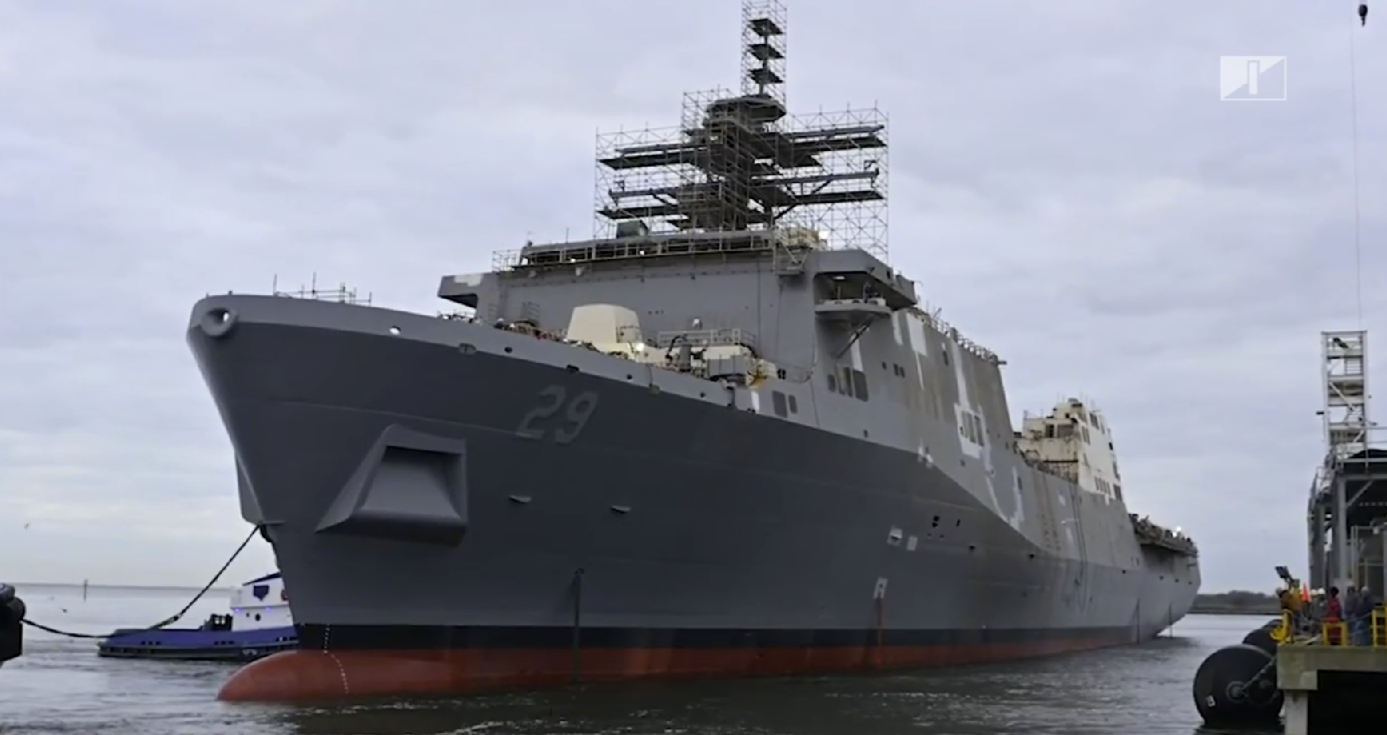 USS McCool (LPD-29) being fitted out post-launch. Credit HII, YouTube screen grab.
Shipbuilding is a process, more modular than many might imagine. A modern warship doesn’t grow plank by plank, like an old sailing ship. Instead, workers cut steel and shape panels. Panels become units. Units become blocks. Blocks are outfitted with piping, cable, ventilation, machinery foundations, and structural details before being joined into larger assemblies.
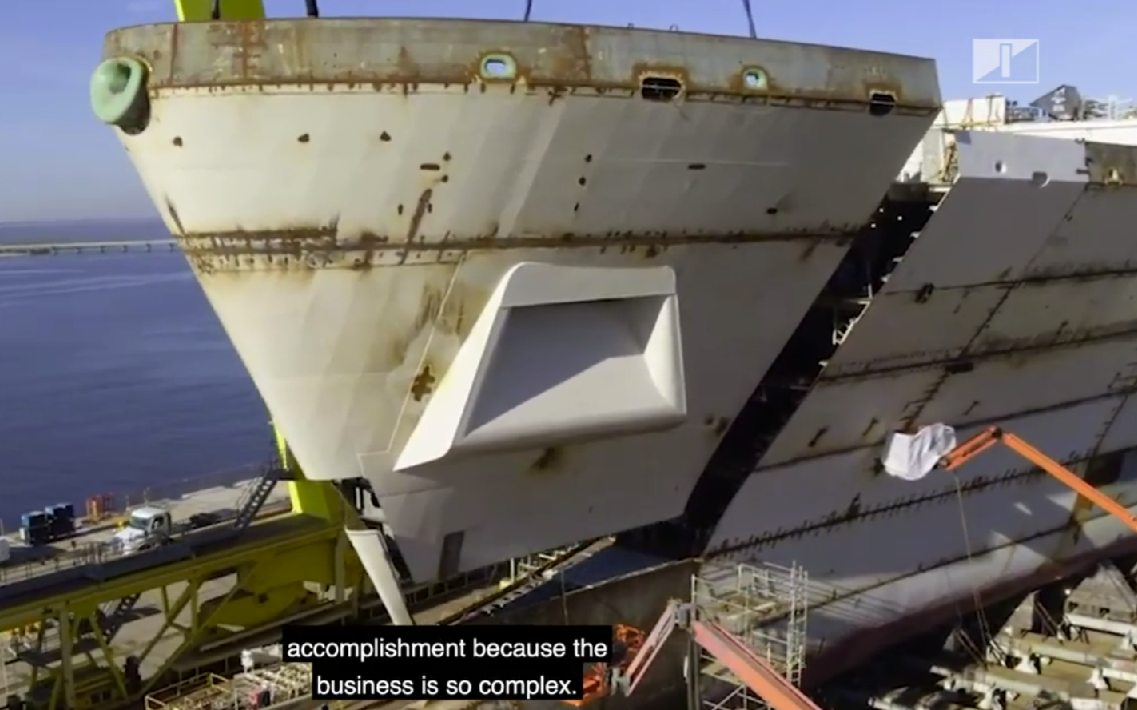 Bow section of USS Harrisburg (LPD-30) being fitted to hull. Credit HII, YouTube screen grab.
Then, beneath massive cranes, skilled shipbuilders lift, fit, and assemble the components. And yes, at the end of the day, there’s something that looks like a Navy ship. But then comes integration.
That is, a Navy ship is a fuel tank, power plant, communications hub, airport, weapons battery, repair shop, and tightly packed living space, all jammed inside a steel hull that must withstand weather, corrosion, sea stress, and combat shock. Every system must fit around every other system. It’s why shipbuilding is hard, and experienced workers are irreplaceable.
While I was there, Ingalls had three LPDs in construction or production flow: USS Harrisburg (LPD-30), USS Pittsburgh (LPD-31), and USS Philadelphia (LPD-32), a Pennsylvania trifecta.
Also in the water or under construction ashore were several Arleigh Burke-class guided missile destroyers, plus USS Bougainville (LHA-8), and even a Zumwalt-class “stealth” destroyer being refitted with new missile-launch systems.
This variety of vessels is important. That is, Ingalls is not just an LPD yard. It also builds Flight III DDG-51 Burke-class destroyers, workhorses of the fleet with a long order book.
LHA work is also consequential. These ships are massive, large-deck aviation platforms, although not nuclear carriers like Nimitz- or Ford-class. LHAs are optimized for Marine aviation and expeditionary operations: F-35B jets, MV-22 Ospreys, heavy-lift helicopters, and more. In any crisis, the LHA gives Marines a mobile airfield and sea base.
The Zumwalt work also illustrates how Ingalls does far more than new construction. It can open up a complex older ship, remove systems, add new ones, and return the platform to service with new capabilities.
Now, the Navy is adapting the Zumwalt-class for hypersonic and long-range strike missions; it’s fitting tomorrow’s weapons into yesterday’s design, and Ingalls is a critical player in that story.
Build me straight, O worthy master!
Stanch and strong, a goodly vessel,
That shall laugh at all disaster,
And with wave and whirlwind wrestle.
These words are from Henry Wadsworth Longfellow, and his 1843 poem “The Building of the Ship.” And they crossed my mind as I walked and rode through the Ingalls shipyard…
Ingalls is a national security site with tight controls and zero photography behind the wire; the yard is filled with components, systems, and industrial methods that are not exactly tourist material.
Meanwhile, our hosts at Ingalls were gracious and courteous. We met senior players involved in building USS Pittsburgh, including the ship program manager, who is… absolutely… a national asset. And that is not flattery.
Complex shipbuilding programs succeed only when smart, dedicated people translate Navy and War Department requirements into daily workflows, solve problems without drama, keep supply chains moving, maintain quality, and protect schedule discipline. That is, in shipbuilding, leadership is not abstract. It shows up in welds, test results, delivery dates, and whether the fleet receives the ship it needs.
And another lesson from Pascagoula is that American seapower rests on people, places, and industrial efforts that most citizens never see.
Certainly, up in Washington, D.C., pundits and politicians debate fleet size, count their ship numbers in budget tables, and argue strategy in think-tank reports. Yes, that’s fine.
But nothing becomes real until someone puts on a hard hat and steel-toed boots, shows up before dawn, and gets to work. That is to say that down at Ingalls is where policy becomes steel.
My visit to Pascagoula showcased the future of naval warfare, with ships like the USS Pittsburgh and others. They’re all being built for a world of drones, missiles, satellites, cyber systems, and Sailors and Marines who must solve hard problems raised by fighting from the sea.
If America is serious about deterring war, supporting allies, protecting sea lanes, and keeping options open for the current and future presidents, then a yard like Ingalls Pascagoula is not optional. Truly, it is critical. It’s our nation’s arsenal by the water.
That’s it for now. Thank you for subscribing and reading.
Happy America 250, and…

A Republic at 250
Posted July 03, 2026
By Jim Rickards
The Builders Are Back
Posted July 02, 2026
By Ray Blanco

The Great Shakeout
Posted July 01, 2026
By Sean Ring

The Inequality Tax
Posted June 30, 2026
By Sean Ring

The Tortoise and the Tesla
Posted June 29, 2026
By Matt Badiali
