
Posted December 16, 2025

By Jim Rickards
8 Things That Will Turbocharge The Gold Price
Events are moving quickly in the gold market. You know about the run-up in gold prices; it's become a mainstream media story. But the gold situation is bigger than that, with important developments almost daily that will sustain the gold bull market for years to come. Let’s look briefly at the gold price action and then turn to these breaking developments.
Gold is in its third great bull market. There really were no bull or bear markets from 1870 to 1971 because the world was on a gold standard at a fixed price. The global gold standard had flaws. Some countries joined earlier than others. The U.S. did not formally adhere to a gold standard until 1900, but the UK and the London gold market maintained a steady price from 1815, after the Napoleonic Wars, until 1914, after which the U.S. set the world price.
There were breaks in the system in 1931-1934 when the UK and the U.S. devalued their currencies against gold, but a new fixed price was established. A true floating rate market in gold did not emerge until Richard Nixon closed the gold window in 1971.
The first bull market (1971 – 1980) saw gold soar 2,200% in eight years. The second bull market (1991 – 2011) witnessed a 670% rally in gold prices over 12 years. The third bull market, which we are in today, can be more difficult to date. If one begins at the interim low of $1,050 per ounce in December 2015 and ends at today’s price of $4,220 per ounce, the gain is 300% over ten years, which is less than the two prior bull markets. Of course, this bull market is far from over, and material gains in the near future should be expected.
However, gold traded in a range of $1,000 to $2,000 per ounce for almost all of 2015 – 2025, until July 1, 2023, when a breakout above $2,000 per ounce began. If we date the bull market from that point, we see a 110% rally in just over 2 years.
If we take the average gain for the first and second bull markets, which is over 1,400%, the average duration of ten years, and apply those metrics to a baseline of $2,000 per ounce in 2023, that suggests gold will reach $28,000 per ounce by 2033. Of course, this method is arbitrary. Gains could be much larger and come much faster. A replay of the 1971 – 1980 scenario would put gold close to $100,000 per ounce by 2032.
With this as background, it’s entirely reasonable to suggest gold could reach $10,000 per ounce by late 2026 on its way much higher. What few investors may realize is that each $1,000 increase in gold's price is easier than the one before. The price gain is the same at each milestone, but the percentage increase is smaller because each increase is working from a higher base. Going from $4,000 to $5,000 per ounce is a 25% gain. But going from $9,000 to $10,000 per ounce is only an 11% gain. This is why the push to $10,000 per ounce will go slowly at first and then quickly.
That much is widely known. What is less well known is a series of underreported events that will turbocharge the price gains ahead. Here is a summary of those events:
- Central banks remain net buyers of gold as they have been since 2010. This puts an informal floor under the price of gold while still allowing unlimited upside.
- Mining output has been flat for the last six years. This does not mean “peak gold,” but it shows that gold is getting harder to find and more expensive to mine. Supply constraints + expanding demand = higher prices.
- The copper-to-gold price ratio is at an all-time low. This speaks to the relative roles of industrial and precious metals. The gold price can rise during recessions and depressions. Gains are not limited to periods of inflation and hot economies.
- Russia has demonstrated that it can survive Western dollar-based financial sanctions by holding over 25% of its reserves in physical gold. That’s a lesson the world, especially the BRICS, is internalizing.
- Digitally tokenized gold has become a huge new source of demand. Tether is leading the way with its XAUt token that has a current market cap (tied to the price of gold) of $2.2 trillion. The gold held in vaults to support the token now exceeds 16.2 metric tonnes, more than the gold reserves of some countries. This gold is not traded, and the token is redeemable only for cash, not for physical gold. This means Tether is the ultimate buy-and-hold gold investor, and its gold is effectively off the market.
- Italy has recently taken steps to assert that Italian gold (2,452 metric tonnes; the third-largest gold reserve in the world after the U.S. and Germany) belongs to the Italian people, not to the Bank of Italy. That dispute has cooled down, but its mere existence shows that a global struggle for possession of physical gold is underway.
- Television and media personality Tucker Carlson has launched an online gold dealing operation. That’s only one among many online dealers, but it shows that gold ownership is reaching a wider audience, and we are getting closer to the retail frenzy stage of price appreciation.
- The U.S. Treasury is giving serious consideration to revaluing its gold reserves by having the Federal Reserve restate the value of the gold certificate given when the Treasury took the Fed’s gold in 1934. The current value of the certificate is $42.22 per ounce. If revalued to $4,200 per ounce, this would not change the world price of gold (it’s just an accounting entry), but it would add about $1 trillion to the Treasury’s account at the Fed, and it would show that the U.S. respects gold as a legitimate monetary asset.
Other material developments in the gold markets are occurring almost daily. We expect this to continue. If you haven't invested in gold yet or your allocation is small, it’s not too late to invest. The biggest gains are still ahead and will happen sooner than later. The time to invest is now.

Can Miners Double Again?
Posted December 15, 2025
By Sean Ring
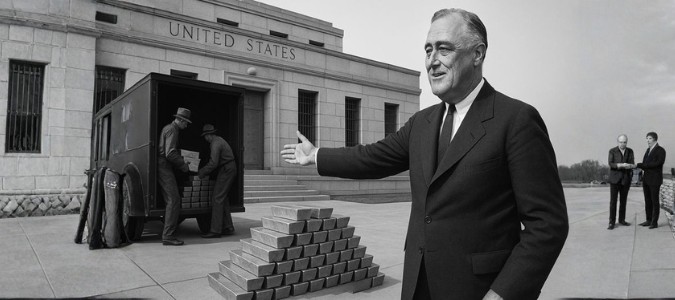
How FDR Put America Behind Golden Bars
Posted December 12, 2025
By Byron King

Swamp Thing
Posted December 11, 2025
By Sean Ring
A Sliver of Silver
Posted December 10, 2025
By Sean Ring

The Public Service of Pushing Brains Into Industry
Posted December 09, 2025
By Sean Ring
