Posted February 20, 2026

By Nick Riso
How Options Boss Stocks
Your 401(k) is in the market. Your pension is in the market. The college fund, the retirement account, the savings you have been told to park in index funds and forget about because time in the market beats timing the market… all of it is in the market.
But! Here’s what nobody told you about that market.
The market we think exists - the one where millions of buyers and sellers rationally price companies based on earnings and growth and interest rates and the fundamental value of human enterprise - that market is largely a story we tell ourselves. It’s a useful fiction – like the surface of a lake that looks calm because you can’t see what’s moving underneath.
What’s moving underneath is something else entirely. Something that has very little to do with the value of any company, the direction of the economy, or the judgment of any human being. Something that runs on math, derivatives, and gravitational forces so powerful that they can hold a $50 trillion stock market in place for an entire trading session, dictating every rally and crushing every decline, and making the whole thing look completely normal from the outside.
Monday, February 9, 2026, was recorded as a normal day. The S&P 500 opened at 6,917 and closed at 6,964, up 0.6%. Financial news anchors called it “constructive.” They talked about “balanced flows” and a market “digesting recent gains.”
They were describing the view from the observation deck - looking down at a factory floor that appeared clean and orderly. If you were down in the grease, watching the order flow and the options tape, reading the real-time data on what was actually happening beneath the headline number, you saw something completely different.
You saw a market that wasn’t discovering prices. You saw a market held in place by an invisible force that most people don’t know exists.
7,000
7,000 is a round number! The kind that appears on magazine covers and in headlines, the kind that retail investors circle on their charts, the kind that TV anchors mention with the tone usually reserved for describing major historical milestones. When you see a market approaching a big round number, the story you’re told is that it represents some collective judgment - millions of participants looking at the economy and the earnings outlook and the interest rate environment and deciding, together, that this is where we are.
That’s the story anyway.
What actually sat at 7,000 on February 9 was something much stranger and much more mechanical. To see it, you have to look at the options market - specifically, at a data point called open interest, which is just a running tally of how many options contracts have been written at each strike price and are still out there, waiting to expire. On most days, with most strikes, open interest is distributed somewhat evenly across the possible price range. But human beings instinctively cluster around round numbers. We like them. They feel significant. And so when people buy or sell options on the S&P 500, a disproportionate number of them choose strikes that end in zeroes - 6,900, 7,000, 7,100.
On February 9, the open interest profile at the 7,000 strike looked like this:
Call contracts (bets the market goes up): 853,431
Put contracts (bets the market goes down): 788,848
Total contracts at 7,000: 1,642,279
One point six million contracts. At a single strike price. Each contract represents 100 shares of the S&P 500, with a notional value of approximately $700,000 at current levels. The total notional value - the amount of market exposure represented by those contracts - was $1.15 trillion. More than the GDP of Switzerland, Saudi Arabia, or Turkey. More, in fact, than the market capitalization of every company in the S&P 500 except for the top seven.
All of it, sitting at one number on a screen.
Now, options contracts are not the same as owning stock. They’re conditional - they only pay out if certain things happen by a certain date. But the institutions that write those contracts - the market makers, the dealers, the firms on the other side of the trade when retail investors buy calls and puts - those institutions can’t just sell the contract and hope for the best. They have to hedge. And the hedging is what matters. Because hedging turns a trillion dollars in paper contracts into a physical force acting on the market itself.
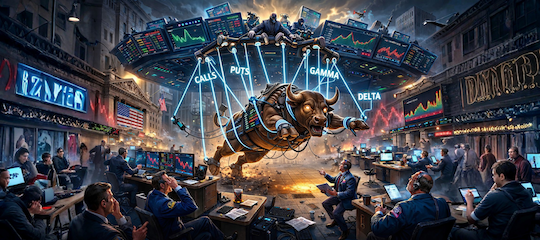
The Gamma Force
To understand what really happens every day in the markets, you need to understand a concept called Gamma, and the easiest way to understand Gamma is to start with something simpler: Delta.
When a dealer sells you a call option - let’s say a 7,000 call on the S&P 500 - they are taking on a liability. If the S&P closes above 7,000 at expiration, they owe you money. A lot of money, potentially. To protect themselves, they hedge by buying S&P 500 futures. How much do they buy? That depends on the option's Delta. Delta measures how much the option’s value changes for every one-point move in the underlying asset. A Delta of 0.5 means the dealer needs to own half as much stock as the option controls. A Delta of 1.0 means they need to own it all.
Here’s the thing about Delta: it changes. When the S&P is trading at 6,900, and you own a 7,000 call, the Delta might be 0.30 - there’s only a 30% chance the option ends up in the money, so the dealer only needs to hedge 30% of the exposure. But as the market rallies toward 7,000, that Delta increases. At 6,870, it might be 0.35. At 6,980, it might be 0.45. By the time the market is sitting right at 7,000, the Delta is close to 0.50, because now it’s a coin flip whether the option expires in or out of the money.
Gamma measures how fast Delta changes. It’s the derivative of the derivative, the rate of change of the rate of change. And here’s why it matters: when Gamma is high, every one-point move in the market forces dealers to make massive adjustments to their hedges. If the market moves up one point, Delta increases, and the dealer has to buy more futures to stay neutral. If the market moves down by one point, Delta decreases, and the dealer must sell futures. The closer you get to a strike price with enormous open interest, the higher the Gamma, and the more violent these adjustments become.
On February 9, the Gamma at the 7,000 strike was approximately 178,835.
That number represents the number of shares - not contracts, shares - that dealers were forced to buy or sell for every one-point move in the S&P 500, just to maintain a neutral hedge. Multiply that by the price of the index, and you get the dollar figure: roughly $1.25 billion in forced buying or selling for every single point the market moved, in either direction.
At that point, a number on a screen becomes a gravitational force.
Climbing Toward the Wall
The S&P 500 opened Monday at 6,917. The early session was uneventful in the way that trading days often are when nothing is happening - small moves, light volume, the market drifting upward in the way it tends to drift when there’s no immediate reason for it not to. By 10:30 AM, it had climbed to 6,940. By noon, 6,960. The trajectory was clear.
Seven thousand was in sight!
What’s important to understand is that this climb was generating enormous mechanical resistance, completely invisible to anyone watching a price chart. Every tick higher - from 6,940 to 6,950 to 6,960 - was increasing the Delta of the 853,431 call contracts sitting at the 7,000 strike. And as Delta increased, the dealers who had sold those calls were forced to buy more and more S&P futures to hedge their growing exposure.
This is the perverse feedback loop at the heart of how Gamma works. In the early part of the rally, forced dealer buying actually helps the market rise. The more the market rallies, the more dealers must buy to hedge, and that buying pushes the market higher, which in turn forces more buying. It’s a self-reinforcing loop, and it’s why rallies into big options strikes often feel effortless - the market is being pulled upward by its own hedging requirements.
But there’s a threshold. A tipping point. As you get close enough to the strike - as the market moves from, say, 6,960 to 6,970 to 6,980 - the math changes. Now the dealers aren’t adding to their hedge in small increments. They’re scrambling. The Gamma is peaking. Every point higher requires billions in additional futures purchases, and the rate at which they have to buy is accelerating. At some point, the strain becomes unsustainable. The models that govern every major options desk in the world are screaming the same message:
If this breaks through, the losses go exponential.
And so the dealers switch from buying to selling. They stop helping the rally and start defending against it. The transition happens quickly and all at once because everyone is running versions of the same model, all calibrated to the same Greek: Gamma.
The Ceiling
By early afternoon, the S&P 500 had clawed its way to 6,980.10. It was within 20 points of 7,000! Close enough that traders who’d been watching the level all day were starting to believe it would break through. The order flow had that anticipatory quality, the way markets feel when everyone’s leaning in the same direction. The headline would write itself: S&P 500 Breaks 7,000 for the First Time: Confetti and champagne.
And then it stopped. Not a gradual pullback or a slow fade as sellers emerged - an instant, total rejection, as though the market had been physically prevented from going any higher.
What happened was the Gamma Wall asserting itself with full force.
Remember the number: $1.25 billion per point. By the time the S&P had rallied from its opening print of 6,917 to the 6,980 high, it had moved 63 points. Sixty-three points times $1.25 billion per point equals approximately $79 billion in forced dealer buying over the course of the session. Seventy-nine billion dollars in futures purchases that had nothing to do with anyone’s view of the economy, nothing to do with earnings or Fed policy or geopolitical risk. Just the mechanical output of hedging models responding to Delta changes on 853,431 call contracts.
But here’s the critical piece: those $79 billion in purchases were made on the way up. They resulted from dealers hedging their short call exposure as the market approached 7,000, buying futures to remain neutral. Now, sitting at 6,980 with only 20 points separating the market from a strike price holding over a trillion dollars in open interest, the models were telling them something very different.
They were telling them to sell.
The math is cleanest if you think about what happens if the market actually crosses 7,000. At that point, the 853,431 call contracts that were out of the money are suddenly at the money, meaning their Delta climbs toward 0.50. The dealers, who had been hedging based on a Delta of maybe 0.10 or 0.20, would suddenly need to more than double their hedges to cover that 0.50 exposure. If the market keeps climbing above 7,000, those calls go in the money, and only then does the Delta begin accelerating toward 1.0.
This is what the models saw at 6,980: a catastrophic liability sitting 20 points away, and a very simple instruction for how to defend against it.
Sell futures and do not let this cross 7,000.
And so they sold. Not one dealer, not one desk, but every dealer running a large options book, all simultaneously, because they were all receiving the same instruction from the same type of model. This was a defensive maneuver, executed by algorithms, in response to a structural necessity created by $1.15 trillion in options contracts that human beings had written and accumulated at a round number because round numbers feel important.
The market reached 6,980.10 and stopped as if it had hit a glass ceiling.
It never got close again.
The Afternoon
For the rest of the session - from 2:30 PM until the closing bell at 4:00 PM - the market did something that looked, from the outside, like ordinary late-day trading. It drifted in a tight range, moving a few points up, a few points down, never going anywhere in particular. Volume was light. The commentary on financial television was sparse. It was boring!
What was actually happening was anything but boring.
The S&P was trapped in the gravitational field of the 7,000 strike, and every movement it made - every attempt to rally, every small decline - was being met with an automatic counterforce calibrated to keep it exactly where it was.
Here’s how the mechanism worked in practice. When the market tried to rally - say, from 6,965 up to 6,970 - that five-point move increased the Delta on the 7,000 calls. The dealers, whose hedging models are continuously updated, detected the increase and responded by selling S&P futures to prevent their net exposure from rising. The selling pushed the market back down. When the market declined from 6,970 to 6,960, the 10-point drop reduced the Delta on the 7,000 calls, prompting dealers to buy futures because they were nowover-hedged relative to their actual exposure. The buying pushed the market back up.
Up triggered selling. Down triggered buying. The market was pinned.
Traders who were active that afternoon describe the tape as “heavy,” a term they use when a market doesn’t want to move. Every push higher felt like wading through something thick. Every dip found a floor that appeared out of nowhere. What they were feeling - without knowing it, without having the data to see it - was $1.25 billion per point in automated Gamma hedging, coming from every direction at once, holding the index in a range so tight it barely moved for ninety minutes.
This was a derivatives market exerting enough force to override whatever the equity market might have done on its own. The S&P 500 - the thing that’s supposed to be the collective wisdom of millions of participants pricing the future of American enterprise - spent the entire afternoon of February 9 in a Lagrange point created by 1.6 million options contracts, moving only as much as the Gamma field allowed it to move.
By 3:30 PM, something else started to happen. The market began to drift lower, point by point, in a slow and eerily methodical descent. 6,965. 6,962. 6,958. It looked like profit-taking. It looked like late-day consolidation. It was actually something called Charm - the time decay of Delta - and it represents the final, most mechanical phase of how options expiration works.
As the clock ticked toward 4:00 PM, the out-of-the-money options on both sides of the 7,000 strike were losing their Delta, not because of price movement, but because of time running out. A 7,200 call that had some probability of paying out at 2:00 PM had almost no probability of paying out by 3:45 PM: there simply wasn’t enough time left for the market to move that far. As those options lost Delta, the dealers who’d been holding futures to hedge them no longer needed those futures. So they sold.
The market drifted lower under the weight of this mechanical unwinding, and by 3:50 PM it had settled in the low 6,960s - almost exactly where it had been at midday, before the failed assault on 7,000. The conveyor belt had done its job. It had walked the price back to the center of the Gamma field, to the point where the maximum number of options would expire worthless, and the maximum amount of premium would be transferred from retail traders to institutional dealers.
The closing bell rang. The S&P 500 closed at 6,964, up 47 points from the open. Up 0.6%. A normal day.
What You’re Actually Inside
The stock market is, increasingly, a derivatives settlement system. The options market, which was designed to be a side bet on the stock market, has grown so enormous relative to the equity market beneath it that the relationship has inverted. The side bet now wags the dog.
Every day the market is open, that inversion is on full display, and the numbers make it impossible to ignore.
None of this is illegal! None of it was manipulation in any technical sense. The system worked exactly as designed. That’s the scary part.
The market isn’t stable because it’s healthy. It’s stable because it’s rigid - pinned in place by a derivatives superstructure so massive that any significant deviation from the requirements of that structure gets crushed back into compliance by billions of dollars of automated hedging flow. The $1.15 trillion in options at 7,000 didn’t just create resistance. It created a ceiling, a floor, and walls on all sides. It turned the S&P 500 into an object in orbit around a strike price, held there by forces that have nothing to do with the value of anything.
On February 9, you watched your 401(k) rise by 0.6% and probably felt good about it. Maybe you checked your account balance once, saw the little green arrow, and moved on with your day. That is the view from the observation deck.
Down in the grease, the market you think you’re in - the one where prices reflect collective human judgment about value - spent six and a half hours being held in place by the gravitational field of 1.6 million derivatives contracts. It climbed toward 7,000 not because investors believed in the economy but because dealers were forced to buy futures to hedge their short calls. It stopped at 6,980, not because 7,000 was expensive, but because crossing that threshold would have triggered a catastrophic unwinding of a trillion-dollar liability. And it drifted back to 6,964 in the final hour, not because anyone decided to sell, but because time decay made the hedges unnecessary and the models said to unwind them.
Every day, the machine runs the same program on whatever strike has the most open interest, with the same mathematical inevitability.
We just can’t see it from where we’re standing.

Investing is So Taxing!
Posted February 19, 2026
By Sean Ring
The Most Expensive Way to Go Broke
Posted February 18, 2026
By Sean Ring

The Bears Gather
Posted February 17, 2026
By Sean Ring

Omar Khayyam: Poet, Rebel, Astronomer
Posted February 16, 2026
By Sean Ring
The Devil in Mexican Mining
Posted February 13, 2026
By Matt Badiali
